
Boerum Hill Brooklyn wedding photography environment overview
Boerum Hill’s position within Brooklyn
Boerum Hill is a compact, low-rise neighborhood in central-western Brooklyn, defined more by its consistent brownstone blocks and narrow streets than by any single landmark. The area sits just south of Downtown Brooklyn, with the built form dropping quickly from mid- and high-rises to three- and four-story rowhouses as you move into its grid.
Definitions of the neighborhood’s extent are generally aligned with how Boerum Hill is described: Atlantic Avenue forms a busy northern and eastern edge in places, the brownstone grid runs toward Cobble Hill to the west and southwest, and blocks toward Gowanus start to open up with more industrial and mixed-use buildings. Within Brooklyn, it reads as a transition zone between the dense civic core and quieter, residential districts.
Smith Street and Court Street run north–south as the main commercial spines, while Dean Street, Wyckoff Street, Pacific Street, and similar side streets hold most of the residential stock. This consistent pattern is what makes the neighborhood predictable to work in: you always know where the busier edges, calmer blocks, and sharper light transitions will occur.
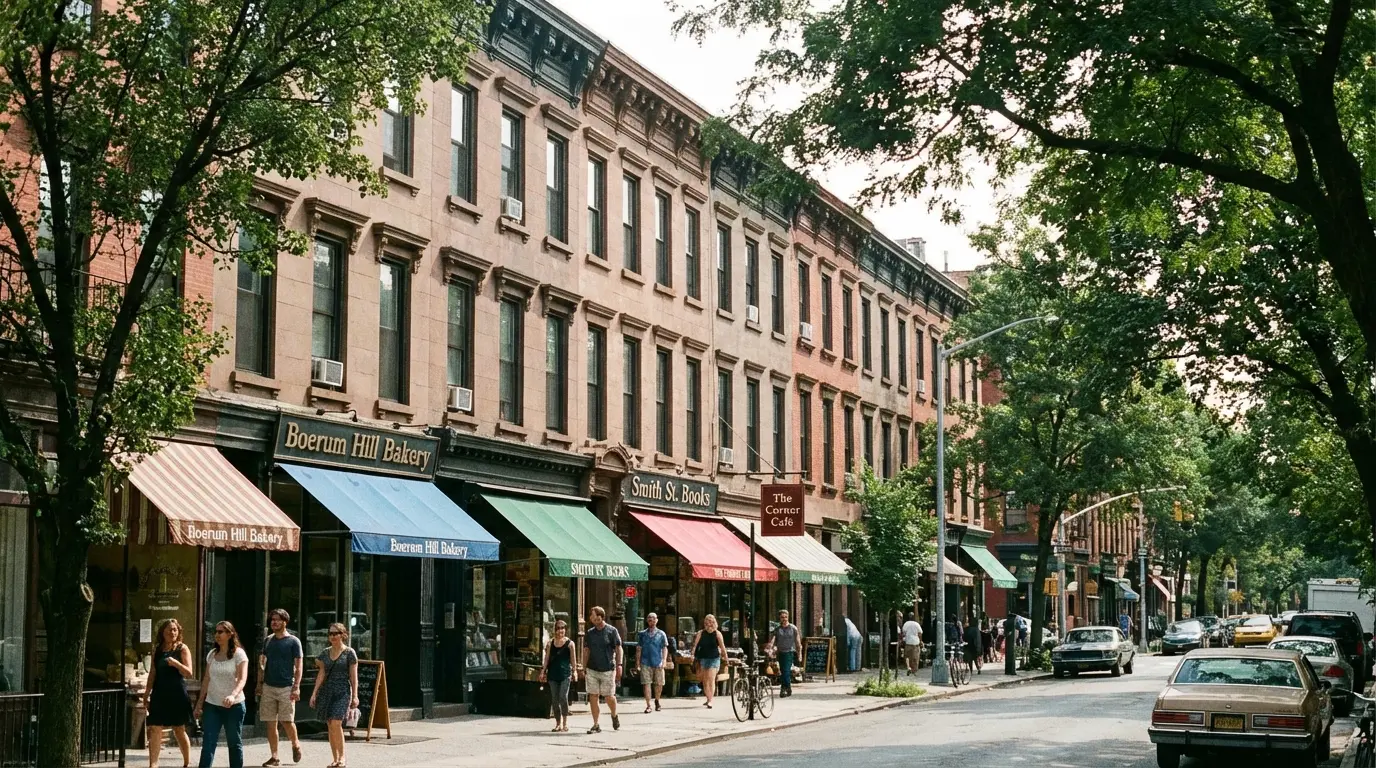
Verifies the low-rise brownstone streetwall, storefront awnings creating patterned shadows, and typical sidewalk scale and pedestrian activity on Smith St in Boerum Hill.
This image confirms how tightly the buildings, awnings, and sidewalks sit together, which sets real limits on camera positions and crowding along the Smith Street retail corridor.
Street access, transit, and typical arrival patterns
Most people arrive in Boerum Hill by subway or on foot rather than by car. Hoyt–Schermerhorn, Bergen Street, and nearby Atlantic Terminal stations feed short, intense bursts of pedestrians onto corners; sessions that start or end near these nodes need to account for sudden crowd spikes when trains unload.
Atlantic Avenue functions as a fast-moving traffic edge, with turning vehicles making crosswalks slower to clear. Smith and Court Streets move more slowly but are often narrowed further by double-parked delivery trucks and storefront loading. These spines have fairly constant background motion—foot traffic, bikes, and deliveries—which is useful for candid energy but rarely allows for a truly empty frame.
Side streets, especially between Dean and Wyckoff, are narrower, with low parking turnover. That means a couple arriving by car has a limited window to find legal space close to a block they want to use; subway arrival is usually more predictable. Mixed bike-lane behavior on Smith and Dean Streets—delivery cyclists weaving around stopped vehicles or shifting direction unexpectedly—adds another layer to how crews position themselves at intersections.
Retail spine, brownstone belt, and Atlantic edge zones
For planning purposes, Boerum Hill breaks cleanly into three working zones:
-
Court–Smith retail spine: Here, the ground floor is mostly cafes, boutiques, and design shops. Awnings, outdoor displays, and occasional sidewalk seating push activity outward. It’s visually dense and lively, but there is constant negotiation with deliveries, staff, and customers if you’re using the curb edge or doorways as background.
-
Dean/Wyckoff brownstone belt: These residential blocks are tighter and typically quieter. Building heights are consistent, trees are more prevalent, and sidewalks, while narrow, are more predictable. This belt is where uninterrupted walking shots and slower-paced portrait sequences are most feasible.
-
Atlantic interface: Along and near Atlantic Avenue, traffic, signage, and infrastructure start to dominate. Scaffolding appears more often on brownstone façades, and corner geometry opens up, offering slightly wider sightlines at the cost of more noise and movement. It’s the least stable zone from a sound and safety perspective, even though the sky exposure can be better.
Understanding which of these micro-areas a couple gravitates toward—crowded and energetic versus contained and residential—guides how time and equipment are allocated on the day.
Street scale and surfaces that shape the frame
Boerum Hill’s built environment is remarkably uniform. Most blocks run with three- to four-story brownstones sharing a common cornice height, so the sky slice above the street is narrow, and façades sit close to the curb. Intersections and wider east–west streets relieve this slightly, but long, wide-open vistas are rare.
On Smith and Court Streets, mixed-use buildings with continuous retail fronts introduce more visual layers—signage, awnings, and window displays—along with strong horizontal lines. These awnings create alternating bands of shade and light over the sidewalk, which can be used intentionally but are difficult to avoid altogether.
Residential side streets tend to have stoops rising directly from the sidewalk, parked cars lining both sides, and a combination of planted and mature street trees. Brownstone façades reflect warm tones back into the scene, while tree canopies, where present, soften contrast and introduce more mid-tones. The result is a streetscape that naturally keeps framing tight and vertical, with limited opportunity to “step back” unless you work at intersections or use crosswalks.
Light through the day on Boerum Hill blocks
Morning light reaches Boerum Hill somewhat unevenly. Taller buildings and structures in Downtown Brooklyn mean that north-south streets near that edge remain in shadow slightly longer; usable soft light for faces often arrives a bit later than sunrise would suggest. East–west side streets, by contrast, start to open up earlier where there is less upstream massing.
Around midday, the combination of narrow streets and tree canopy creates a patchwork of light on sidewalks. On canopy-heavy blocks, faces can move quickly from bright sun to full shade within a few steps. On more exposed brownstone rows, midday light is stronger and more direct, bouncing off façades in a warm, almost reflective way.
Late afternoon is the most predictable period. As the sun drops, it runs along the length of east–west streets, giving consistent, warm, side- or backlight. Brownstones hold this “golden hour” quality well because of their color, and the low-rise nature of the area means there are fewer unexpected long shadows from towers. With no waterfront in play, there are no glare or reflection surprises—just the reliable interplay of building mass, tree canopy, and sun angle.
How wedding photography sessions actually use Boerum Hill
Most couples using Boerum Hill for Wedding Photography are either local residents or people who already have a connection to the brownstone streets. They tend to prioritize calm, neighborhood-scale scenes over skyline views or major landmarks.
Sessions often start on or near the Court–Smith spine to make use of transit access and the visual context of cafes and small shops, then move quickly onto residential blocks where pacing can slow down. The Dean/Wyckoff belt is especially practical for this—sidewalks are narrow but manageable, tree cover is intermittent, and the repetition of stoops and façades allows multiple angles within a very short walking radius.
Because the streets are compact, crews generally keep the footprint light: camera bodies and a small lighting kit rather than large rigs. The focus is on moving fluidly between intersections, crosswalks, and residential stretches rather than locking into a single “hero” location for long periods.
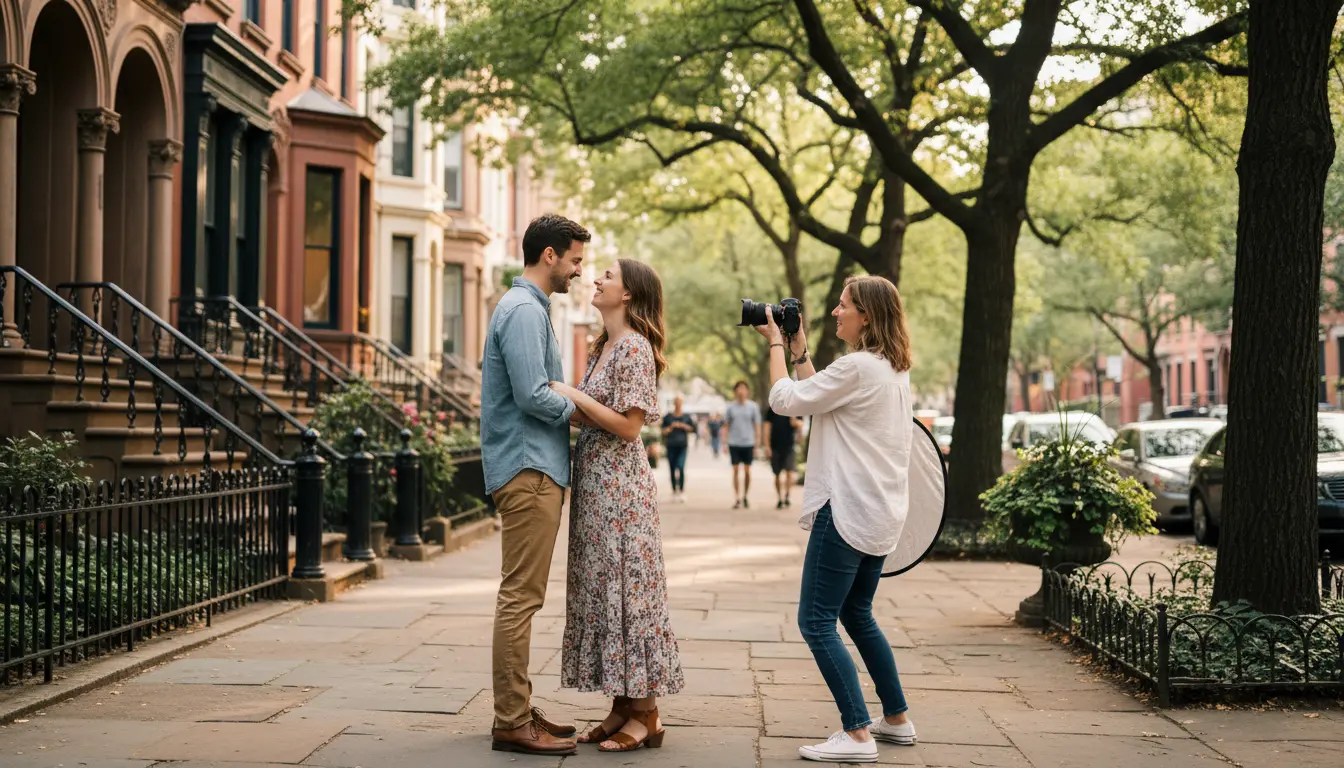
Shows a realistic portrait location in Boerum Hill’s Dean/Wyckoff brownstone belt and verifies filtered tree light, sidewalk space available for sessions, and nearby pedestrian activity; stoop use is visible but not relied on.
This confirms that much of the work happens on public sidewalks beside stoops, with enough room for a couple, photographer, and occasional passerby—rather than on private steps.
Choosing between busier corners and quieter side streets
A recurring decision for couples is whether to lean into the activity on Smith and Court Streets or prioritize the quieter, more controlled environment of the side streets. The retail spine provides constant ambient movement—people heading to cafes, delivery workers, cyclists passing through. This can lend a sense of lived-in context but makes it unrealistic to expect long, uninterrupted shots without someone entering frame.
Turning off those spines onto a residential block usually changes the pace immediately. Traffic drops, sound levels lower, and the number of pedestrians falls to residents walking dogs, parents with strollers, or kids on scooters. This calmer backdrop is better suited to slower portrait sequences or more intimate moments, with the understanding that parked cars and recycling bins will still be part of the reality.
The transition between these two environments often happens within a single intersection: one direction looks into shopfronts and awnings, another into a corridor of brownstones and trees. Planning tends to revolve around which side of that line a couple prefers to emphasize, and how much of the retail energy they are comfortable having in the background.
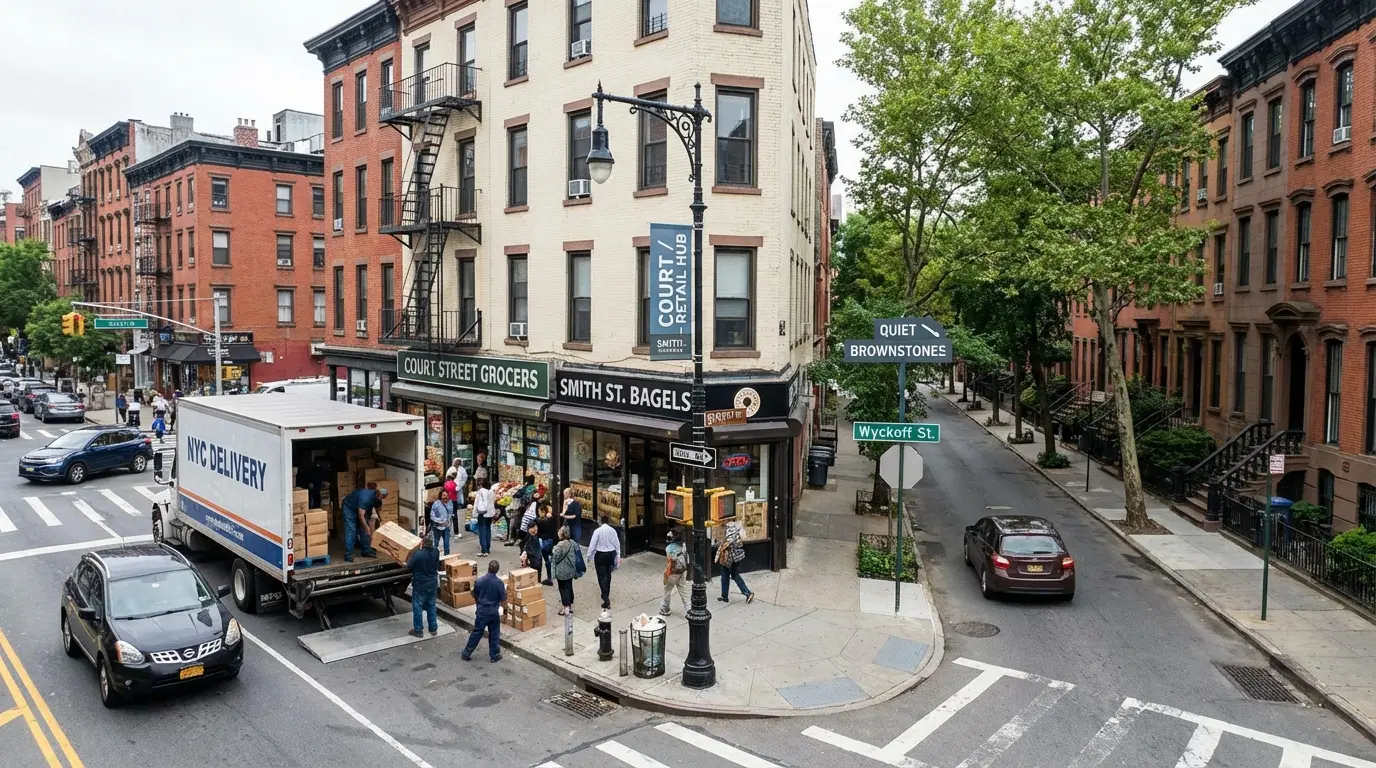
Allows verification of contrasts between busy retail spines (delivery and pedestrian spill-out) and the quieter Dean/Wyckoff residential side streets used for more private portraits.
This image illustrates how a single corner can offer both a busy commercial view and, by rotating a few degrees, a much calmer residential street, which is exactly the tradeoff couples and crews weigh.
Professional Photography Options in Boerum Hill
These related services are commonly combined around Boerum Hill sessions, depending on how couples want to document the day:
On-site workflow and equipment footprint
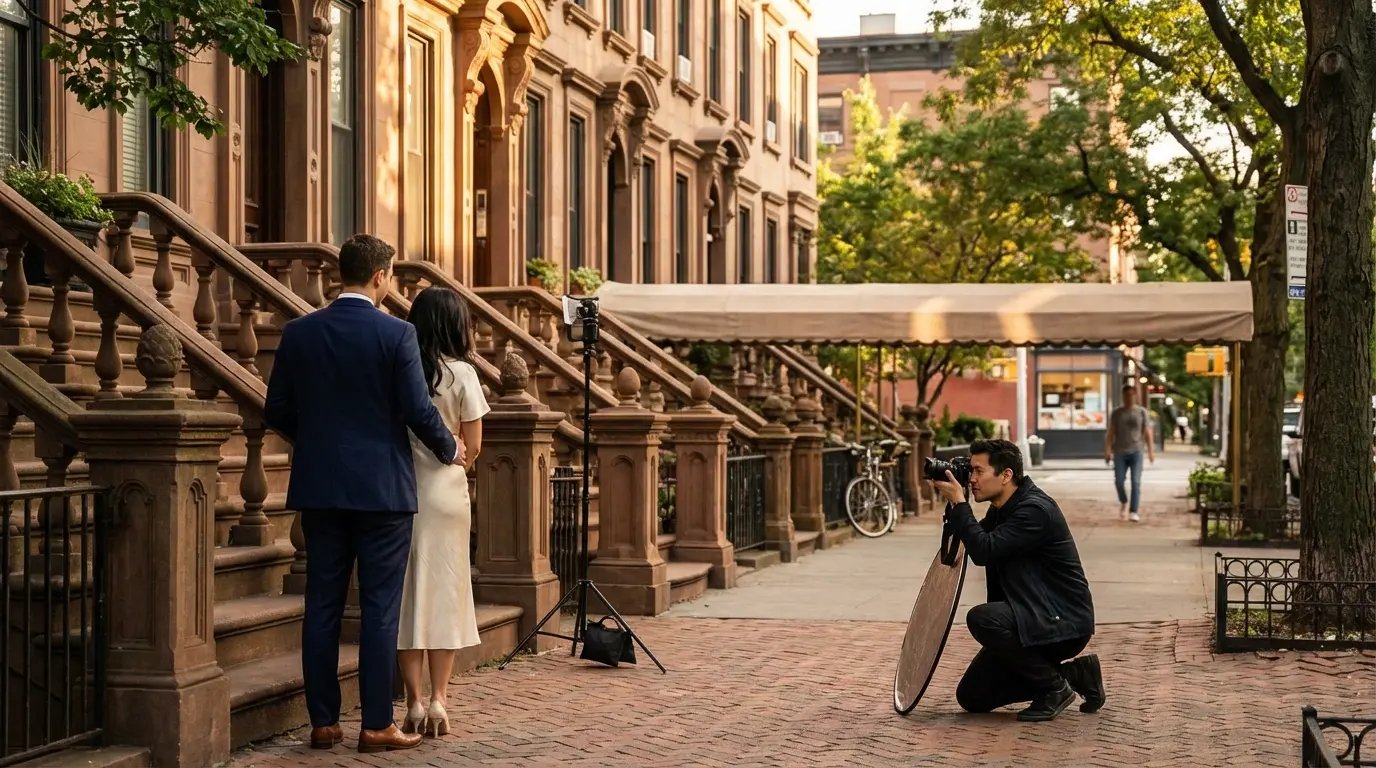
Because sidewalks in Boerum Hill are narrow and often shared with stoops, trash set-outs, and tree pits, any professional crew working here typically plans for a compact, easily movable setup. Light stands are kept low and weighted, reflectors are handheld or clipped where possible, and gear bags are tucked close to building lines to leave clear passage.
On Smith and Court Streets, storefront entrances add another constraint: you cannot block doors or display zones without immediate impact on staff and customers. Short, clearly communicated pauses near a doorway—rather than extended staging—are more realistic. Assistants often serve as informal traffic marshals, briefly pausing pedestrians or directing them around stands when necessary.
Time is spent walking the immediate block ahead of the couple to anticipate obstructions: construction fencing, fresh scaffolding, noisy generators, or piled deliveries. This pre-check is especially important in a neighborhood where overnight changes—like new sidewalk sheds—can materially alter usable angles from one day to the next.
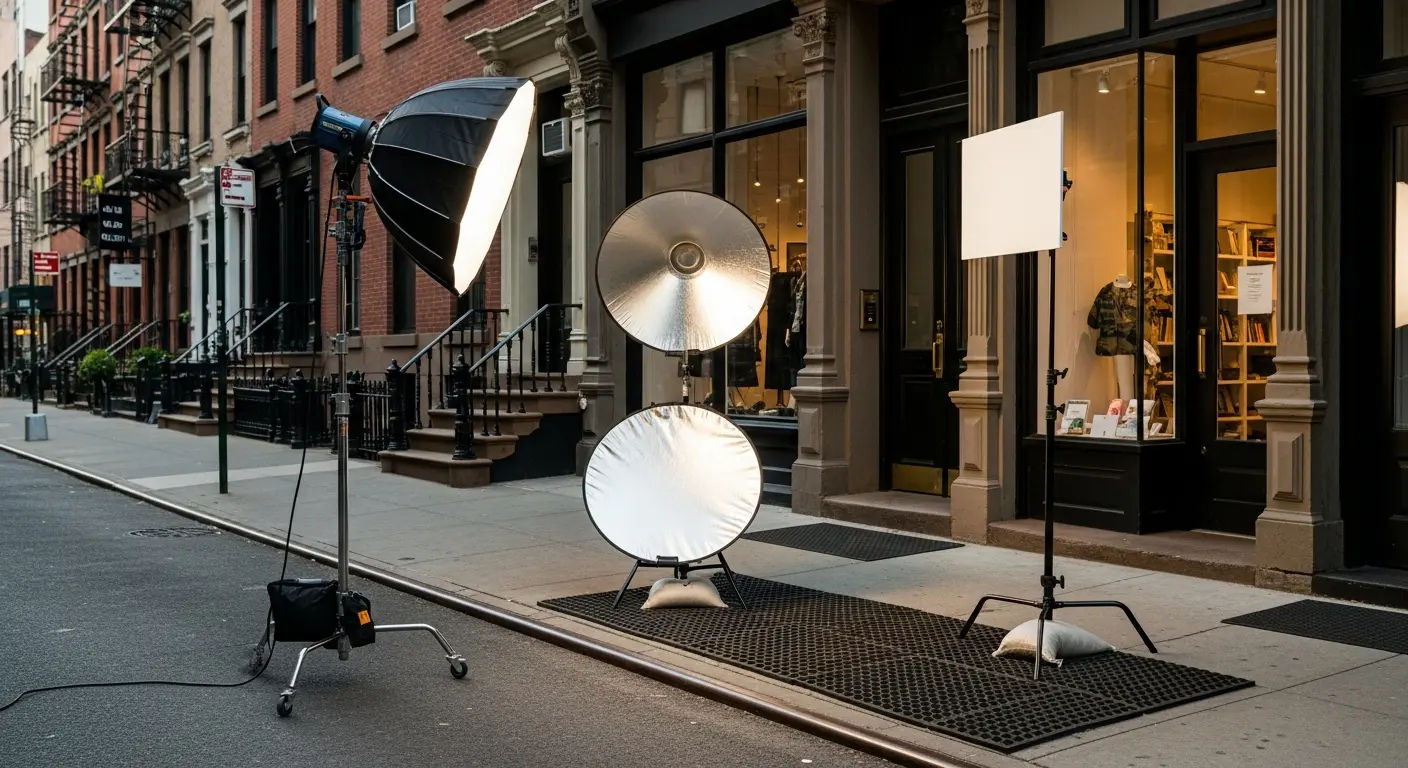
Documents how equipment is staged on narrow sidewalks in Boerum Hill: weight usage, small-footprint lighting, and sidewalk protection to reduce obstruction of storefront access.
The setup shown here demonstrates the realistic scale of lighting gear relative to the sidewalk and awning shadows, emphasizing why crews keep stands weighted, footprints tight, and walkways clear.
Permission, stoops, rooftops, and small parks
Several frequently requested locations in Boerum Hill come with access realities that couples need to factor in:
-
Residential stoops: Stoops are private property. Even if a stair feels open to the street, using it for posed portraits requires permission from the owner or tenant. Without that, crews typically stay on the public sidewalk adjacent to the façade, using railings, doors, and window details in frame but not the steps themselves.
-
Rooftops and terraces: Almost all roof spaces here are under the control of building owners or managers, with no casual rooftop culture the way some converted industrial districts have. Access, when possible, is usually tied to a specific venue or building relationship and cannot be assumed for a standard neighborhood walk.
-
Storefront thresholds: The strip of space just outside a shop—doorways, window ledges, steps—is generally considered part of that business’s domain. Brief use is often tolerated if crews are clearly not obstructing customers, but longer setups or any equipment that narrows entry paths may prompt staff to intervene.
-
Parks and pocket spaces: Small greens like Boerum Park function less as event venues and more as everyday breathing spaces for residents. Short, low-impact presence typically blends in, but caregiver groups, kids, and strollers can quickly fill benches and paths, making it impractical to rely on a single park corner at a precise time.
Effective planning in Boerum Hill assumes that some of the most visually appealing surfaces are either private or lightly contested and builds in alternatives on nearby public rights-of-way.
Managing edge conditions near Atlantic Avenue
Along Atlantic Avenue, the environment shifts again: traffic flow is heavier and faster, horns and braking are more common, and infrastructure elements like MTA vents and utility access panels appear underfoot. This edge can offer slightly larger sky windows and wider intersections but introduces more variables in both sound and safety.
Construction activity is also more common near Atlantic, where buildings cycle through façade work and scaffolding in shorter bursts. Freshly erected sidewalk sheds can cut available light, redirect pedestrians into narrower channels, and make previously workable corners unusable for wide compositions. These changes can happen with little notice, even between a scouting visit and the event day.
To manage this, crews who choose to work near Atlantic stick to very small setups and clear visual boundaries: cones to mark stand legs, sandbags to stabilize equipment against wind from passing trucks, and clear sight lines for cyclists and pedestrians. Noise levels are monitored when audio is being captured, with an understanding that heavy vehicle surges and vent noise may limit which clips are usable in final edits.
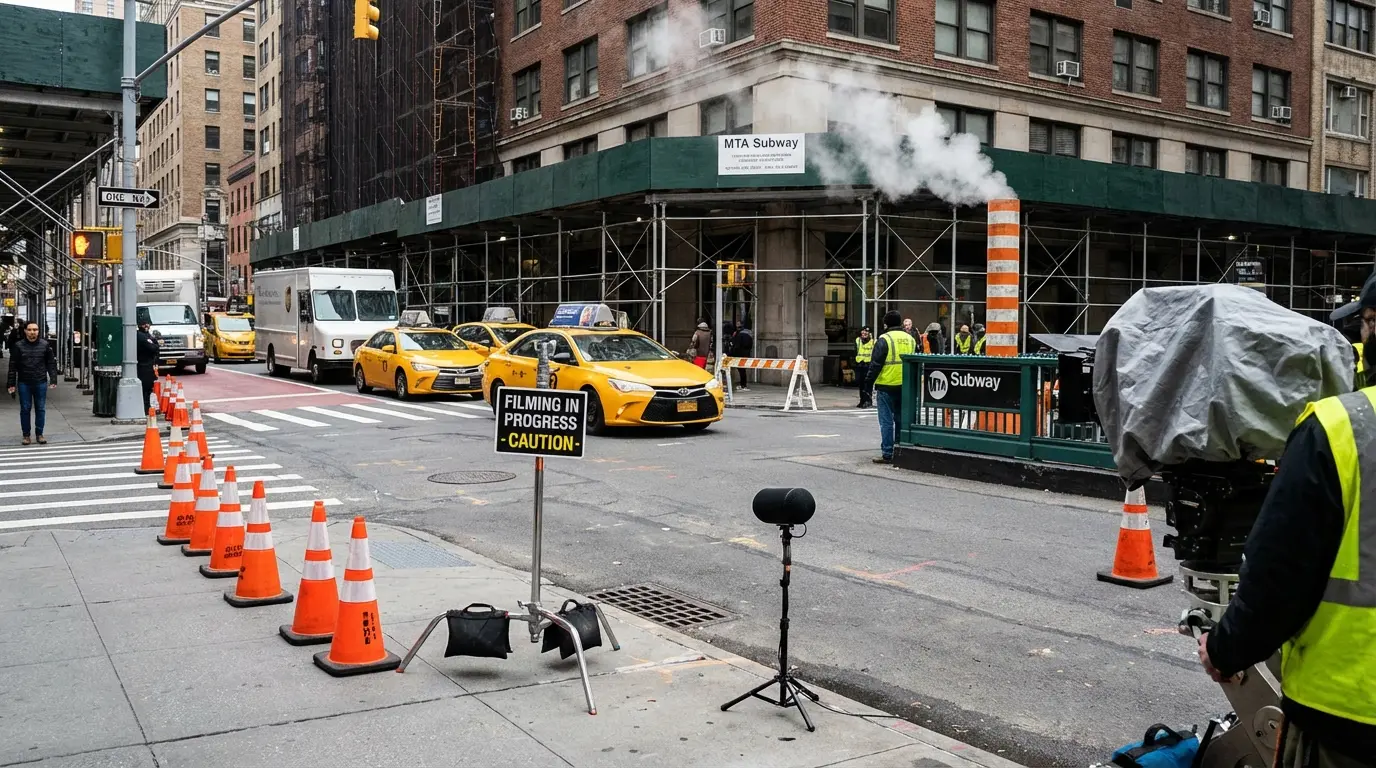
Illustrates typical constraints on the Atlantic Ave edge (traffic, scaffolding, infrastructure vents) and the on-site equipment used to reduce risk and respond to noise and movement.
This photo makes clear how close traffic, scaffolding, and MTA hardware sit to any shoot area on Atlantic, and why cones, sandbags, and sound monitoring are non-negotiable there.
Parks, playgrounds, and community use patterns
Boerum Park is one of the neighborhood’s key small green spaces, ringed by brownstones and closely linked to the nearby subway infrastructure. It functions as a local park first and foremost: benches fill quickly on mild days, playground edges are lined with strollers, and short walking loops serve older residents and caregivers.
The presence of parents, kids, and school groups means that the park’s atmosphere changes quickly through the day. Late morning can be relatively quiet, followed by midday and after-school stretches where ball games, scooter traffic, and play structures generate both movement and sound. These patterns matter for any session planning to incorporate the park, because it’s rarely empty even when it appears open on a quick drive-by.
Groups like the Boerum Hill Association focus on maintaining neighborhood livability, including traffic calming and the condition of small public spaces. Their work contributes to the predictable, residential feel around parks and playgrounds—but also reinforces that these areas are shared community assets, not private backdrops.
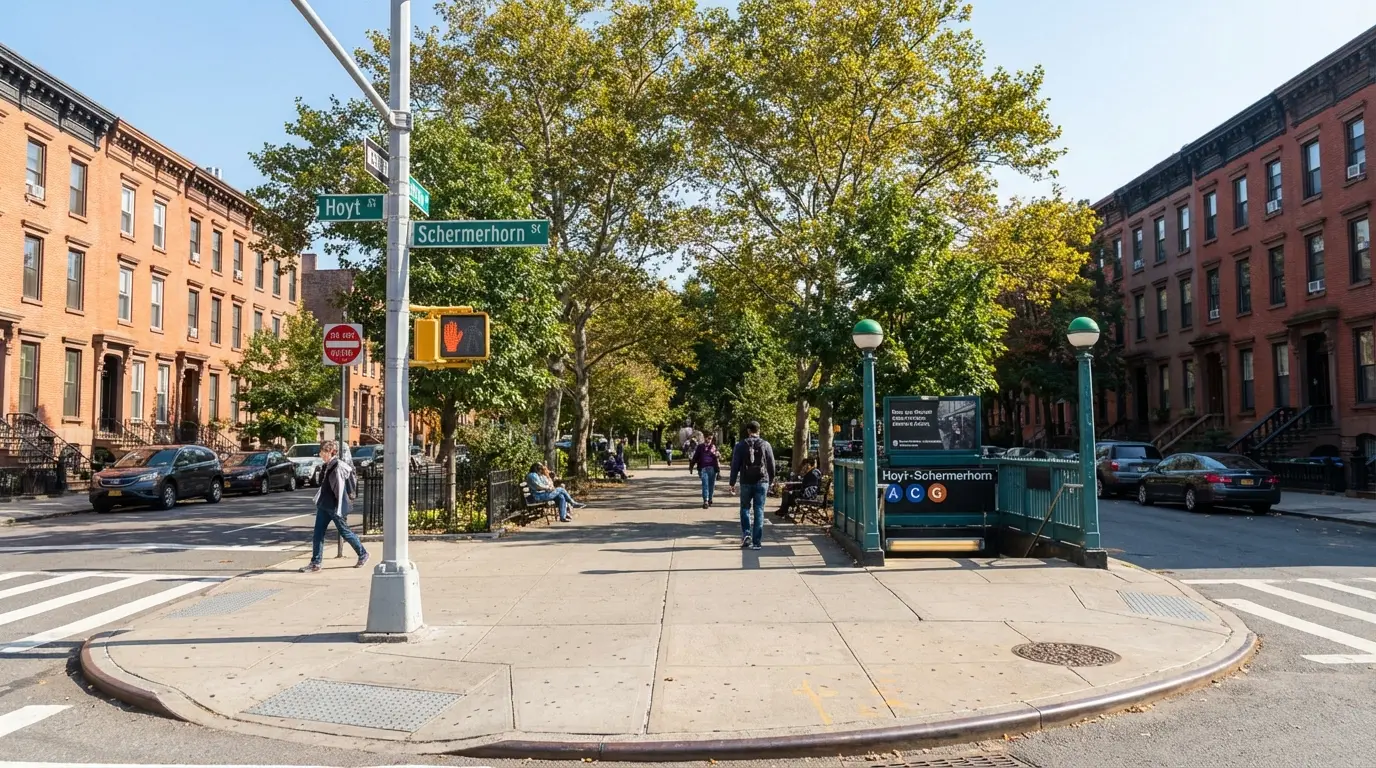
Confirms the neighborhood identity by showing Boerum Park, nearby brownstone blocks and a subway access point—useful to verify exact neighborhood presence and typical park usage.
This scene verifies how tightly Boerum Park is woven into surrounding brownstone streets and transit elements, and how family use shapes available space.
What final images from Boerum Hill typically show
Finished galleries that feature Boerum Hill tend to emphasize tight compositions: couples framed against stoops, doors, or tree trunks, with just enough of the street context to read as a Brooklyn brownstone block. The limited distance between buildings and curb means backgrounds compress quickly, and parked cars and street furniture often appear at the edges of frames.
Tree canopy and building color have a strong influence on the final look. In leaf season, greens mix with the browns and reds of brick, producing a softer, filtered palette; in winter, branches expose more sky and accentuate the linear rhythm of façades and railings. Because of the frequent use of side streets, passersby usually show up only as distant figures or hints of motion rather than clearly identifiable faces.
Audio-containing deliverables—such as vows or spoken toasts recorded during a neighborhood walk—will reflect the ambient soundtrack of Boerum Hill: low-level traffic noise, MTA ventilation hum near certain corners, and occasional shouts or play sounds from playgrounds. Couples who are aware of this from the outset tend to be more comfortable with the authentic, non-studio character those elements add.
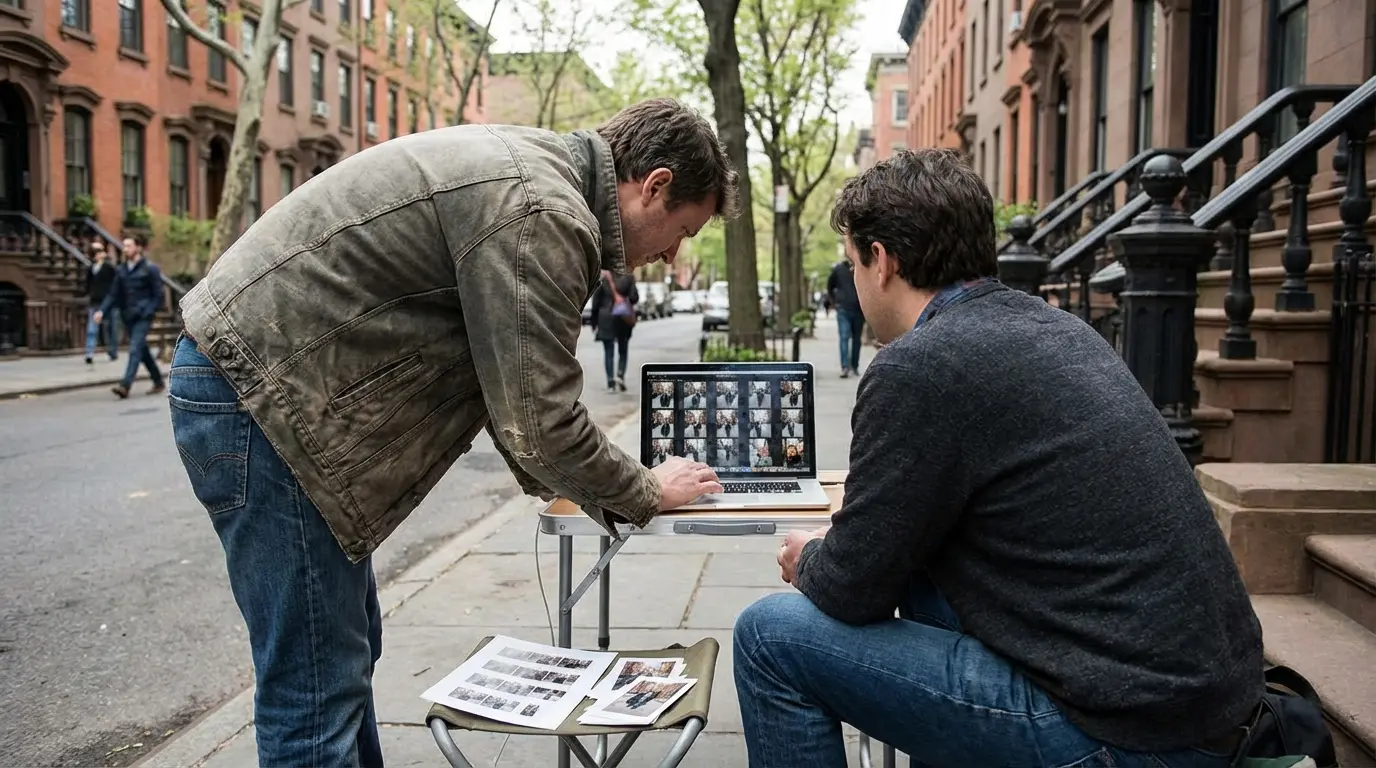
Demonstrates a realistic sample delivery scenario—how images from Boerum Hill sessions typically render background scale, tree-filtered light and framing choices in final selects.
The previews shown here underline how much of the frame is filled by nearby brownstones and trees, with distant street elements adding context rather than dominating.
Everyday friction: construction, noise, bikes, and families
Boerum Hill is orderly but not static, and several recurring “chaos” factors shape how a session feels on the ground:
-
Construction rhythm: Brownstone façade work tends to appear in short, intense bursts—scaffolding goes up, netting and plywood cover familiar brick, and contractors occupy curb space with vans and dumpsters. This is most common near the Atlantic edge but can happen on any block. A location that scouted well a month prior may be fully under wraps on the event day.
-
Noise from infrastructure: MTA vents around Hoyt–Schermerhorn and certain side streets emit a constant low mechanical hum, occasionally ramping up when trains pass below. Combined with bus engines, sirens from nearby Downtown Brooklyn, and closer-range car horns on Atlantic, this can limit where clean audio is captured for vows or interviews.
-
Parenting infrastructure: Sidewalks near schools and playgrounds see very localized surges in activity: strollers cluster at certain corners, scooters and small bikes weave through, and groups of kids briefly occupy entire crosswalks. These spikes are short but intense; scheduling around school start and dismissal times helps, but surprise bell schedules or after-school programs can still change the picture.
-
Bike-lane behavior: Official lanes and informal bike routes intersect on Dean and Smith Streets. Food-delivery riders often slip between stopped vehicles, ride against traffic for short stretches, or cut diagonally across intersections to save time. Crews working at curb edges or in crosswalks need constant situational awareness to avoid conflicts.
Sessions that account for these elements—by building in extra time, scouting backup corners, and staying flexible about exact backgrounds—tend to proceed more smoothly and yield results that feel grounded in how the neighborhood actually operates.
Connections to nearby neighborhoods
Boerum Hill does not exist in isolation; its boundaries bleed into adjacent districts in ways that affect both logistics and aesthetics. Toward Cobble Hill, the brownstone fabric continues with similar tree-lined streets and small-scale retail, so extended walks can cross the line without any clear visual break. Toward Gowanus, the grid opens into wider streets and industrial or new-construction frontages, offering a more exposed sky and less uniform architecture.
To the north, Downtown Brooklyn’s taller buildings and busier transit hubs influence both light and crowd patterns on Boerum Hill’s upper blocks. Crowds, noise, and shadow from that direction are all slightly stronger, gradually tapering as you move deeper into the residential belt. Couples planning longer coverage sometimes factor in these transitions, deciding whether to remain fully within Boerum Hill’s low-rise environment or to let the session drift across an edge for variety.
Other Brooklyn Communities in our coverage
Questions couples commonly ask about Boerum Hill sessions
Is there a best time of day to avoid heavy foot traffic?
Retail streets like Smith and Court are busiest on weekend middays and early evenings. For steadier conditions, many crews favor weekday mornings after school drop-off (roughly 9:30–11:00) or later afternoon windows on residential blocks, when commuter flows are lighter and playground peaks have not yet started.
Do side streets really offer more consistent lighting than the main avenues?
They tend to, especially in late afternoon. East–west residential streets with moderate tree cover often hold a stable, diffused light as the sun runs along them, while Smith and Court are broken up by awning shadows and taller mixed-use corners. That predictability is one reason so many portraits are done a block or two off the main spines.
Is it realistic to arrive by car, or should we plan on the subway?
Parking is limited and turnover on residential blocks is low, so finding a legal space exactly where you want to start can be difficult, particularly on weekends. Many couples arrive by subway to Hoyt–Schermerhorn or Bergen Street and then use a car only for longer transfers at the beginning or end of the day, not for short hops within the neighborhood.
Can we use a brownstone stoop for portraits without special arrangements?
Not by default. Stoops and front gardens are private property, and using them requires explicit permission from the resident or owner. Most sessions rely on the public sidewalk and façades directly behind it, which still provide recognizable brownstone context without stepping onto private steps.
What about rooftops or terraces with views—are those easy to access?
In Boerum Hill, rooftops are almost always controlled by building owners or tied to specific venues, and casual access is uncommon. If rooftop imagery is important, it usually needs to be arranged through a particular building or event space rather than assumed as part of a typical neighborhood walk.
How do seasonal changes in the trees affect the look of photos and video?
In spring and summer, tree canopy softens light and introduces more green into the palette, but also creates shifting patches of sun and shade on sidewalks. In late fall and winter, branches open up more sky, leading to cleaner, more direct light and a stronger emphasis on architectural lines. Both looks are workable; they just require slightly different exposure and framing choices.
Will noise from Atlantic Avenue and transit be obvious in our footage?
If you record audio near Atlantic Avenue, major intersections, or MTA vent locations, some level of traffic and mechanical noise will almost always be present. Placing key spoken moments on quieter residential blocks and being selective about which clips include ambient sound helps keep that noise from overwhelming the final edit.
Is it realistic to expect “empty street” shots in Boerum Hill?
Completely empty blocks are rare, especially on the retail spines. On side streets, it is possible to get frames with minimal background activity, but that usually involves waiting a minute or two for pedestrians, cyclists, or cars to clear. Most final sets include a mix of cleaner portraits and frames where the neighborhood’s normal level of life is still visible in the distance.