
Brooklyn Heights in Brooklyn as a setting for wedding and couple photography
Reading the shape of Brooklyn Heights on the map
Brooklyn Heights sits on the low bluff immediately south of the Brooklyn Bridge, with the East River and Brooklyn Bridge Park down the slope and the civic core of Downtown Brooklyn behind Cadman Plaza. To the north, the neighborhood thins out towards Old Fulton Street and the transition into DUMBO; to the south, the streets run toward Atlantic Avenue and the seam with Cobble Hill. On most maps, the core of the Heights is the brownstone grid around Clinton, Hicks, Willow and Henry Streets, anchored by Montague Street running east–west.
The official planning boundary roughly follows this pattern and confirms that the Promenade, Montague Street spine and Cadman Plaza edge are all part of the same neighborhood entity, as outlined in the city’s own Brooklyn Heights Neighborhood Profile. For photography, this means a compact area with very different backdrops within a few minutes’ walk: west-facing river overlooks, tight residential side streets, and the more open civic lawns around Cadman Plaza Park. Many couples and families treat all of this as “Brooklyn Heights” even when they wander right up to the park entrances along Furman Street.
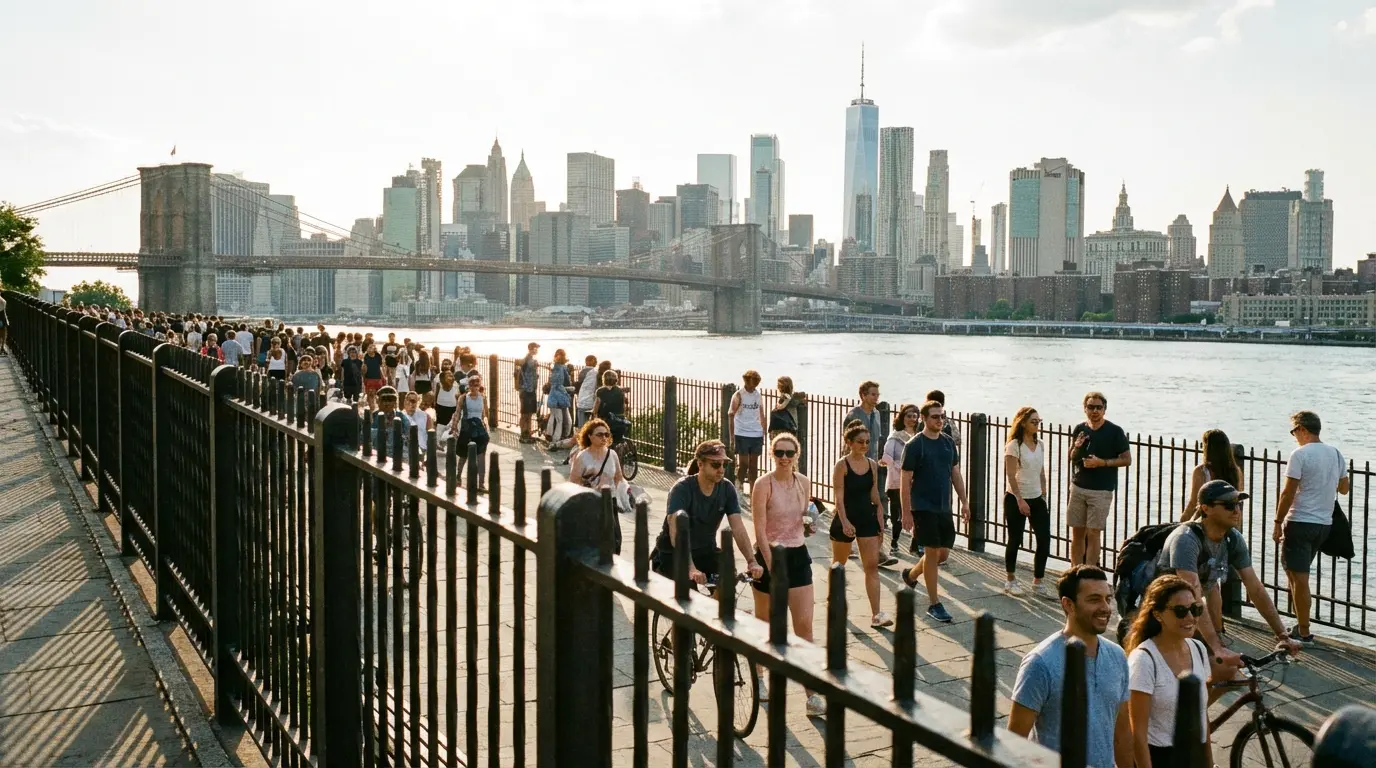
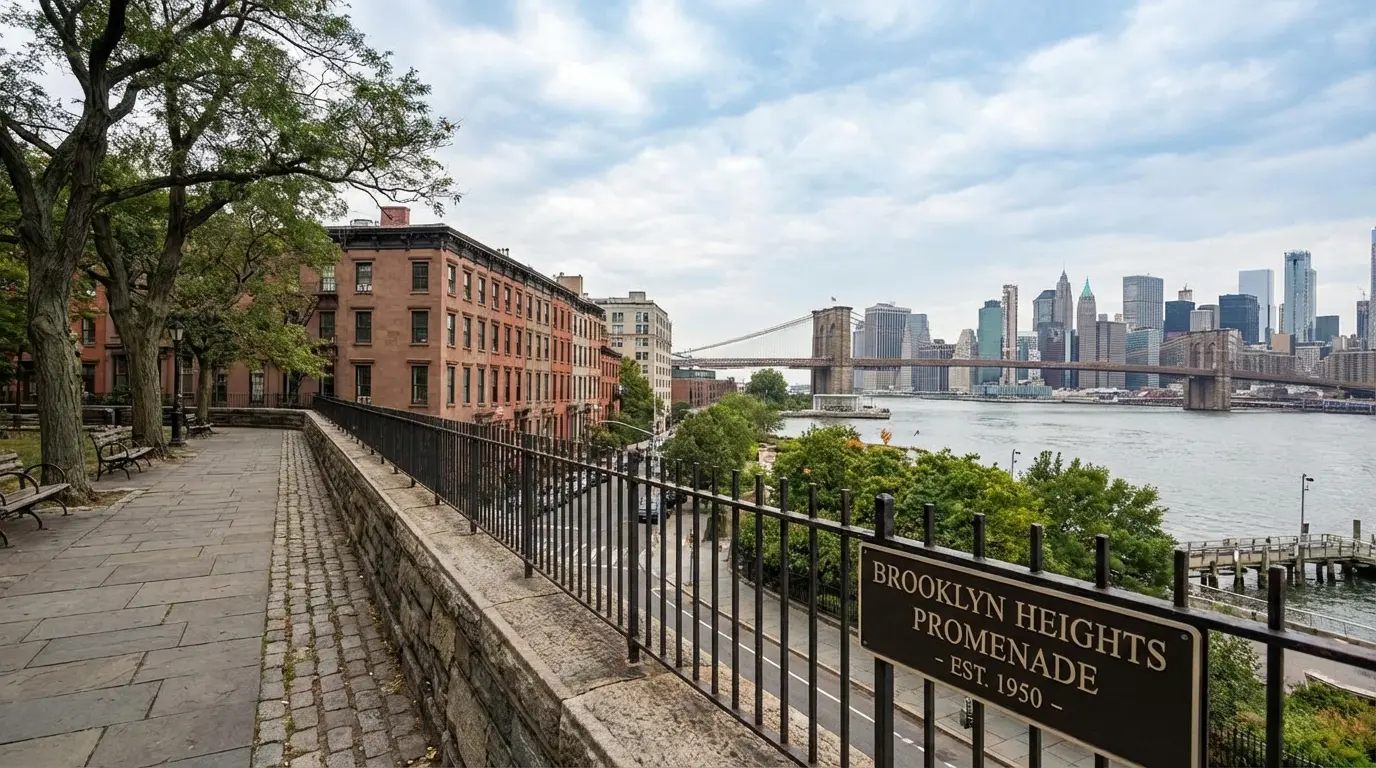
View verifies the Promenade’s skyline orientation, walkway width and typical pedestrian presence a photographer must account for when planning sessions.
The Promenade balustrade, the river, and the Manhattan towers directly across the water make it clear why this stretch is so central to local photo planning.
Promenade views, Montague side streets and other common shoot spots
Most wedding and engagement sessions associated with Brooklyn Heights cluster around three types of spaces:
- The Brooklyn Heights Promenade, with its uninterrupted skyline band and river in the background. Officially listed as the Brooklyn Heights Promenade, this is where couples expect that classic railing-plus-skyline frame.
- The quieter Montague Street side blocks, where brownstone stoops, trees and parked cars compress into a more intimate backdrop.
- The open lawns and paths along the Cadman Plaza edge, used when a little more space is needed for small groups.
Crowd levels often decide which of these spots makes sense. On fair-weather weekends, the Promenade can be shoulder-to-shoulder near the Montague Street entrance, so some couples work with a local Wedding photographer to time sessions for earlier in the morning or to slide one block off Montague, where stoops and brickwork offer softer, less hectic frames. For small ceremonies or vow renewals, the Promenade railing itself sometimes becomes the “venue,” but the same couple might walk back into the side streets for portraits that feel more private.
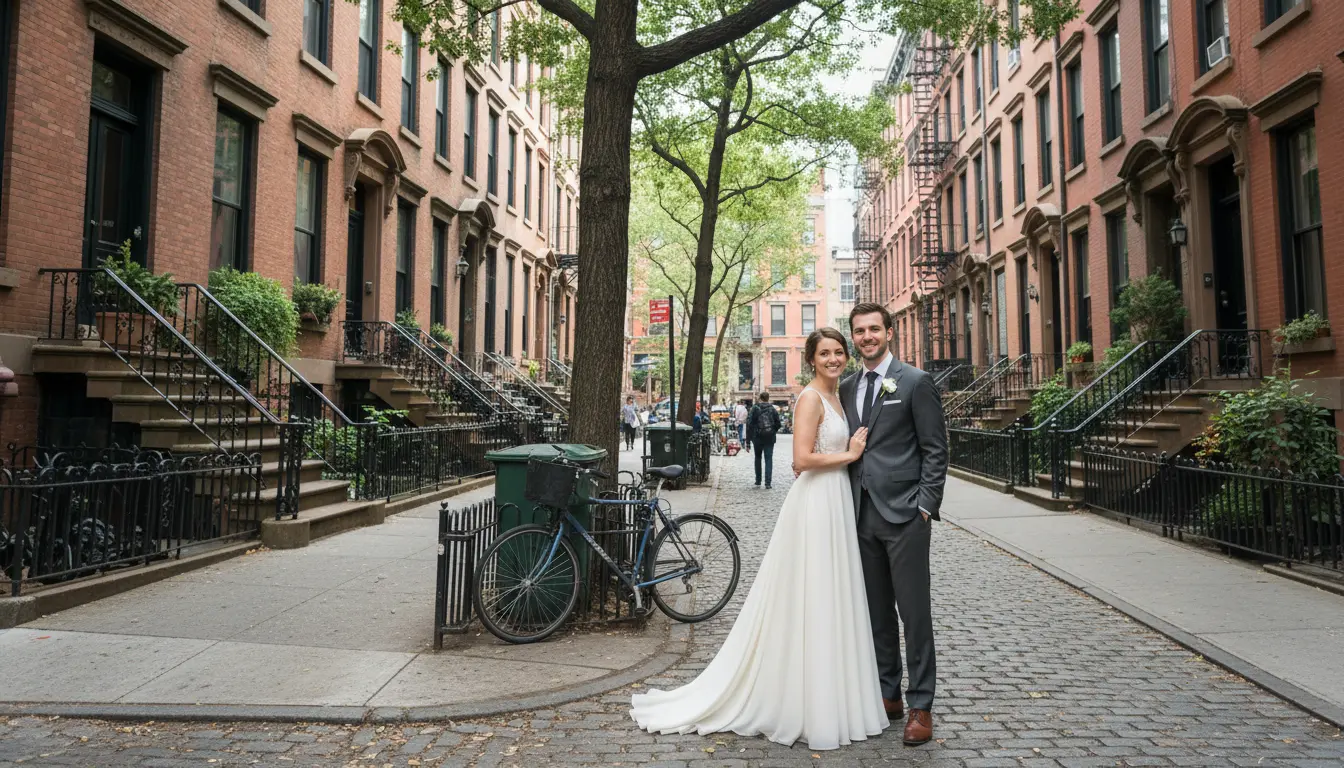
Shows common Montague St shoot settings—brownstone backgrounds and the sidewalk/curb conditions a photographer will need to navigate for couple or small-group sessions.
The photo here makes the scale clear: sidewalks are narrow, stoops are close, and a single delivery van can suddenly dominate the frame, which is why timing and angle choices matter as much as the buildings themselves.
Micro-areas and transitions: North Heights, Cadman edge and Atlantic end
Within a few blocks, Brooklyn Heights shifts from river overlook to more interior residential streets and then to busy boundary corridors. North Heights, around the Old Fulton cluster, slopes down toward DUMBO and inherits some of its foot traffic; Clinton and Henry closer to Remsen and Joralemon feel quieter and more predictably residential. The Cadman Plaza side, by contrast, opens up into wider lawns and civic buildings, which changes how far back a photographer can stand and how much of the skyline or courthouse façades appear in frame.
These internal differences are why couples deciding where to be photographed in “Brooklyn Heights” often end up choosing between:
- North Heights / Old Fulton: more movement, more mixed-use storefronts, a visible grade change and quick access down toward the waterfront.
- Mid-grid brownstone blocks: tree cover, consistent stoops, less through-traffic.
- Atlantic Avenue end: more commercial frontage and a clearer seam with neighboring areas like Cobble Hill.
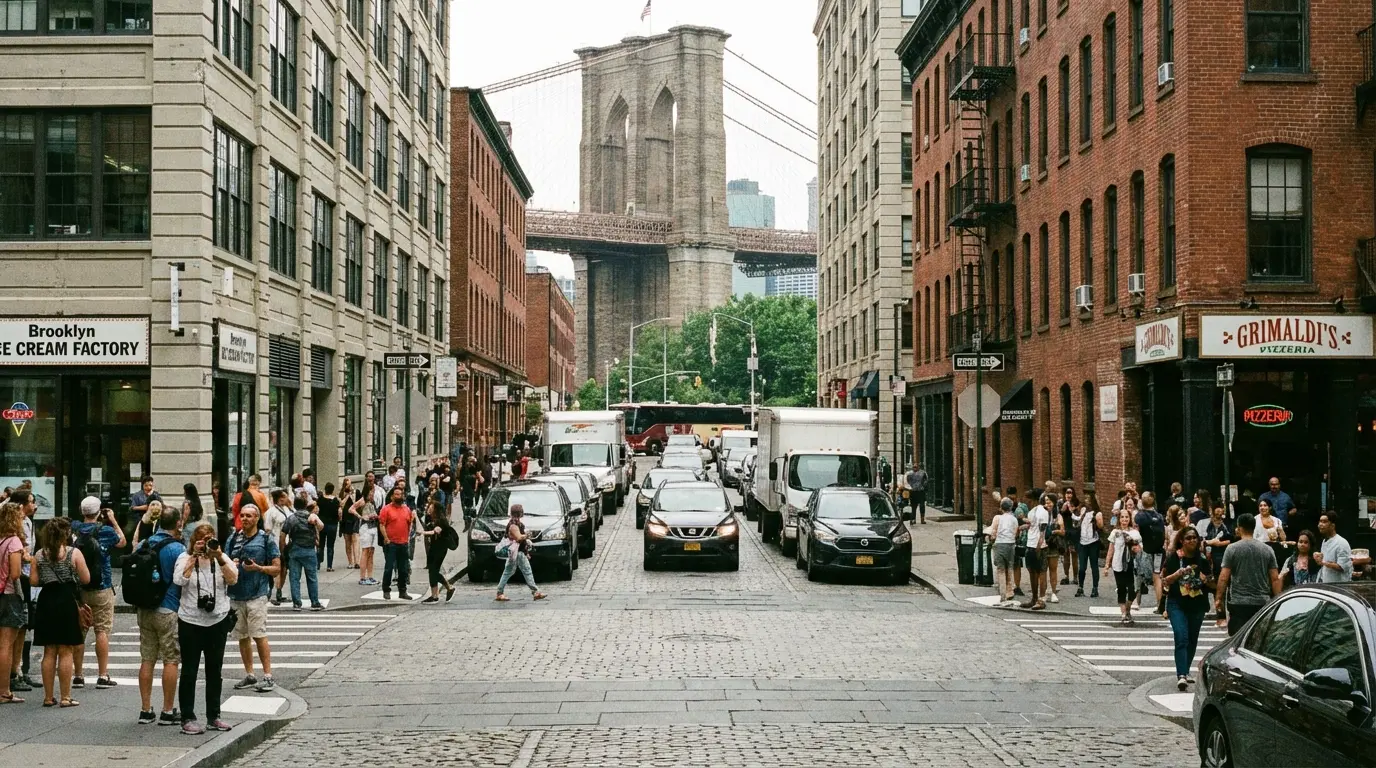
Visual evidence of the slope, pedestrian volumes and vehicle interactions at this key transition point—useful when choosing between promenade, Montague St or Old Fulton access.
The Old Fulton slope image shows why some couples avoid this approach in formal attire: the grade, the mixed storefronts and the cars converging at the bottom make it feel more like a busy transition space than a calm portrait backdrop.
Day‑of logistics on narrow brownstone streets
Once you step off Montague or Old Fulton, much of the Heights is a tight brownstone grid. Streets like Hicks, Willow and Grace Court are charming but narrow, with sidewalks just wide enough for two people to pass. This affects how much equipment can realistically be used. Most sessions here rely on compact cameras, small stabilizers and minimal lighting, both for courtesy to residents and because there is no room to stage large cases or multiple light stands without blocking pedestrians.
Stoops are also privately owned, even when they feel like part of the sidewalk. Using them for poses typically depends on a prior arrangement with the homeowner or choosing a rental or friend’s building. For couples wanting “stoop shots” as part of a wedding or engagement session, this usually becomes a conversation about which specific building they have access to, not just “any brownstone.”
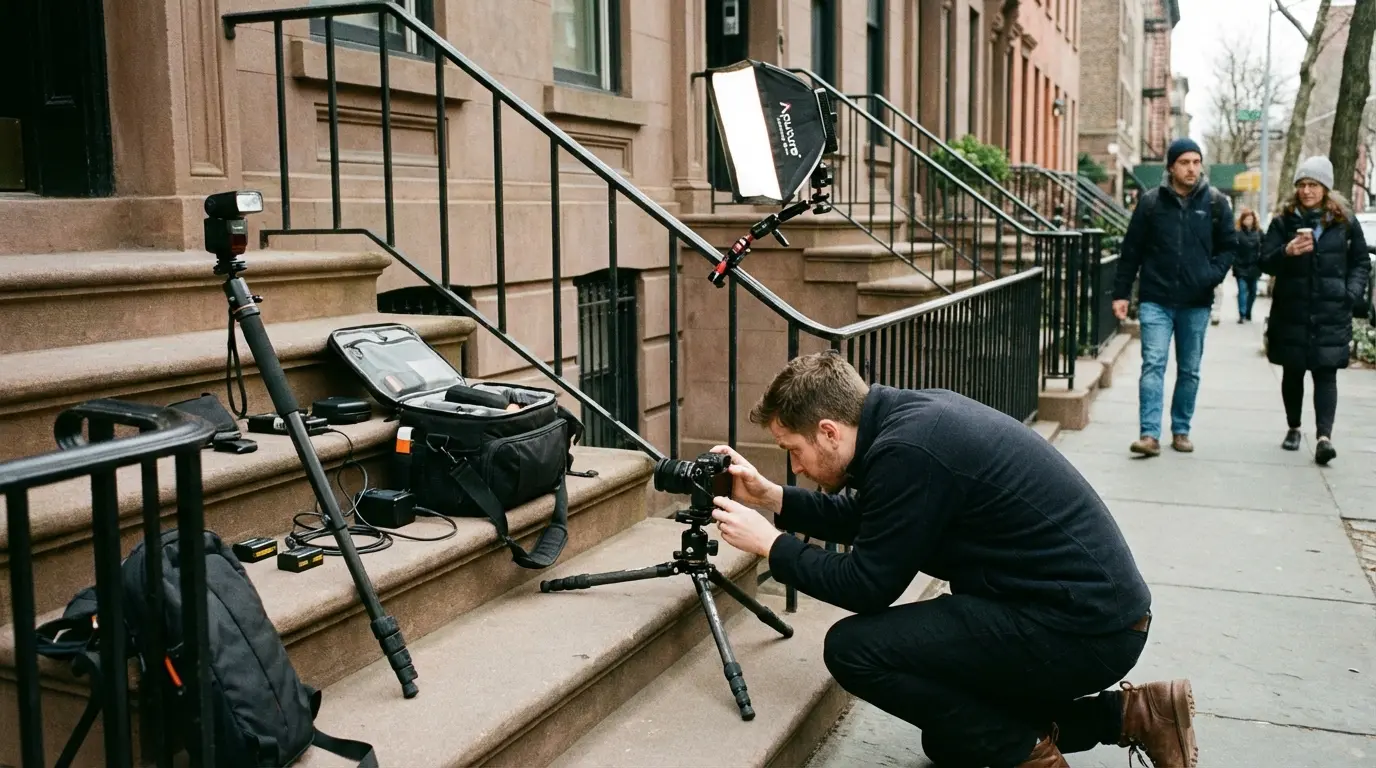
Demonstrates the small gear footprint and quick-setup approach often required on narrow brownstone sidewalks; verifies feasibility for quick sessions without large rigs.
This setup shows the scale of what fits: one small light, a monopod and a parked car only a step away. Anything larger would quickly spill into the street.
Curb space, deliveries, buses and other planning risks
Around the Montague Street west end and near the Promenade entrances, curb space is in constant flux. Delivery vans often double‑park in front of small grocers or cafés, especially in the late morning, and buses occupy the signed stops near the top of the hill. If a couple is being dropped off by car or rideshare, there may only be a brief gap between vans, buses and taxis to pull to the curb.
This is where bus dependency and service patterns directly affect photography. On weekdays, commuters queuing for buses along Cadman Plaza and Montague can fill the sidewalk and compress available staging space. A session that looks quiet on a Sunday afternoon could feel completely different at 8:30am on a Tuesday when office workers, deliveries and idling buses all overlap. Near civic buildings, there are also restrictions on tripods and extended setups, so quick, hand‑held work is usually the safer option for short formals or courthouse‑adjacent portraits.
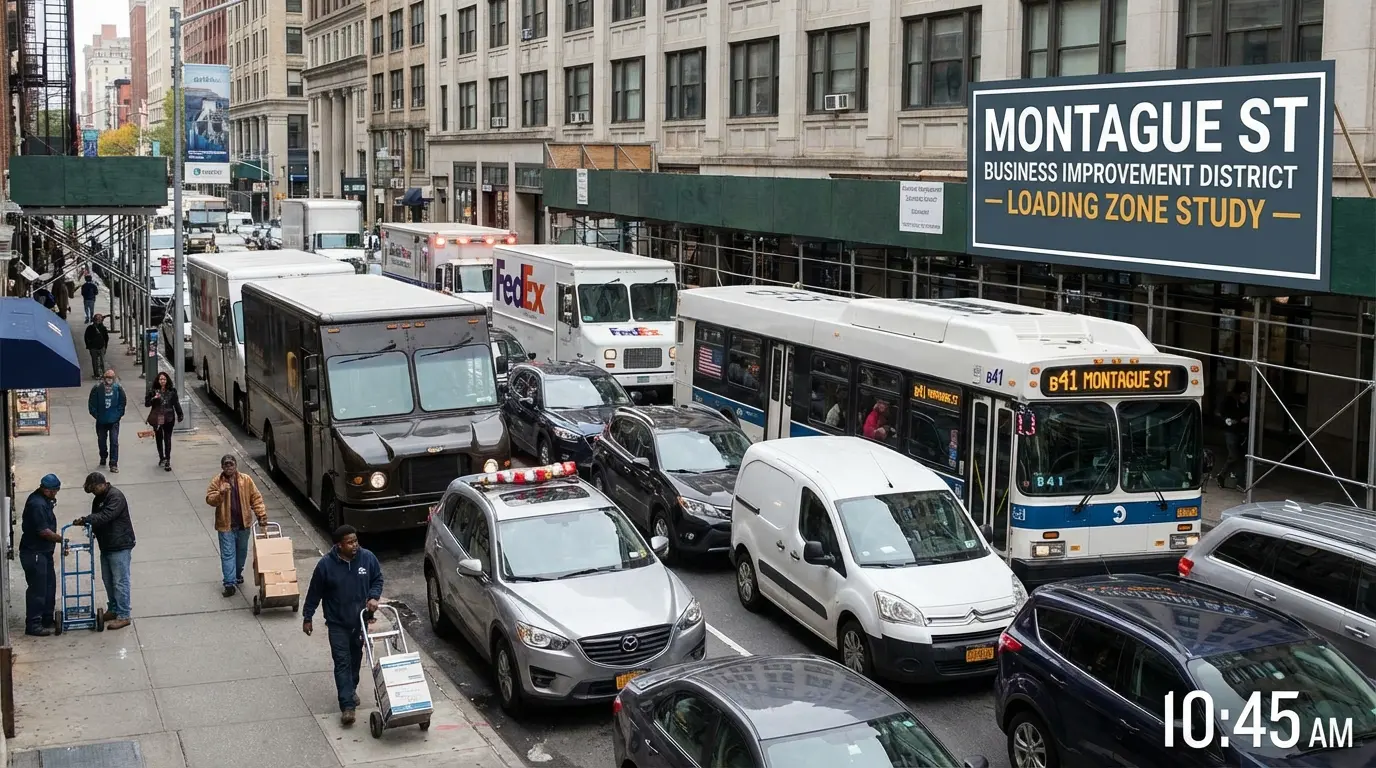
Verifies curb-loading behavior and limited short-term parking on Montague St; useful for planning drop-off, quick sessions and timing around delivery windows.
The image makes clear how little space exists between a double‑parked van, the bus stop and moving traffic—important context for anyone planning arrivals in formal wear.
Wedding Photography Services in Brooklyn Heights
Light, trees and skyline: how conditions shift through the day
Because Brooklyn Heights runs along a west‑facing bluff, light behavior is fairly predictable. Mornings on the Promenade and Columbia Heights bluff tend to be backlit from the city side, with softer, cooler light and the Manhattan towers less prominent. By late afternoon, the sun drops behind the skyline, producing silhouettes and a reflective glow on the water. Sunset sessions here lean into that backlit outline, while earlier afternoon slots offer more direct light on faces with the skyline still visible but less dramatic.
On the side streets, the continuous tree canopy and building height create alternating pockets of shade and dappled light. Montague’s side blocks often stay in shadow at street level even when the upper floors are bright, which is helpful for even skin tones but can also make the street feel dim on camera. Clinton and Willow, with slightly wider gaps between buildings and varying tree coverage, can shift quickly from open light at an intersection to deep shade mid‑block. Planning for these changes avoids surprises, especially in months when leaves thicken and the canopy blocks more overhead light.
Columbia Heights bluff and renovation patterns as local proof
Columbia Heights, running along the top of the bluff above the highway and park, is one of the clearest visual markers that you are in Brooklyn Heights rather than down in the waterfront park. Rows of brownstones line the ridge, with a consistent parapet height and mature trees in front. From certain spots you can see over the balustrades and glimpse the skyline, but the feeling is more residential and contained than on the open Promenade.
Renovation work and scaffolding are common here, especially in warmer months when façade repairs and window replacements are scheduled. This affects framing: a block that looked perfect a year ago might now have a full run of green plywood and netting. Photographers planning Columbia Heights shots usually keep a mental map of which façades are clear and where scaffolding is currently interrupting the rhythm of the row.
Confirms the brownstone bluff topography, common scaffolding/renovation presence and the specific visual textures of Columbia Heights used for planning shoots.
The scaffolding in this view is typical rather than exceptional, underscoring why advance scouting helps avoid construction dominating an otherwise classic frame.
What final Promenade and brownstone images usually include
Finished images from Brooklyn Heights sessions tend to include a mix of controlled and uncontrolled elements. On the Promenade, even well‑timed sessions will often have a passerby at the frame edge or a jogger in the background. Wind across the bluff can lift veils, hair and clothing, which sometimes adds motion but can also require multiple takes. On Montague side streets, parked cars and trash cans might be just out of frame, with careful angles used to hide them.
Couples planning wedding, engagement or proposal sessions here generally expect that some of the city’s texture will remain visible: other people on the walkway, boats on the river, construction cranes in distant skylines. The goal is usually to balance that real urban context with the more timeless elements—the balustrade, the brownstone stoops, the tree canopy—rather than to erase it entirely.
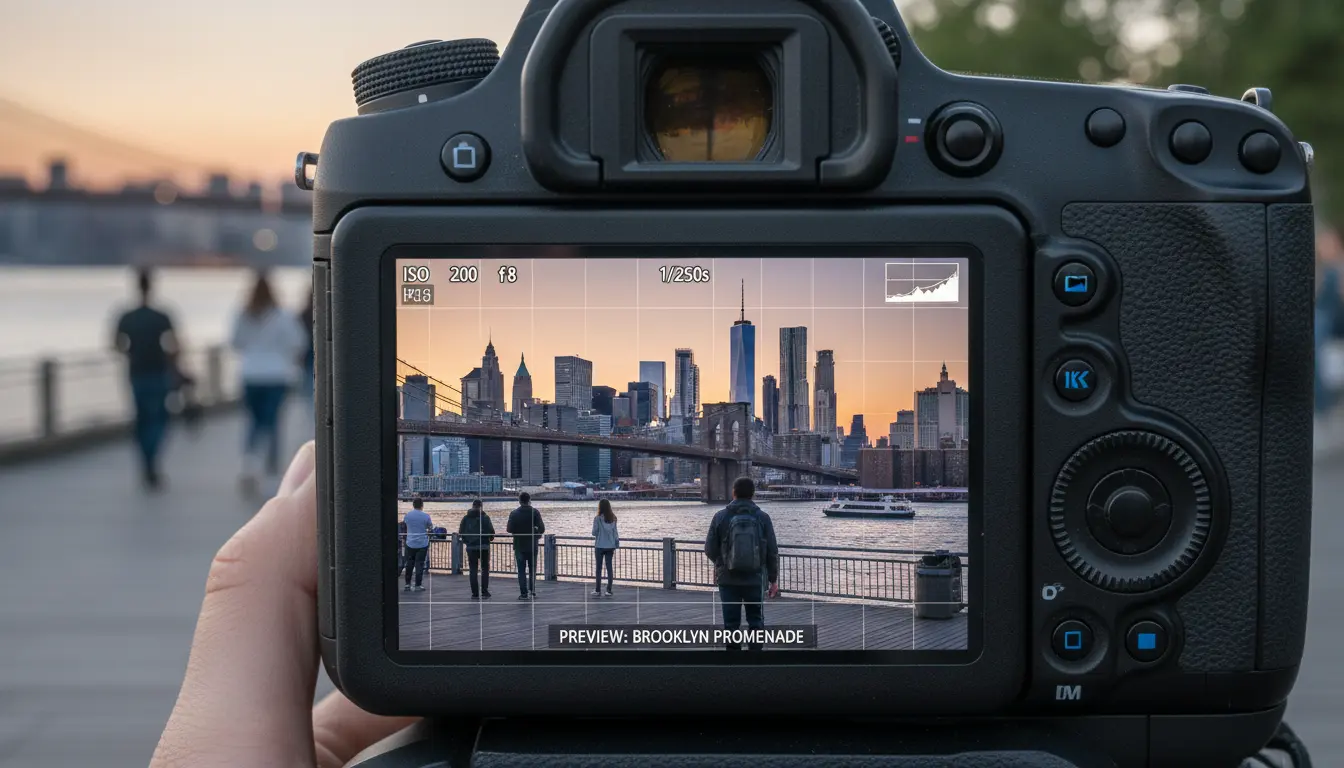
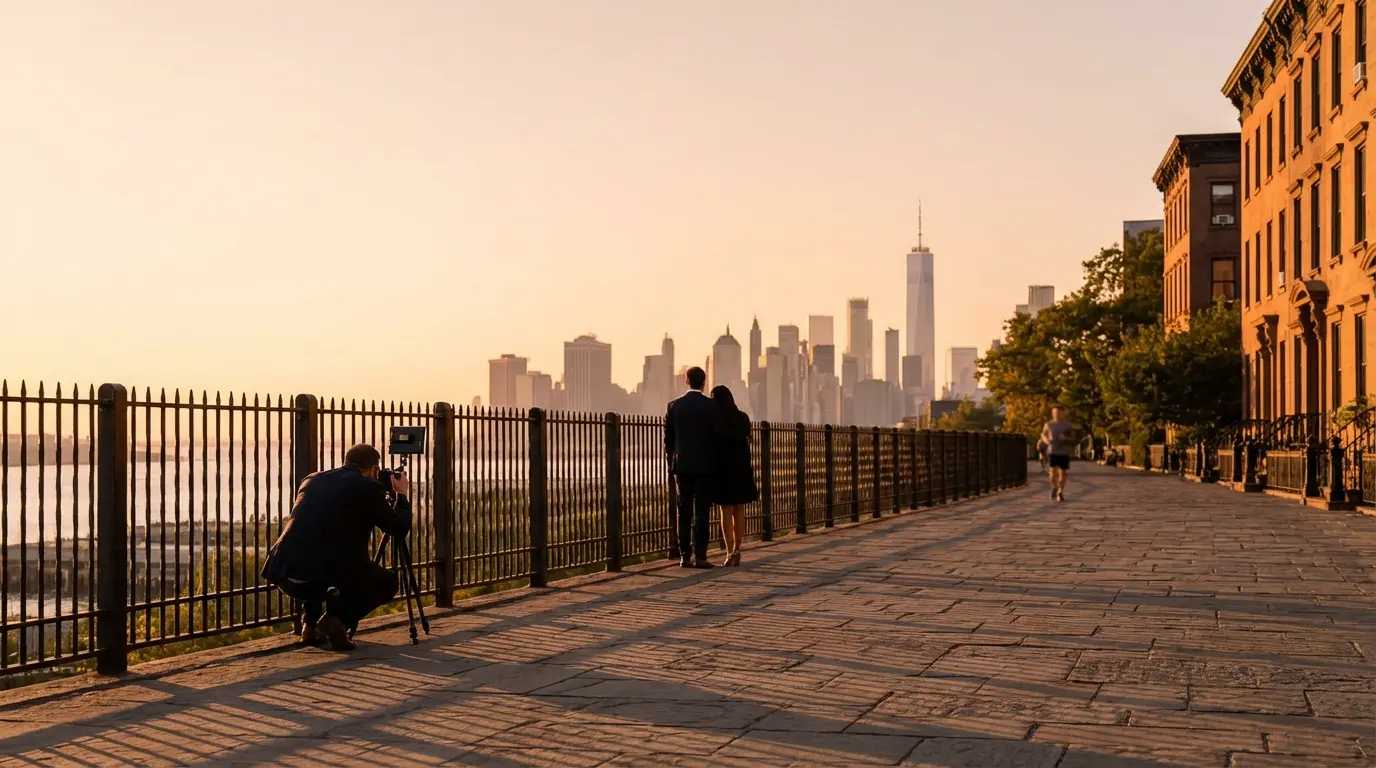
Shows a typical on-site preview image clients receive—skyline framing with occasional passerby or wind effects—helping set realistic expectations for Promenade shoots.
The LCD preview here is representative: skyline present, a stray passerby near the edge, and visible wind in hair and clothing—true to how the space actually behaves.
Small frictions that shape real sessions in Brooklyn Heights
Certain everyday details in Brooklyn Heights quietly shape how photo sessions run, especially in the morning:
- Storefront typology on Montague: Ground‑floor shops with apartments above mean rolling gates, awnings and sandwich boards appear and disappear through the day. Early mornings show closed gates and cleaner sidewalks; late mornings bring stacked delivery carts, open doors and more visual clutter at street level.
- Commercial–residential seams: Corners like Montague and Hicks or Old Fulton near the slope show a sharp mix of retail and residential entrances. A couple can be framed against a townhouse door while, just off camera, a restaurant is receiving boxes or a barista is dragging out trash.
- Bus and school patterns: On weekdays, buses along Cadman Plaza and school drop‑offs on nearby blocks add idling engines and short bursts of sidewalk congestion. That noise profile is part of the neighborhood’s reality and can matter for video or for couples hoping for a quiet, intimate feel.
- Morning noise profile: Before 9am, garbage trucks, leaf blowers, and construction crews on Columbia Heights often dominate the soundscape even when streets look empty. By late morning, that gives way to stroller traffic and delivery vans. Sessions planned for “quiet” times often aim for the middle ground between these two phases.
Understanding these micro‑patterns helps set realistic expectations about how peaceful or busy a given block will feel at the exact time a shoot is scheduled.
Connecting Brooklyn Heights sessions to wider Brooklyn plans
Many couples who live in or gravitate toward Brooklyn Heights also think beyond the immediate neighborhood when planning their wedding imagery. A proposal on the Promenade might be paired with a later session on a Brooklyn beach or at an out‑of‑state venue, and some couples use a Heights engagement shoot as a visual counterpart to a destination ceremony elsewhere. Because of this, it is common to treat Brooklyn Heights as one chapter in a broader visual story that also includes more open sand, different skylines or travel‑focused images.
Within the broader Brooklyn context, Heights works well as the “home base” look: brownstones, mature trees and the Manhattan skyline at a distance. Other neighborhoods or locations then add contrast—industrial textures, beaches, or large event spaces—while keeping travel times and logistics manageable before or after wedding days.
Adjacent Neighborhoods we serve near Brooklyn Heights
Questions people usually ask before scheduling a Brooklyn Heights shoot
When is the Promenade least crowded for photos?
Typically, shortly after sunrise on weekdays is the quietest, with fewer joggers and commuters. Late weekend afternoons and sunset are the busiest, especially near the Montague Street entrance.
Do we need permission to use a brownstone stoop?
If you plan to sit or stand on a specific stoop, it’s courteous—and often necessary—to have the owner’s permission, since stoops are private property even though they sit right off the sidewalk.
Is it better to schedule courthouse‑adjacent portraits before or after a ceremony?
Around Cadman Plaza and nearby courts, mornings can be busier with official business and security, while midday to early afternoon often allows slightly more flexible curb space for quick portraits.
Where should we meet for a fast session with limited time?
The top of Montague Street near the Promenade entrance is a common meeting point, but curb space is tight. Some couples prefer a quieter corner one block off Montague, then walk together to the first backdrop.
How reliable is parking or drop‑off for wedding parties?
There is very limited street parking and active bus and delivery activity near central access points. Most groups rely on car services for quick drop‑off and pickup rather than trying to park nearby.
Does wind at the bluff really affect photos?
Yes. The Promenade and Columbia Heights bluff catch more wind than interior streets. Veils, loose hair and long dresses can move a lot, which can be used creatively but is worth anticipating.
Is sunrise or sunset better for skyline shots here?
Sunset gives the classic backlit Manhattan silhouette and warmer tones, while sunrise offers softer, cooler light and fewer people but a less dramatic skyline glow.
What counts as Brooklyn Heights vs. Brooklyn Bridge Park in photos?
The bluff‑top streets, Promenade and Montague corridor are clearly within Brooklyn Heights. Once you descend toward the piers and interior lawns, you are in the park, even though many people still casually describe those images as being “in Brooklyn Heights.”