
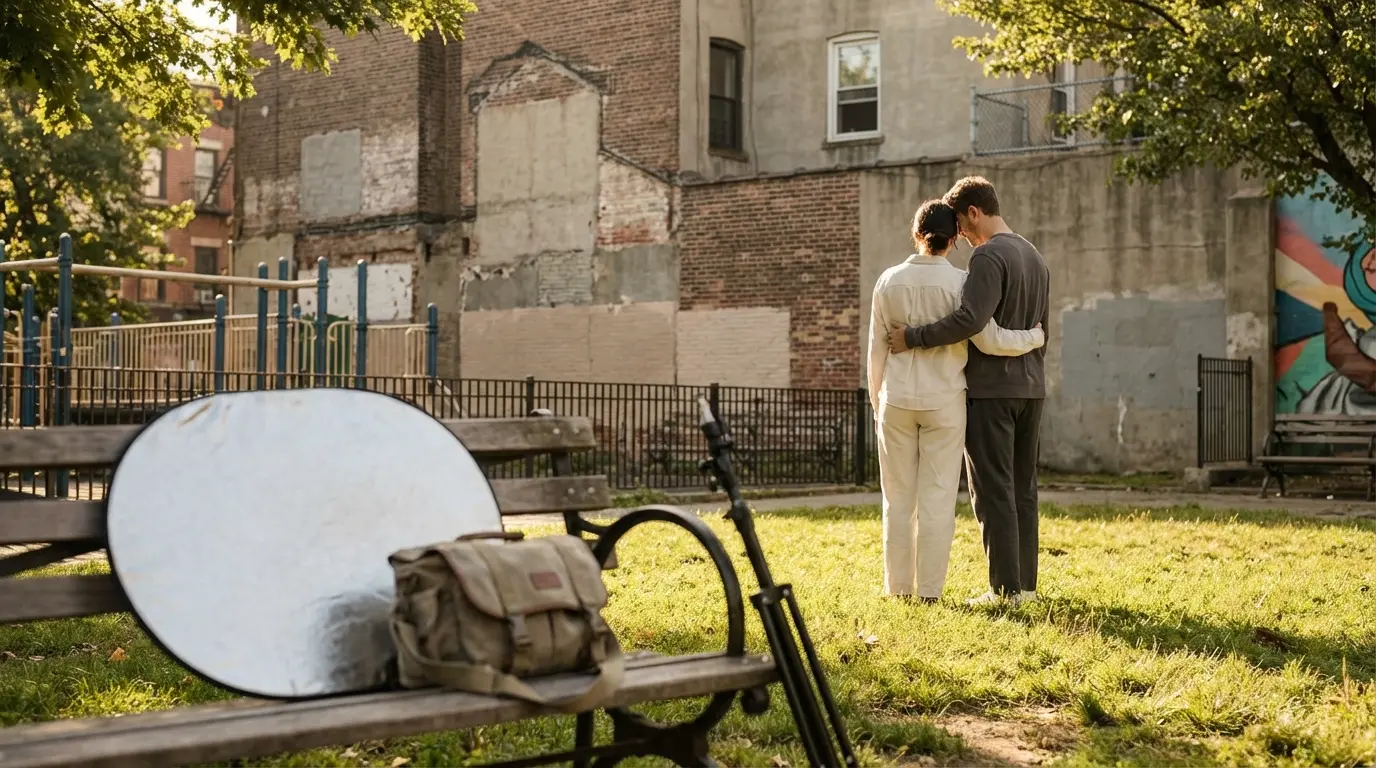
Bushwick in Brooklyn as a Setting for Wedding Photography
Street layout and edges of Bushwick within Brooklyn
Bushwick sits in the northeastern part of Brooklyn, where the street grid shifts from tight residential blocks into longer industrial runs. For couples, planners, and photographers, it helps to think of the neighborhood as a set of overlapping bands rather than a simple box on a map.
To the west, the feel gradually changes into East Williamsburg along the Morgan and Grand corridors, where warehouse conversions and lofts start to thin out toward the BQE. East and southeast, the grid continues almost seamlessly into Ridgewood, with Myrtle and Wyckoff acting more like a filter than a hard border. South of Broadway, the street texture and building stock shift again as you move into Bedford‑Stuyvesant, with fewer industrial blocks and more classic brownstone runs. Formal descriptions of Bushwick, Brooklyn match what people see on the ground: mixed-use corridors, low- to mid-rise housing, and persistent industrial pockets.
Maria Hernandez Park functions as a central reference point, with open sightlines out to the surrounding mid-rise buildings and tree-lined side streets. From there, short walks north or west quickly transition into denser warehouse and studio zones, while a few blocks south or east bring you closer to elevated tracks and louder traffic corridors.
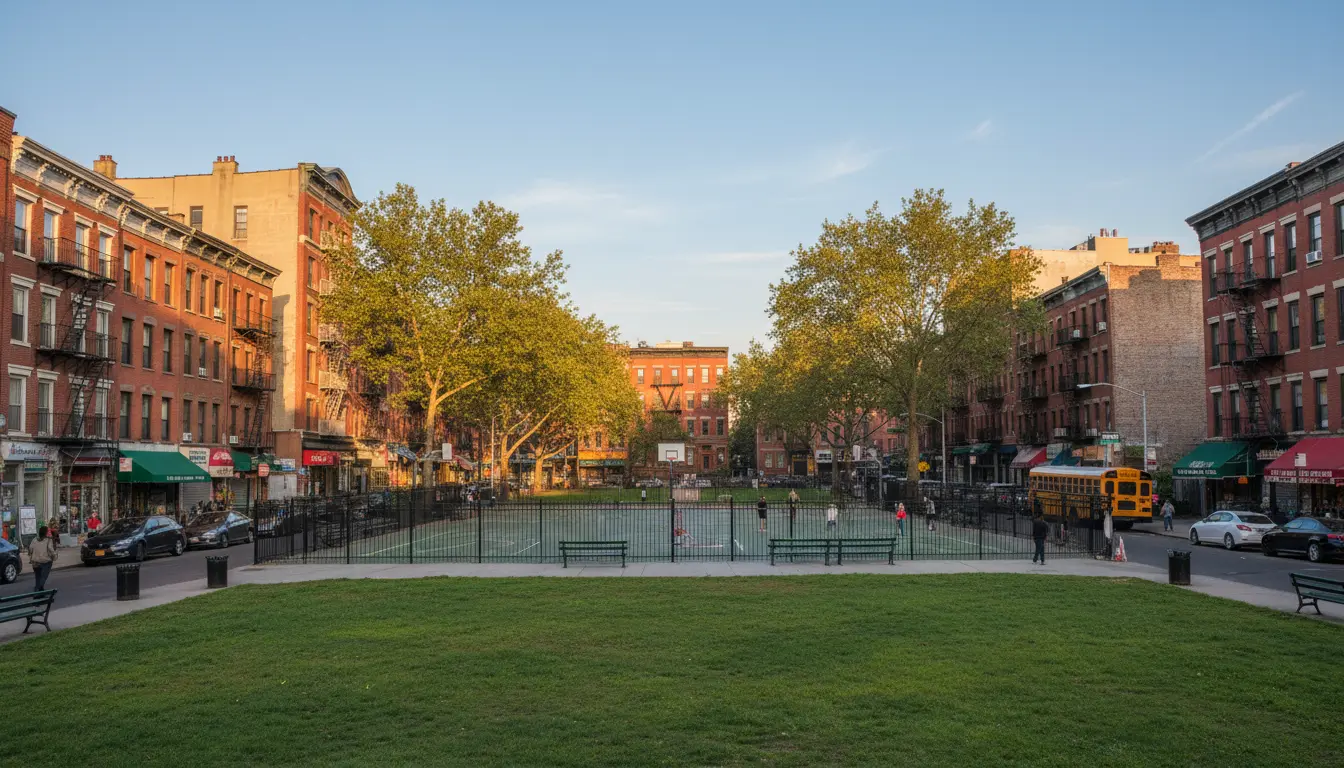
Shows the park’s openness, nearby building textures, and morning light conditions a photographer can expect when planning outdoor sessions in Bushwick.
This view confirms how quickly open green space gives way to patched brick facades and intersecting cross streets—useful when you’re planning to move a couple or small group between shaded benches and harder urban backdrops within a single session.
Subway stops, diagonal corridors, and parking realities
Most people arrive in Bushwick via the L or the J/M/Z, and those lines define real movement funnels on wedding days. The L train stations at Morgan, Jefferson, and DeKalb cluster guests and vendors onto a few key corners, so meeting points often default to those stairways or adjacent cafés. During weekend service changes, the narrow Morgan Avenue entrances can back up, with lines of people and gear cases compressing onto the sidewalk—something to factor in if a small crew is trying to move on a fixed timeline.
Along Broadway, the Myrtle–Broadway J/M/Z hub creates a diagonal slice of activity that rarely quiets down. Buses, rideshares, and through-traffic converge under the elevated structure, making it efficient for access but complicated for clean ambient sound or uncluttered wide shots. Noise from trains, announcements, and bus engines is constant here, which matters more for wedding film or elopement video segments that rely on live audio.
Parking is inconsistent across Bushwick. Side streets north of Flushing tend to alternate between tight one-way blocks with heavy overnight parking and occasional wider stretches where loading docks break up the curb. Alternate-side regulations create rotating no-parking clusters that shift week to week, and on some industrial blocks, trucks double-park near warehouse doors, forcing pedestrians into the street. For couples or crews arriving by car, it’s realistic to budget extra time to circle the block or walk a few minutes from wherever a space opens up.
Micro-area backdrops for Bushwick wedding shoots
Within those broad boundaries, a handful of Bushwick micro-areas repeatedly show up in wedding and couple sessions because of how they combine texture, space, and access.
-
Morgan/Troutman corridor
Here, converted warehouses sit next to active loading bays, with murals and patched brick walls breaking up long facades. Side streets around Morgan Avenue offer short sightlines framed by roll-up gates, loft windows, and occasional café build-outs. This is where “industrial Bushwick” tends to look exactly like clients expect, but you still have to work around delivery vans and quick shifts in street activity. -
Jefferson retail and café band
Around Jefferson Street, commercial storefronts, smaller venues, and corner bars share the same blocks. Corners can flip quickly from quiet to crowded when a bar opens its doors or a delivery truck pulls up. For photos, this creates a mix of graphic signage, mid-block murals, and intermittent crowd density—good for energy, but less predictable if you’re aiming for slower, more private portraits. -
Park-adjacent residential blocks
The streets immediately around Maria Hernandez Park provide a softer edge to Bushwick, with trees, playground fencing, and mid-rise apartment facades. Morning sessions here benefit from the park’s open canopy and clear sightlines to the sky, before foot traffic builds toward late morning and afternoon. -
Flushing Avenue edge
Along Flushing, the industrial spine of Bushwick becomes more pronounced: wider lanes, larger trucks, and longer unbroken walls. These stretches are useful for bold, minimal backdrops or motion-focused video segments, but they also bring more engine noise, exhaust, and occasional street repairs underfoot.
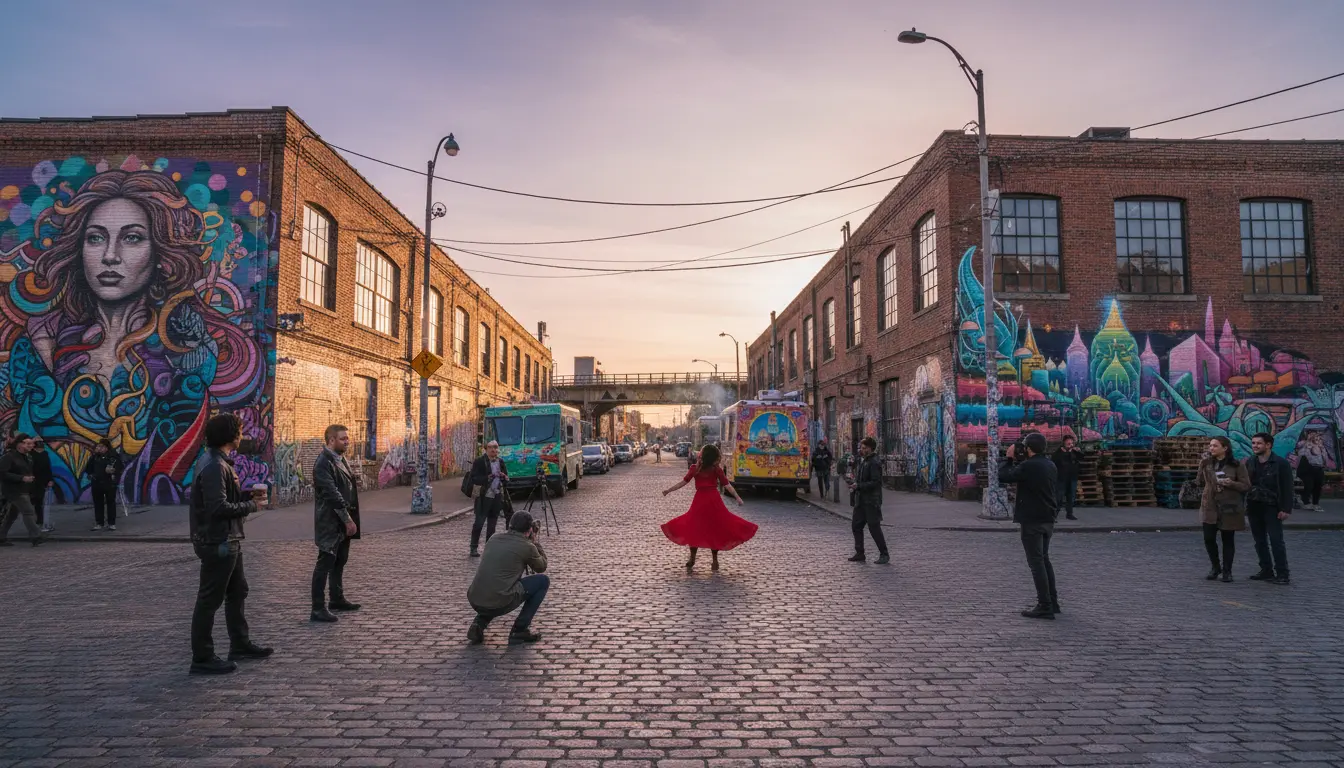
Demonstrates typical industrial backdrops and nearby pedestrian and vehicle activity that affect on-street photo sessions in Bushwick.
In this Morgan/Troutman view, you can see how closely pedestrians, café seating, and parked vans sit to any couple being photographed—there is rarely a truly empty block, so realistic planning assumes passersby and moving vehicles as part of the environment.
These physical conditions shape how a Wedding photographer organizes routes, backup spots, and timing. The same corner can serve both a first look and later candid street images if you know when delivery traffic peaks or when bar doors typically open.
Comparing Bushwick spots by light, noise, and crowd levels
Choosing between Bushwick locations often comes down to how light behaves on specific blocks, and how much ambient activity you’re comfortable including in your images or video.
North–south cross streets near Morgan and Jefferson pick up strong lateral light in the afternoon. However, tall warehouses and loft conversions interrupt that light with long, irregular shadows that creep across the street faster than in open residential neighborhoods. On Troutman Street, mural walls and light-colored surfaces bounce extra light back onto subjects, but that effect can disappear suddenly when a delivery truck pulls in and blocks the sun.
Maria Hernandez Park, by contrast, tends to offer the earliest usable light of the day thanks to its open center. Even when nearby streets are still in shadow, the interior lawn and main paths already receive consistent brightness, which is helpful for morning ceremonies or pre-ceremony portraits.
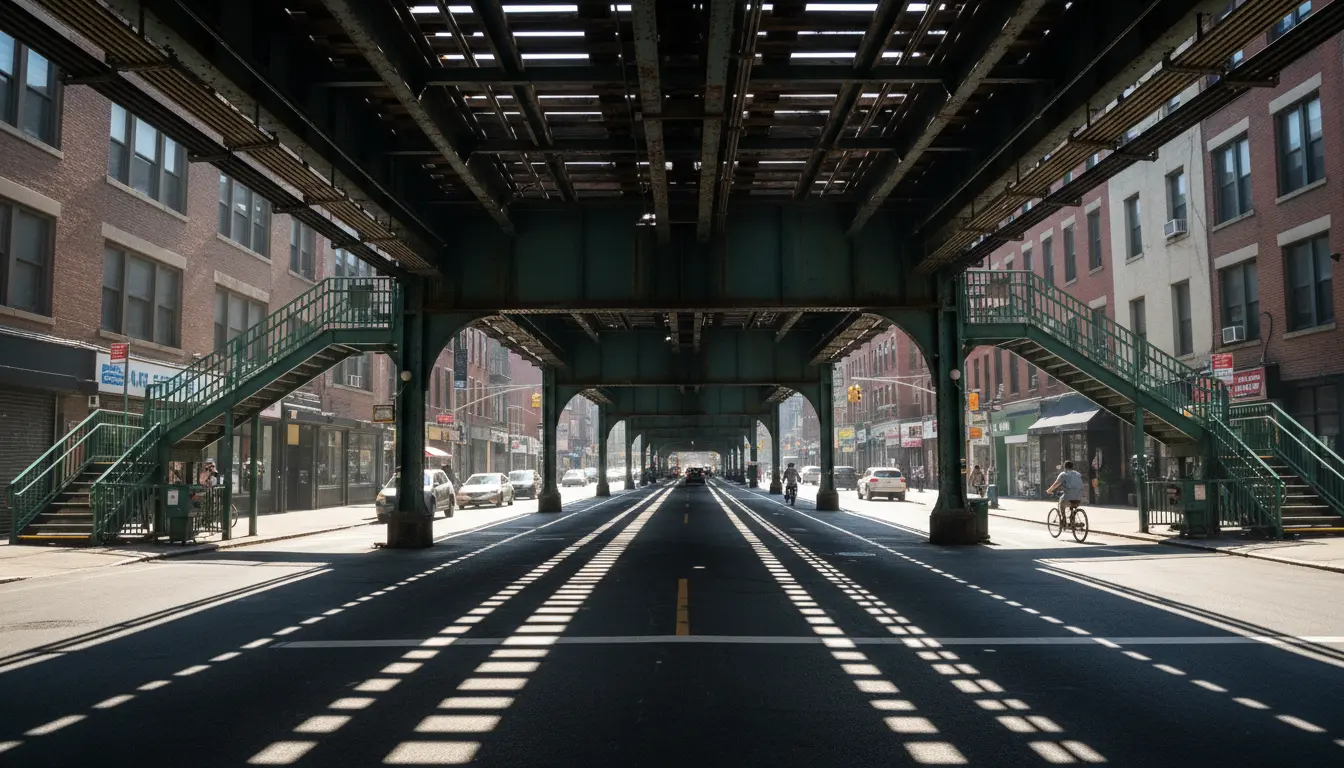
Visual comparison of lighting and access near the elevated line; useful for assessing noise, shadow duration, and entry/egress at nearby subway stairs.
Under the Myrtle–Broadway elevated tracks, heavy steel beams cast deep, cold-toned shadows that linger even on clear days. This affects not only exposure settings but also how long you can rely on any pocket of light before it is swallowed by the structure’s shifting shadow. At the same time, the station staircase funnels people and sound directly into that space, so any romantic moment captured there will always include visible urban movement and noise.
For couples planning Wedding Photography specifically in Bushwick, these micro-conditions are often the real deciding factors: whether you prefer open, even park light; high-contrast industrial shadows; or mixed scenes with neon signage, traffic streaks, and reflective murals.
Wedding Photography Services in Bushwick
These related services often share the same physical locations and timing constraints—loft interiors, industrial corridors, and park edges—so understanding Bushwick’s light and movement patterns helps in planning all of them together.
Working space, gear, and crew movement on Bushwick streets
Bushwick blocks are rarely empty, and many sidewalks are narrower than they first appear once you factor in tree pits, sandwich boards, and outdoor seating. That has direct implications for how much gear and how many people fit safely on a corner.
Along Knickerbocker Avenue, for example, corridors of storefronts and vendor carts compress walking space. A small photo or video team can usually operate with handheld or compact light setups, but full-size stands, booms, or rolling cases are harder to position without protruding into pedestrian flow. Delivery trucks pull up at unpredictable intervals, especially near convenience stores and small groceries, temporarily blocking sightlines and forcing quick repositioning.
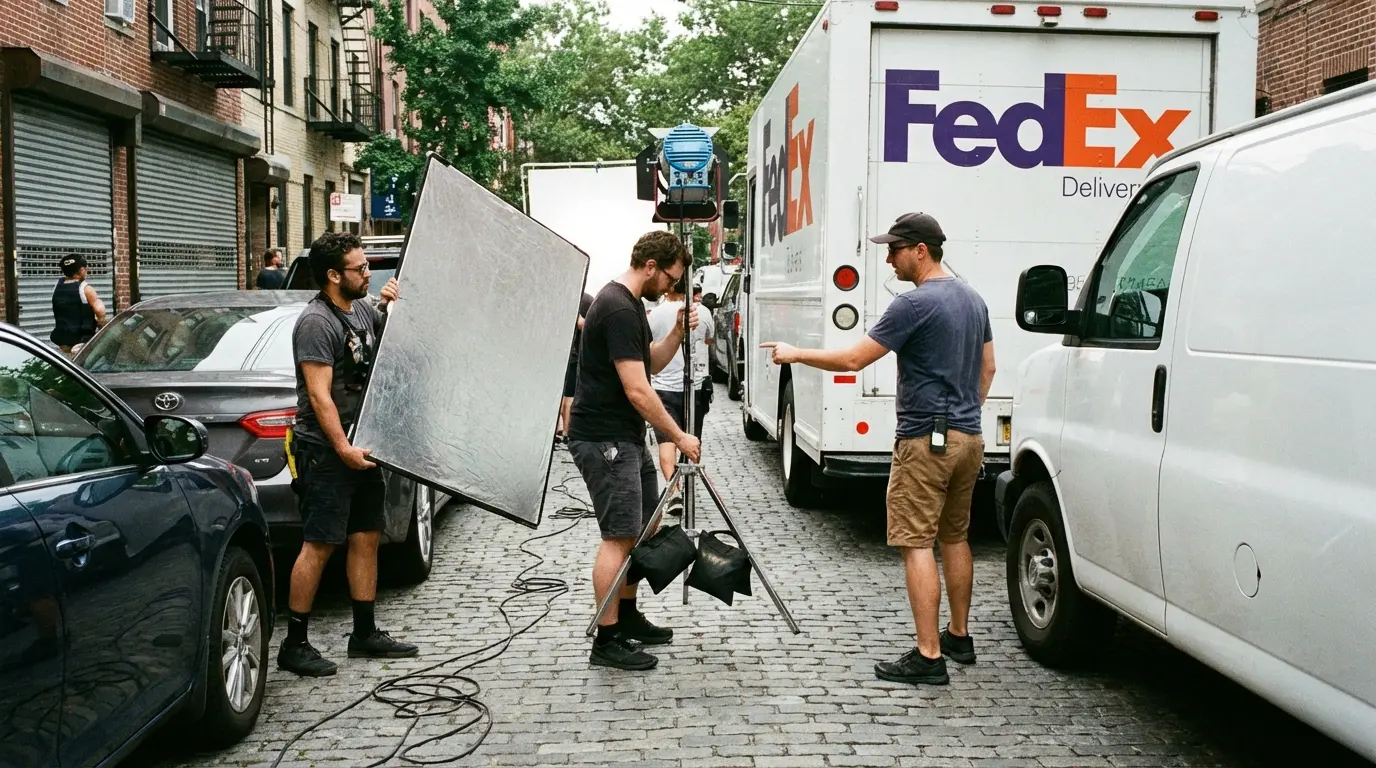
Shows realistic setup constraints—narrow streets, parked vehicles, and commercial deliveries—that inform crew size and gear choices for Bushwick shoots.
In this Knickerbocker setup, the reflectors and light stand are already close to parked cars and a passing truck, illustrating how quickly the usable buffer around a couple shrinks. Planning for compact, quickly movable setups is more realistic than assuming there will be room for large, static rigs.
Constraints, permits, and on-the-day risks to plan around
A number of Bushwick locations are straightforward to use; others introduce constraints that matter when you’re coordinating people, outfits, and time-sensitive events.
-
Parks and open spaces
Maria Hernandez Park is generally accessible, but weekend afternoons can bring dense crowding: pickup games, dog walkers, and families occupy many of the more photogenic corners at once. For any session needing clear space or motion (such as tracking shots for wedding film work), morning or weekday timing reduces the risk of constant background interruptions. -
Rooftops and private terraces
Rooftop access is mostly private and building-specific. Many walk-up and elevator buildings rely on tenant permissions, coded entries, and management policies that can change without notice. It is not safe to assume that any visible roofline or terrace in Bushwick is available for photos; secure confirmation is needed well in advance. -
Studios and event spaces
Converted loft studios commonly operate on precise rental windows with strict entry and exit times. This leaves little margin if subway issues or traffic delay arrival. Once inside, though, these spaces offer controlled lighting and insulation from street noise, complementing the more unpredictable outdoor environment. -
Wind, traffic, and street repairs
Wide intersections like Knickerbocker/Wyckoff can be surprisingly windy, tugging at veils, dresses, and audio equipment. Along Flushing Avenue and similar industrial stretches, heavy truck traffic adds not only sound and exhaust, but also periodic blockages when vehicles idle at loading docks. Ongoing street repairs introduce temporary hazards and detours that affect heel-friendly routing and wheelchair or stroller access.
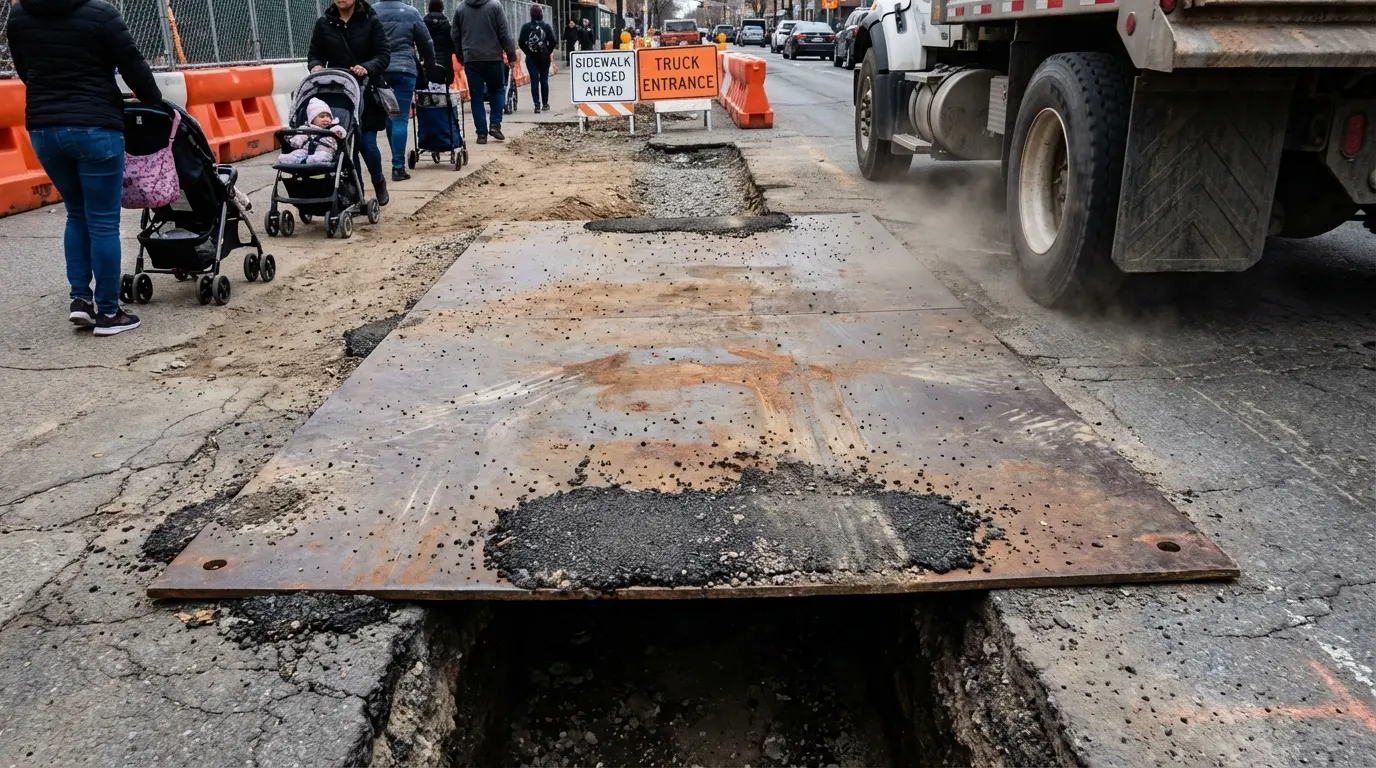
Highlights pavement irregularities and truck activity that can require route changes, footwear considerations, or alternate staging when organizing a session in industrial pockets.
This Flushing Avenue scene shows how a single metal plate and nearby trucks can change the way people move along the block, forcing small groups to tighten up and navigate uneven surfaces—details that matter when planning footwear, accessibility, and rolling equipment.
Hyperlocal quirks: bars, corners, and unscripted backgrounds
Some of Bushwick’s most photographed corners are also the least predictable. Around Troutman and Irving, bar spillover late in the day can quickly reclaim the sidewalk, with patrons, bicycles, and outdoor seating expanding beyond marked areas. What was a calm mural wall at 2 p.m. may be partially blocked by 6 p.m., altering both your frame and your comfort level for intimate portraits.
At the Jefferson and Knickerbocker intersection, street-corner personality is constantly shifting. Pop-up vendors may park carts near crosswalks, storefronts rotate displays onto the sidewalk, and delivery vans idle mid-block while unloading. These moving parts create a lively background, but they also mean that any “clean” composition using that corner has a short shelf life. For video, the blend of music from open doors, bus engines, and conversations adds a dense, layered sound bed that you either embrace or avoid.
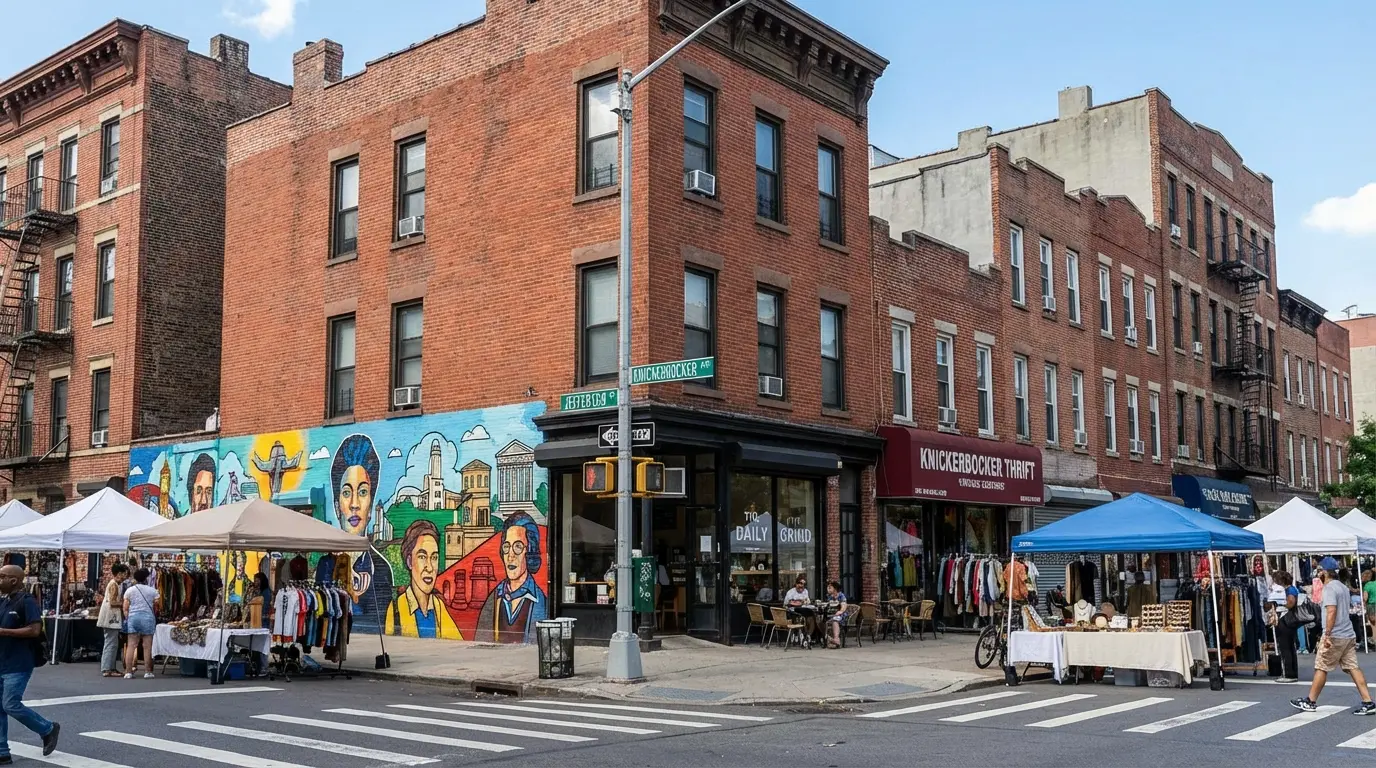
Provides unmistakable micro-area cues—retail scale, vendor activity, and mural textures—that help validate specific Bushwick location choices for sessions.
This Jefferson/Knickerbocker view underlines how close storefronts, vendor carts, and mural fragments sit to one another, making it clear that “quiet” in this micro-area is relative and often temporary.
From session to finished photographs and films
Because so much of Bushwick’s appeal comes from its mix of industrial and residential spaces, many couples pair outdoor segments with time inside a loft, studio, or private venue. Indoors, exposed brick, large factory windows, and polished concrete floors provide controlled backdrops for detail shots, family groupings, or reviewing images on a laptop before or after the wedding day.
These interiors are also where final work is often viewed—reviewing print proofs at a table, watching a first cut of a wedding film, or comparing sequences from different Bushwick locations. The same light that streams through tall windows in the afternoon can reveal printing nuances in albums or subtle color shifts in video.
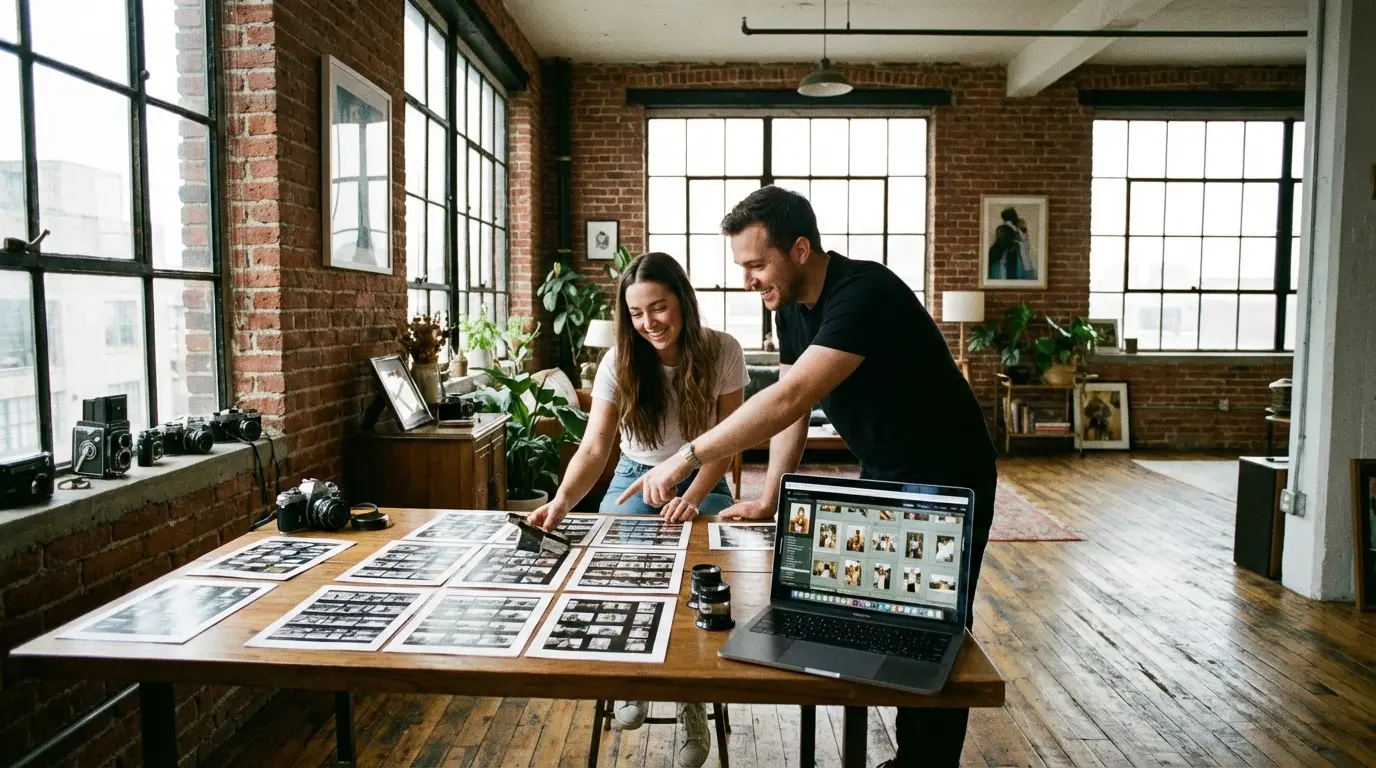
Illustrates a realistic indoor review or proofing setup and the type of light and space available in typical Bushwick loft studios for viewing deliverables.
This loft proofing table reflects a common Bushwick workflow: images move from busy streets and parks into quiet, controlled spaces where couples can evaluate prints and films without the distractions of traffic, music, or bar activity just outside.
Adjacent Neighborhoods we serve near Bushwick
Common questions about using Bushwick for wedding photography
How difficult is parking in Bushwick for a wedding or photo session?
Parking is inconsistent. Residential side streets can be fully packed, especially overnight and on weekends, and alternate-side rules clear entire blocks at certain hours. Industrial stretches sometimes have more gaps but are also used heavily by trucks, which double-park near loading docks. It’s realistic to plan for a short walk from wherever a spot opens up.
When is natural light most reliable in Bushwick?
Morning light is most consistent in and around Maria Hernandez Park and nearby open intersections. In the afternoon, north–south streets near Morgan and Jefferson receive strong side light, but tall warehouses and lofts cast deep shadows that move quickly. Under the elevated lines around Myrtle–Broadway, areas stay in shadow much longer than you might expect.
Is rooftop access a realistic option for Bushwick wedding portraits?
Rooftop access is mostly private and controlled by individual building management or tenants. Many doors are coded or locked, and policies can change without notice. Unless you have explicit permission arranged in advance, it’s not safe to count on rooftop views as part of your plan.
What indoor backup options exist if weather turns bad?
Common indoor options include rented loft studios, private event venues, and, in some cases, larger apartments with suitable light and space. These are typically reserved on specific time blocks, so they work best when integrated into the day’s schedule rather than treated as a last-minute backup.
How busy do Bushwick streets and parks get on weekends?
Weekends bring heavier use to Maria Hernandez Park, especially in the afternoon, and increase foot traffic along commercial corridors like Knickerbocker and Jefferson. Corners that feel quiet on a weekday morning can be crowded by late afternoon, with bar spillover and vendor activity compressing available space on the sidewalks.
How close are subway stations to typical Bushwick venues and shoot locations?
Many popular lofts, studios, and event spaces cluster within a few blocks of Morgan, Jefferson, or DeKalb L stations, or near the Myrtle–Broadway J/M/Z stop. However, station stairways—particularly at Morgan—can be narrow, and weekend service changes sometimes create backups on the sidewalks as riders queue or reroute.
What should we expect in terms of noise for video and audio recording?
Industrial corridors like Flushing bring truck engines and loading activity; elevated train zones layer in train noise, announcements, and bus traffic; and busy corners such as Jefferson/Knickerbocker add music from storefronts and street chatter. For segments that need clean audio, indoor spaces or park interiors at quieter times of day are more reliable.
Are there issues with street repairs or uneven surfaces in Bushwick?
Yes. Ongoing utility work and pavement cuts—especially along Flushing Avenue and some side streets—create metal plates, patched asphalt, and occasional sidewalk detours. These affect footwear choices, accessibility for strollers or wheelchairs, and the ability to roll carts or cases smoothly between locations.
Can we move between Bushwick and nearby neighborhoods during a wedding day?
Moving between Bushwick and nearby areas like Williamsburg or Bedford-Stuyvesant is common, but the combination of traffic, one-way streets, and parking can add more time than the map distance suggests. It’s helpful to build in buffer time if your day’s plan includes multiple neighborhoods.
How does bar activity affect evening photo or video sessions?
In bar-dense micro-areas such as Troutman/Irving and parts of Jefferson, sidewalk space can shrink quickly as evening crowds grow. This adds energy and ambient light but reduces privacy and control over your background. If you prefer cleaner frames, scheduling those locations earlier in the day is more realistic than relying on them at peak evening hours.