
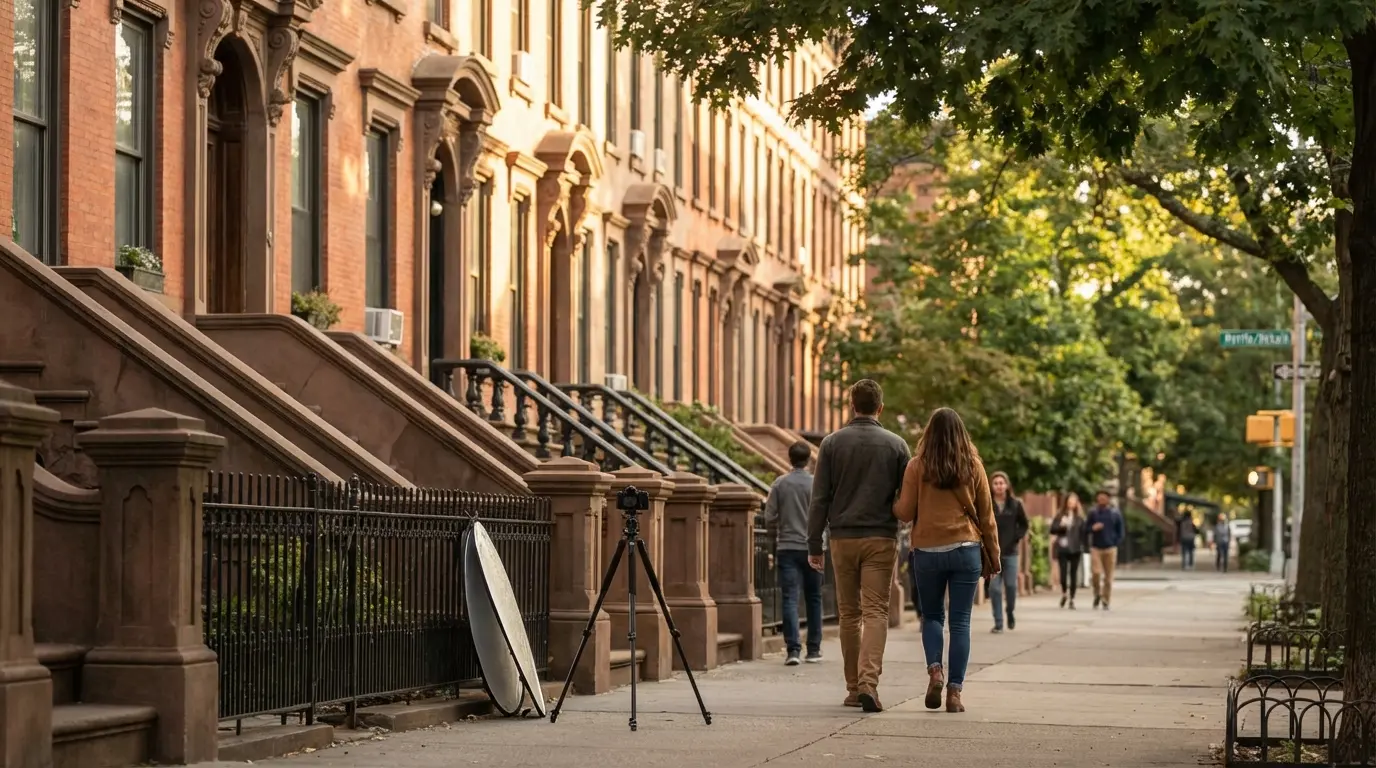
Clinton Hill Brooklyn wedding photography environment overview
How Clinton Hill sits within Brooklyn
Clinton Hill is a compact, mid-density neighborhood in central Brooklyn, sitting between the brownstone belts to the west and the deeper residential blocks of central Brooklyn to the east. It reads as a mostly residential grid with a few clear spines: Myrtle Avenue on the north edge, Dekalb Avenue cutting through the middle, and Clinton Avenue running as a wide, tree-lined axis.
Official descriptions such as Clinton Hill, Brooklyn – Wikipedia place the neighborhood west of Bedford-Stuyvesant, east of Fort Greene, and generally north of the Prospect Heights area. On the ground, those boundaries are felt more than they are seen: Classon Avenue feels like the handoff toward Bed-Stuy, while the transition toward Fort Greene is softer along Dekalb and Myrtle. Vanderbilt Avenue is the loose south-southwest connector that eventually leads down toward the Prospect Heights side streets.
Most couples using Clinton Hill are already moving somewhere else in Brooklyn the same day—ceremony in one area, portraits in another—so this neighborhood’s role is usually as a calm, mid-route stop rather than an isolated destination.
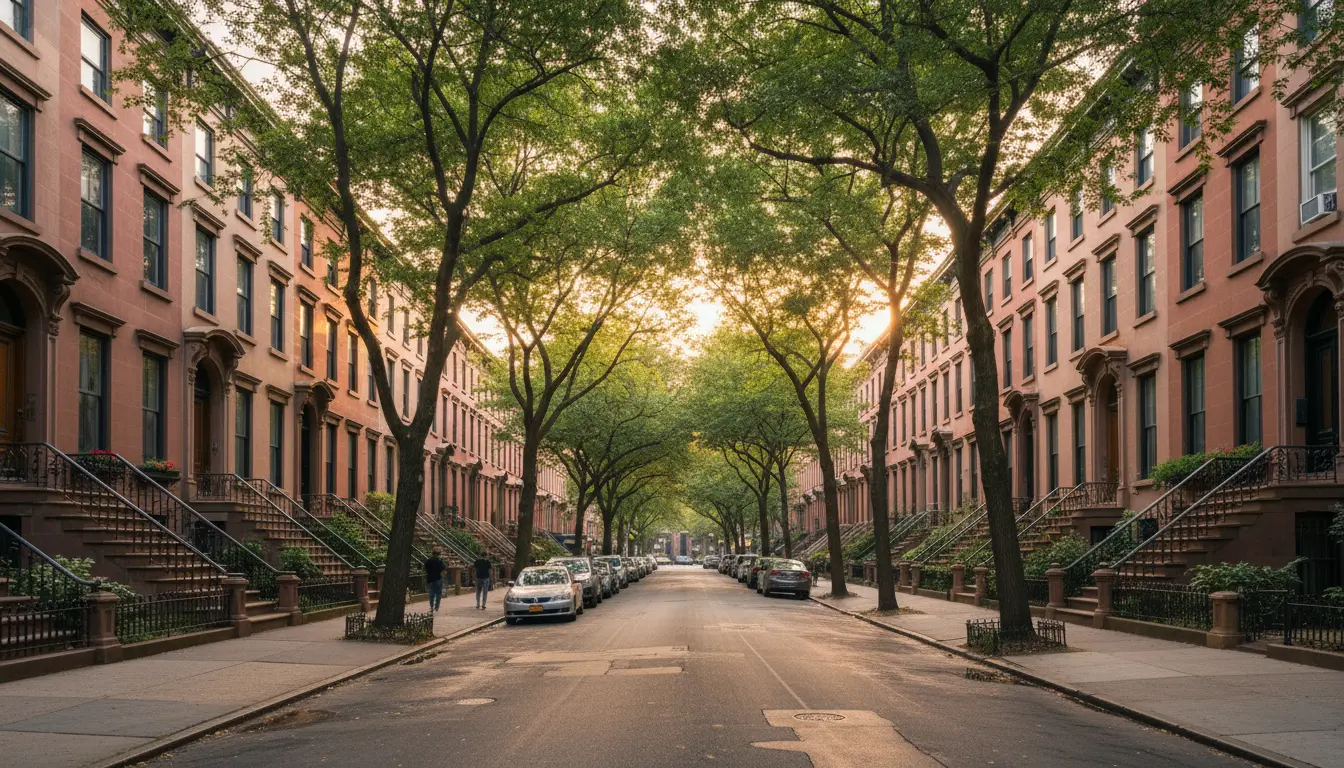
Verifies the brownstone rhythm, tree canopy density, and sidewalk scale a couple can expect on Clinton Avenue in Clinton Hill.
This Clinton Avenue view confirms the core street structure that many sessions rely on: consistent stoops, mature trees creating a canopy, and sidewalks that are comfortable for a couple plus a small crew, but not wide enough for large setups.
Typical session scope on Clinton Hill blocks
Most wedding-related shoots here stay within a tight footprint: a few Clinton Avenue blocks, a small park edge, and one or two passes around the Pratt Institute perimeter. The goal is usually to get a sequence of brownstone facades, some soft greenery, and maybe a campus-adjacent shot without crossing into spaces that feel obviously private or restricted.
Common, realistic zones include:
- Clinton Ave mansion row – Long, continuous runs of historic brownstones with deep stoops and heavy tree coverage. Good for walking sequences and stationary portraits on the public sidewalk.
- Underwood Park’s edge – A compact park where usable space is mostly the perimeter: benches by the fence line, a narrow interior path, and open sky broken by tree branches.
- Pratt perimeter blocks (Willoughby–Hall–Myrtle) – The outside of the fence gives a campus-in-the-background feel without stepping into areas that may require formal permission.

Shows a realistic park-edge session in Clinton Hill and lets buyers verify bench availability, bench shading, and proximity to residential blocks.
The Underwood Park image shows the actual scale couples can expect: a few benches, partial afternoon shade, and close-by residential facades. It’s enough for a short portrait sequence, but the park is too small to function like a full-scale location.
Choosing between quiet streets and busy corridors
One of the first decisions is whether to keep everything on the quieter brownstone blocks or to include some of the busier commercial edges for contrast.
- Quieter side streets (Clinton, Washington, Waverly south of Myrtle): These feel wider and calmer. Street density is mostly parked cars, dog walkers, and residents. It’s easier to run a short sequence without constant interruptions.
- Myrtle Avenue retail strip: This is the main commercial spine. Sidewalks compress between storefronts and curb, and foot traffic spikes near the Pratt gates, small shops, and bus stops.
- Dekalb Avenue: A mid-level option—fewer shops and less compression than Myrtle, but more activity than interior residential streets.
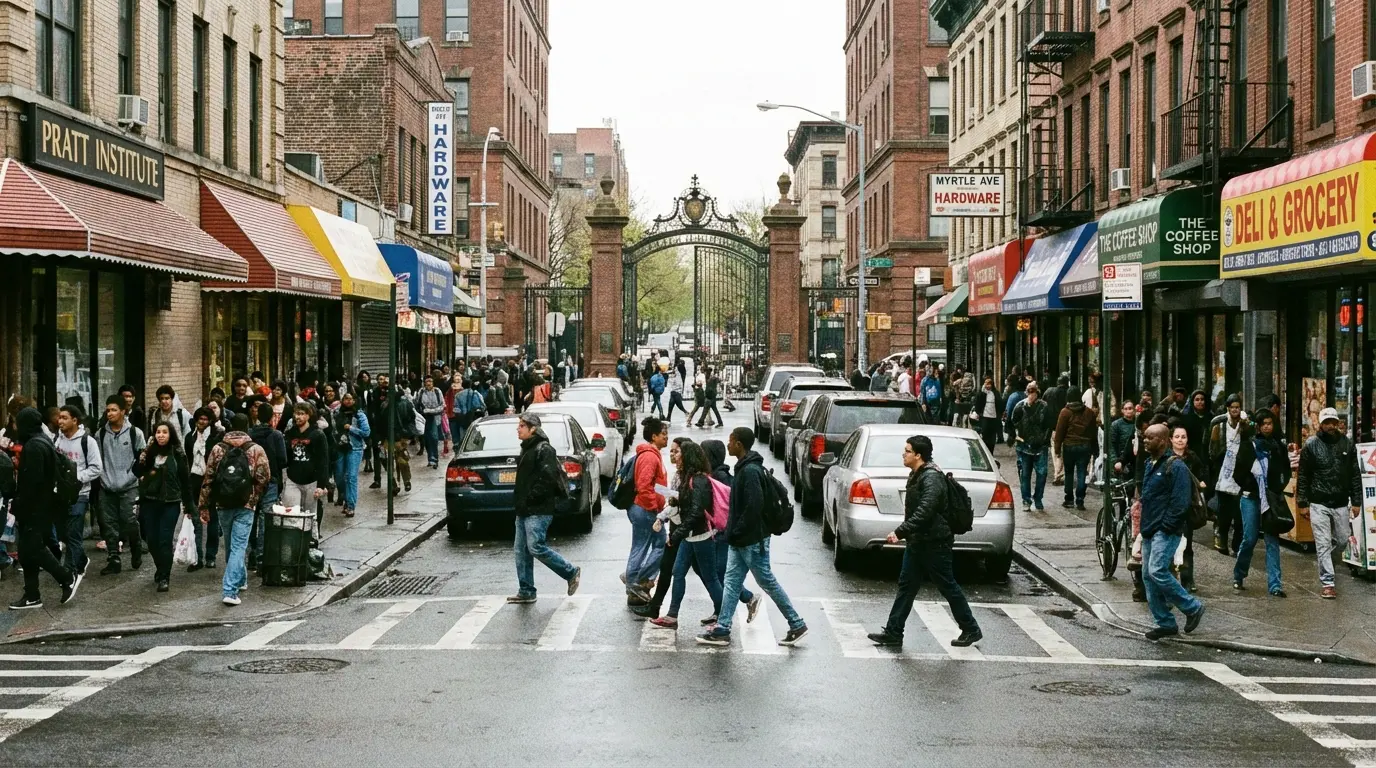
Lets buyers compare crowding and commercial sidewalk compression on Myrtle Avenue against quieter Clinton Hill blocks when choosing a session location.
The Myrtle Avenue image makes the trade-off clear: more visual energy and signage, but less maneuvering room and more chance that pedestrians will pass through the frame. The awnings you see here are not just visual elements—they also double as quick micro-shelters when weather turns suddenly.
Light and shade patterns across Clinton Hill
The way light behaves in Clinton Hill is driven by three factors: tree canopy density, mid-rise interruptions near Myrtle, and open patches around Pratt and small parks. This directly affects how Wedding Photography sessions can be timed without leaning heavily on artificial lighting.
- Morning: East-facing gaps along Vanderbilt and Washington pick up softer light early. Clinton Avenue gets broken, dappled light through the trees, which can be flattering but inconsistent if you’re trying to run precise posing sequences.
- Midday: The Clinton Avenue canopy filters overhead sun into softer, more diffuse patches, while the more exposed cross-streets can produce harder shadows. Around Pratt’s greens, open-sky light is strong, but narrow building shadows move quickly and can cut across a frame in minutes.
- Late afternoon: Myrtle’s south side drops into shade first due to the building line; the north sidewalk holds usable side-light longer. Dekalb, with fewer tall structures, often gives you a bit more even light earlier. Near sunset, Clinton’s canopy creates a gentle, almost studio-like top diffusion, but the trade-off is lower overall brightness.
Knowing which side of the avenue to stand on and how the tree canopy breaks up the sun is often more important here than the exact time on the calendar invite.
Wedding photographer Services in Clinton Hill
- Wedding photographer
- Color Correction
- Cinematic Wedding Videographer
- Destination wedding photography
These related services tend to be layered onto the same light windows described above—coverage on the street, motion sequences along the avenues, and post-production adjustments that account for Clinton Hill’s specific mix of greenery and brick.
On-the-day movement and simple workflow
On a typical Clinton Hill shoot day, movement tends to follow a loop rather than a straight line. Couples might start on a quieter Clinton Avenue block, cut over toward Underwood Park for a quick bench or greenery sequence, then swing past the Pratt perimeter or a nearby church before heading off to a venue in another neighborhood.
Sidewalk logistics matter:
- Stoops are private: The stone steps and landings belong to the building, not the sidewalk. Staying clearly on the public side of the property line avoids awkward interactions and respects residents.
- Sidewalk width: In many spots, you can comfortably position a couple and one or two crew members, but large gear spreads start to narrow pedestrian passage, especially where trees or fences pinch the walkway.
- Crossings and corners: Crosswalks at Clinton/Dekalb or Washington/Dekalb can be useful reset points—brief pauses where you can reorient without blocking anyone’s front door.
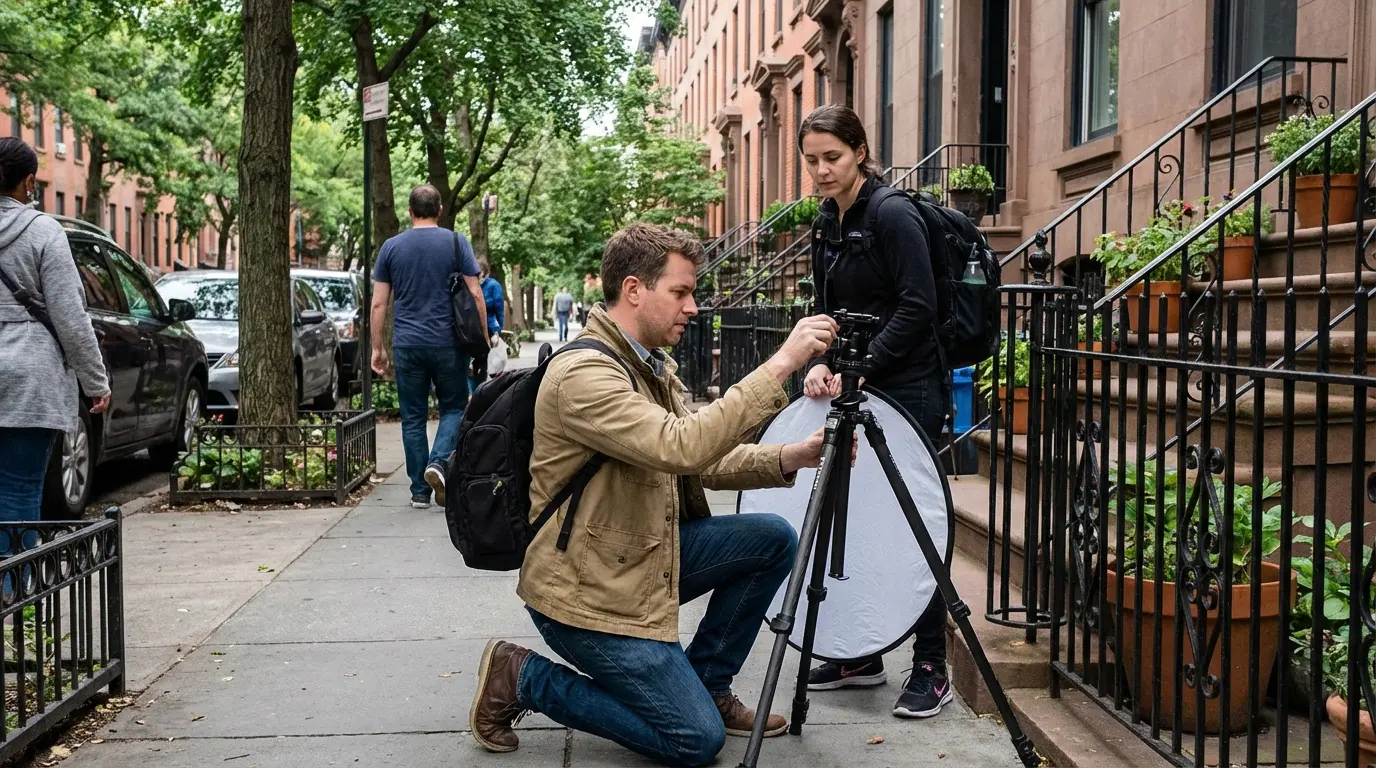
Demonstrates typical setup logistics on Clinton Hill stoops: limited sidewalk space, canopy shade, and the need for compact gear placement.
The stoop setup image shows how compact a crew needs to be: tripod legs tucked toward the building side, a reflector held within the tree-filtered light, and enough clearance left for a pedestrian to walk through without stepping into the street.
Managing weather, wind, and other risks on these streets
Environmental constraints in Clinton Hill are subtle but real, especially when the day does not match the forecast.
- Crowding: Myrtle Avenue and the Pratt gates can suddenly surge with students, shoppers, or bus riders. Weekends might look calmer on a map but can spike with unplanned street activity.
- Wind corridors: The Waverly/Steuben area, where industrial-to-creative buildings face each other across narrow streets, can funnel wind. Light stands and umbrellas are at higher risk here and should be weighted.
- Shelter options: Micro-weather shelters are limited: small awnings along Myrtle, recessed doorways on Waverly/Steuben, and the occasional overhang near building entries. Parks like Underwood offer almost no overhead protection.
Permit-wise, it’s safer to assume less access, not more. Pratt’s interior greens often read as public parkland but are effectively semi-private; brownstone stoops are private; and rooftops on mid-rise residential buildings require explicit management approval. Even small, organized setups in a compact park can draw the attention of staff or neighbors, so staying nimble is usually more feasible than building out large rigs.
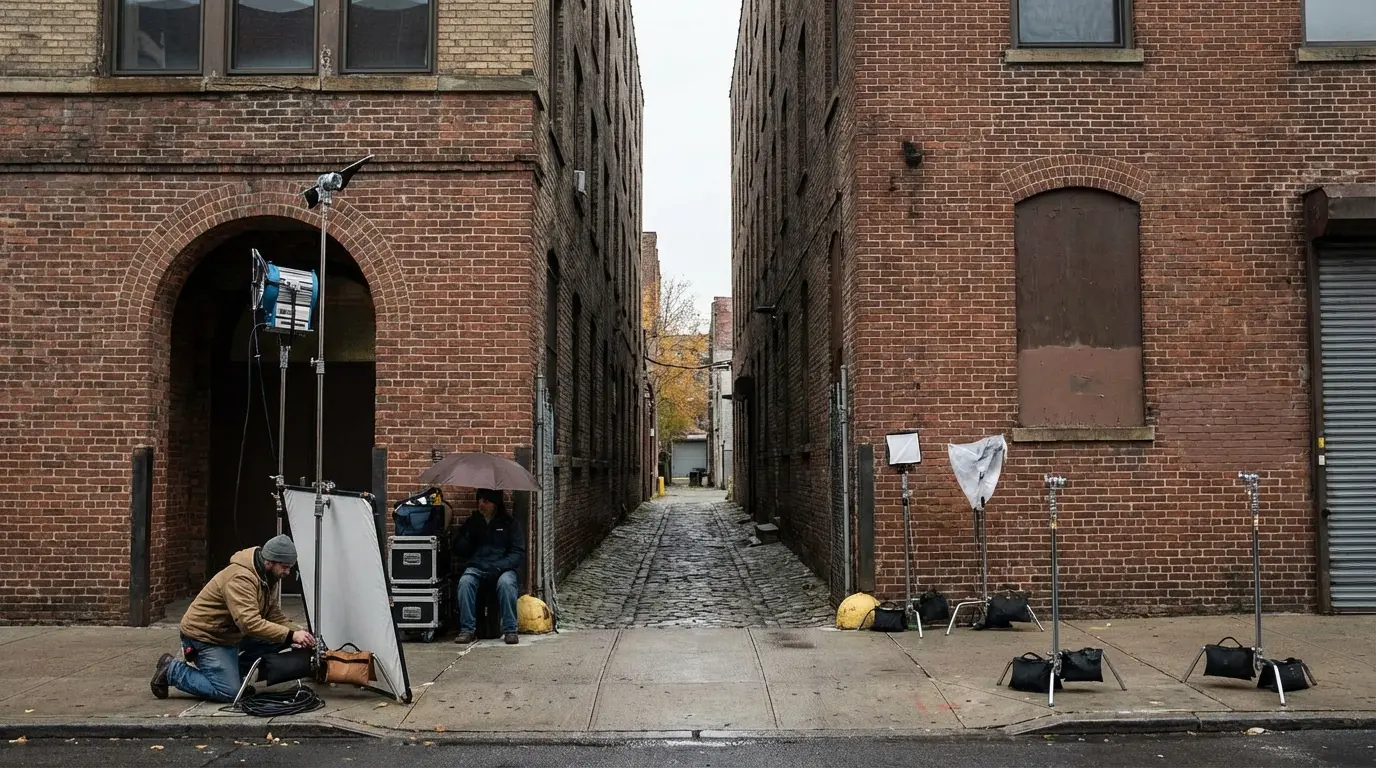
Shows how crews anchor gear and use industrial alcoves or umbrellas for quick shelter and wind mitigation in the Waverly/Steuben area.
The Waverly/Steuben corridor image makes the wind issue obvious: tall brick walls on both sides, a narrowed street, and gear that must be sandbagged. The nearby recessed doorway offers one of the few quick shelters if rain hits mid-shot.
Landmarks that confirm you’re in the right part of Clinton Hill
Couples often orient themselves using a few anchor structures rather than street names:
- St. Joseph’s Co-Cathedral: Its façade and steps define one of the neighborhood’s most recognizable religious landmarks and act as a visual anchor for nearby streets.
- Pratt Institute perimeter: The iron fence, brick buildings, and campus gates instantly signal the Pratt edge, even if you’re technically on a public sidewalk.
- Clinton Avenue historic district: Long, consistent rows of brownstones and mansions give away that you’re firmly within Clinton Hill, not yet in Fort Greene or Bedford-Stuyvesant.
Context from organizations like Clinton Hill – Brooklyn Historical Society underscores why the building stock looks so cohesive along key stretches: much of it falls within historic district guidelines, which affects everything from façade color to the way stoops meet the sidewalk.
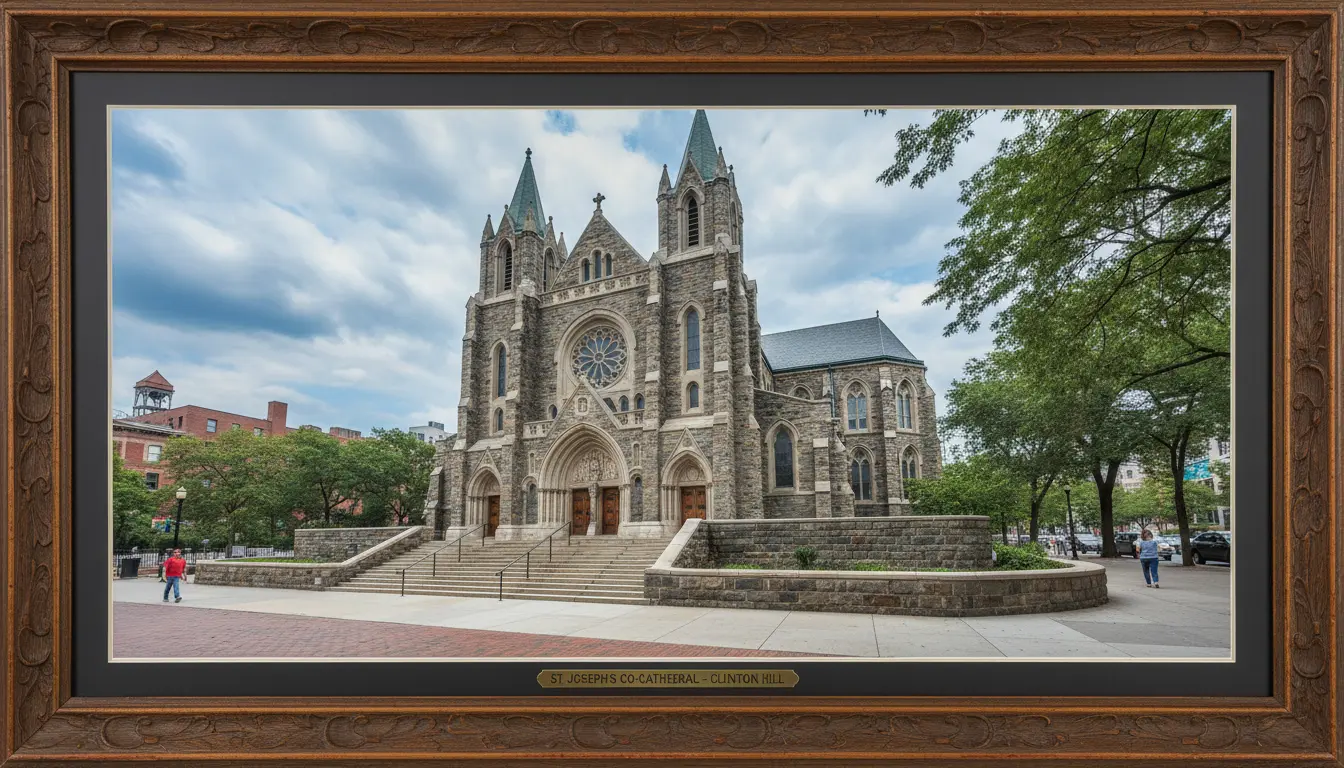
Provides an unmistakable Clinton Hill landmark so buyers can verify the photographer’s local familiarity and mapping accuracy.
This St. Joseph’s Co-Cathedral image verifies both the landmark and its immediate street context: broad steps, a modest setback from the roadway, and enough sidewalk space to stage a couple without spilling into traffic.
How Clinton Hill affects your final images and editing
Clinton Hill’s surfaces and greenery leave a clear fingerprint on finished images. Warm brick, painted brownstone, and dense green canopy often interact to create:
- Warm midtones from brick and stoops, especially in late afternoon.
- Green reflections under trees, which can tint skin tones in shaded areas.
- High contrast pockets where open sky meets dense shadow along campus edges or side streets.
On-site review helps manage expectations—seeing thumbnails in real time shows how the neighborhood is influencing color and contrast before the day is over.

Lets buyers see a realistic on-location review: typical color shifts from brick and canopy light, and the file-review format they can expect during or after a session in Clinton Hill.
The laptop-on-bench scene at Underwood Park shows this clearly: warm brick in the background, green overhead, and a mix of shade and dappled light shaping the thumbnails on screen—all of which informs later color and exposure work.
Everyday quirks: benches, boundaries, and density shifts
Several small, location-specific quirks tend to matter more than they appear on a map:
- Micro-boundaries around Pratt: The campus fence creates a psychological border. Sidewalks outside are public, but anything that looks like a quad or lawn behind the fence reads as private. Security and students treat it that way, so most sessions stay strictly on the street side.
- Myrtle as a mental edge: For many couples, Myrtle feels like the “top” of Clinton Hill. Crossing north of it often feels like leaving the neighborhood, even if the official line is more nuanced.
- Best bench logic: Underwood Park benches get partial afternoon shade, but they’re limited in number; if they’re full, the only other easy seating is low walls or stoop steps (which are usually private). Benches along the Pratt fence line are frequently occupied by students, making them unreliable staging points.
- Street density feel: Clinton Avenue can feel wide and open despite the trees—cars are parked in neat rows, and the canopy is high. By contrast, Myrtle compresses everything: signs overhead, awnings low, people flowing around café tables and storefronts. Classon and Washington fall somewhere in between, with pulses of activity rather than constant flow.
- Micro-weather shelters: On a sudden downpour day, the most realistic covers are Myrtle’s shallow shop awnings, the industrial alcoves on Waverly/Steuben, and the odd recessed entry. Parks and open campus edges offer light and space but almost no rain cover, which affects where couples can wait out a shower.
These “small” factors—where people naturally sit, where they think the neighborhood ends, and which corners feel pinched—often shape Clinton Hill sessions as much as any planned shot list.
Adjacent Neighborhoods we serve near Clinton Hill
FAQ: practical Clinton Hill questions from couples
Which blocks provide the most consistent light for portraits?
Clinton Avenue between roughly Myrtle and Dekalb is the most reliable: tree canopy softens midday sun, and building heights are modest enough that you don’t get sudden, tall-shadow stripes. Dekalb’s cross streets also hold fairly even light in the earlier part of the day.
Are Pratt-area shoots allowed?
Sidewalks along the Pratt fence (on Hall, Willoughby, and Myrtle) are public and commonly used as backdrops with campus buildings in the distance. Stepping through gates onto lawns or interior paths can trigger permission issues, so most sessions stay outside the fence unless you’ve arranged access separately.
How busy does Myrtle Avenue actually get?
Traffic and foot flow rise sharply near storefront clusters and bus stops, especially near Pratt’s main gates. Midday weekdays and early evenings can feel compressed; early morning or later in the evening is calmer, but you’ll still share space with deliveries and local foot traffic.
Where can couples wait out sudden weather in Clinton Hill?
Because parks and campus edges offer almost no cover, practical options are shallow awnings on Myrtle, recessed doorways in the Waverly/Steuben corridor, and occasional overhangs near larger buildings. These aren’t large shelters, but they’re usually enough for two people and a small crew to stay dry while the rain passes.
Can we use brownstone stoops for photos?
The stone steps and landings are private property, so it’s best to treat them as off-limits unless you have explicit permission from the owner. Most sessions work strictly from the sidewalk, framing stoops in the background rather than placing people on them.
What’s the best time of day for Clinton Avenue specifically?
Late afternoon into early evening generally works well: the canopy diffuses sun into softer side-light without plunging the whole block into deep shade. Midday is workable too because of the trees, but you’ll see more dappled patterns on the ground and façades.
Is parking or transit more practical on a wedding day?
For quick portrait stops, ride-hail drop-offs on side streets like Clinton, Washington, or Dekalb are usually smoother than hunting for parking near Myrtle. If people are arriving by subway from other parts of Brooklyn, it’s common to meet on a side street and keep the session within walking distance to avoid re-parking or multiple train transfers.
Will street noise be a problem for video?
On the quieter residential blocks, noise is mostly occasional car passes, distant traffic from the avenues, and normal neighborhood activity. Along Myrtle and parts of Dekalb, expect more frequent buses, delivery trucks, and storefront sound spill, which matters more for any video components than for still photos.
Are small parks like Underwood enough for a full session?
Underwood Park and similar spaces work best as one chapter of a session rather than the whole thing. Their small footprints and limited seating mean you’ll usually pair them with nearby streets—Clinton or Dekalb—to create a more varied set of backgrounds without excessive walking.
Do trees change the look of photos across seasons?
Yes. In full leaf, the canopy adds green reflections and shade patterns that soften light but shift color. In late fall and winter, branches open up more sky, increasing contrast and making façades appear slightly cooler. Planning around that seasonal shift helps match the neighborhood’s look to the couple’s expectations.