
Coney Island in Brooklyn as a Real-World Wedding Photography Setting
Understanding Coney Island’s Position on the Brooklyn Coast
Coney Island sits at the southern edge of Brooklyn, pressed between the Atlantic shoreline and a set of low- to mid-rise inland blocks that tie back toward Gravesend and the rest of southern Brooklyn. For wedding and event sessions, it functions as a compact triangle: beach and Riegelmann Boardwalk on the south, Surf Avenue as the commercial and transit spine just north of that, and quieter residential streets stepping further inland.
Public references like Coney Island, Brooklyn – Wikipedia place the neighborhood between private Sea Gate at the far western tip and the continuous waterfront that runs toward Brighton Beach in the east. Practically, that means the amusement core, ballpark, and subway terminal are clustered around the central-west side, while the feel changes noticeably as you move east toward Brighton Beach or inland toward areas that eventually transition toward Gravesend.
Sea Gate is a hard stop for most shoots: it is a gated community at the western end, so sessions usually stay east of that line, using the public boardwalk and beach segments that wrap around the amusement parks. Inland, the street grid channels toward Stillwell Avenue and, beyond that, to main roads that connect back toward neighborhoods like Gravesend, where many couples or staff may be arriving from by car.
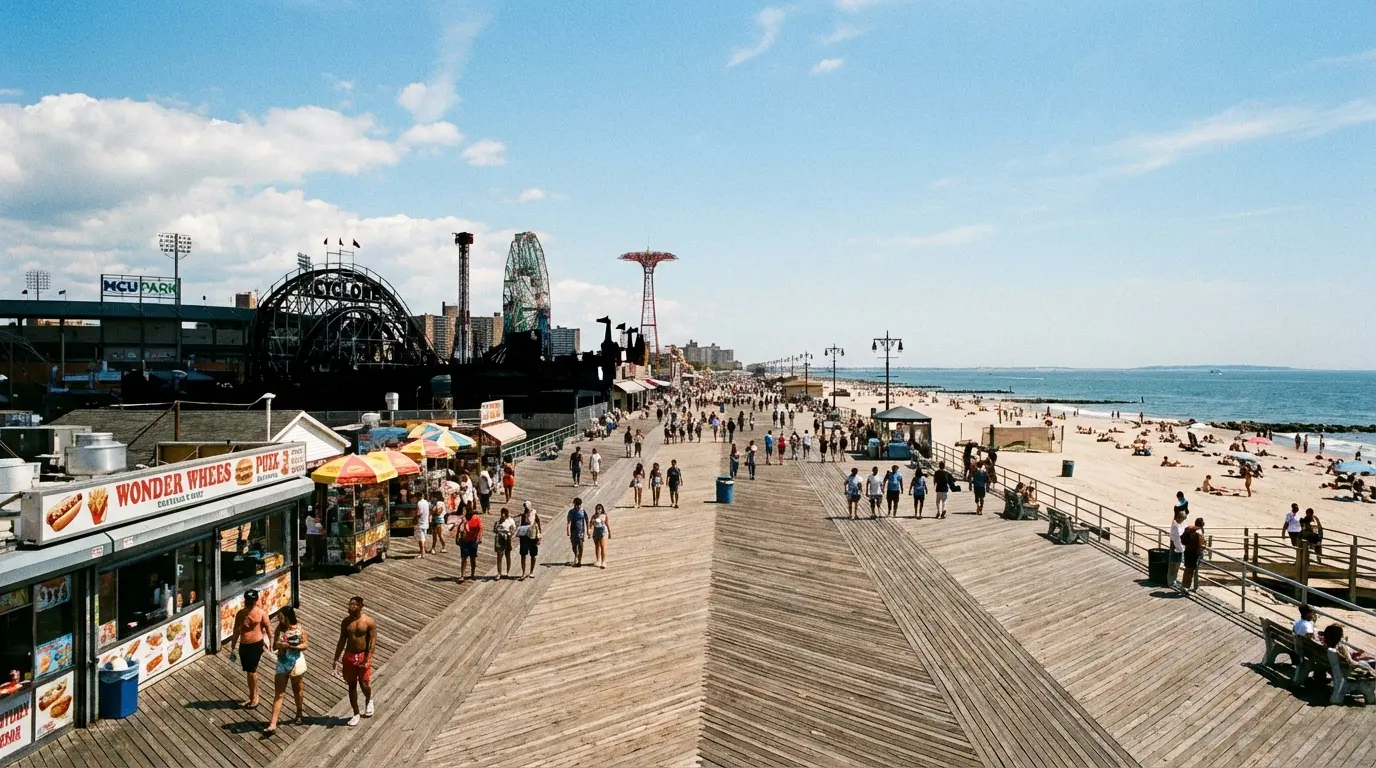
Identifies the boardwalk–beach relationship and the ride-dominated skyline; useful to verify open-horizon light and ride shadow patterns on the boardwalk.
This image confirms how the rides sit just inland from the wooden planks while the ocean horizon remains fully open, illustrating the strong contrast bands created by ride shadows crossing the boardwalk during the day.
Stillwell Avenue as the Main Gateway
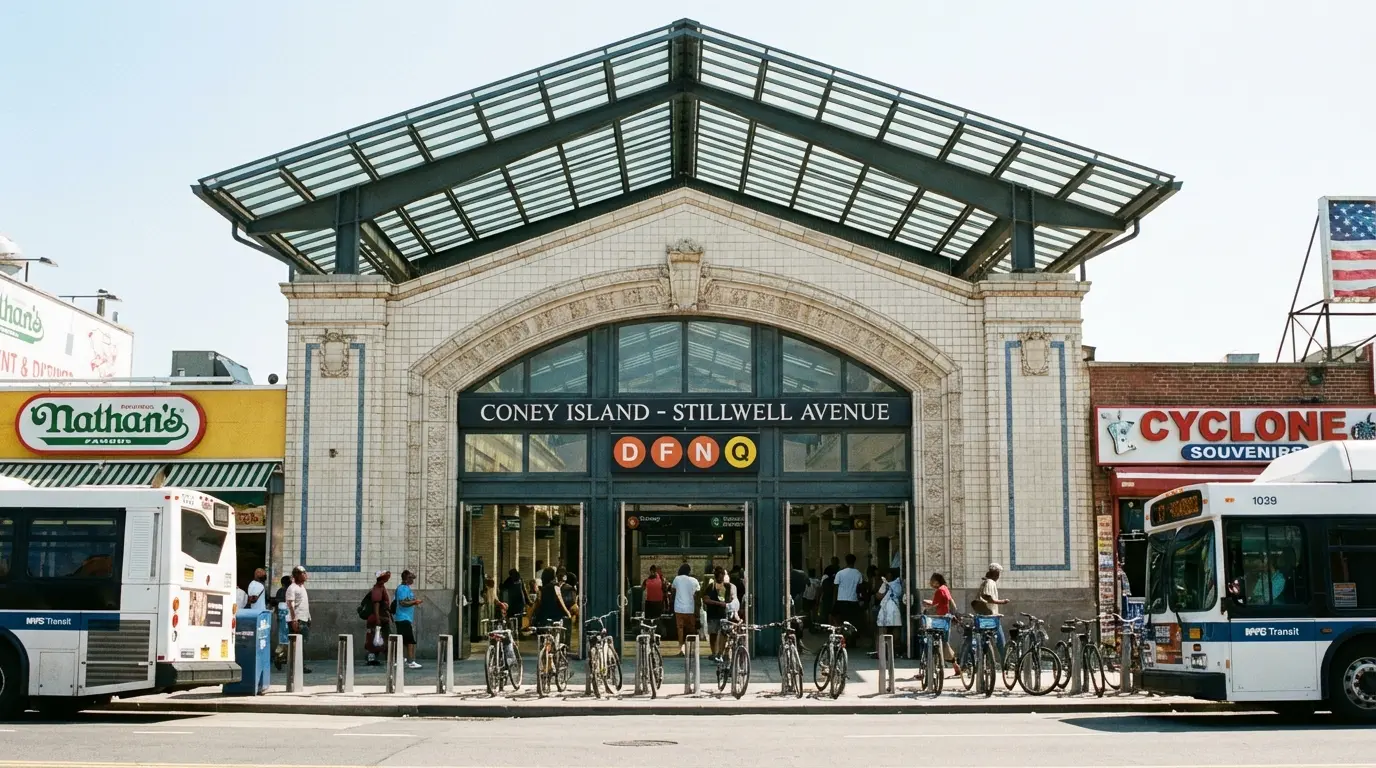
Most wedding parties, crews, and guests arrive via the Stillwell Avenue subway terminal, which empties directly onto Surf Avenue and the amusement-zone core. Multiple lines terminate here, so pedestrian flow is heavy and constant, especially on weekends and in summer.
The terminal and the adjacent blocks sit in a noticeable “subway rumble zone.” Trains entering and idling at Stillwell emit low-frequency vibration that is very audible on nearby corners, particularly around Surf Avenue intersections. For photography, that means ambient noise levels are high near the terminal, even when crowd density briefly dips.
Confirms the Stillwell Avenue transit hub and the Surf Avenue streetscape that most people pass through on the way to beach or boardwalk sessions.
This view verifies the direct relationship between the terminal entrance, bus stops, and the Surf Avenue corridor, which is usually the starting point for moving couples and gear toward the boardwalk.
Moving Between Surf Avenue, the Boardwalk, and Side Streets
From Stillwell, movement to shoot locations follows a few predictable paths:
- North–south: Short cross streets run from Surf Avenue down to Riegelmann Boardwalk. These form the main funnels for couples and crews heading to the beach or amusement backdrops.
- Surf Avenue itself: Acts as the vehicular and commercial spine, with food stands, arcades, and deliveries. Trucks and ride maintenance vehicles often double-park here, affecting timing when moving equipment.
- Boardwalk corridor: Riegelmann Boardwalk is a pedestrian-only band parallel to the water. It ranges from crowded and noisy near Luna Park to relatively calmer stretches as you move east.
A key “street-by-street shift” happens between cross streets like West 5th, West 10th, and West 12th. West 10th, near the heart of the rides, feels visually busy and acoustically loud; just a few blocks east or west, low-rise residential facades and smaller corner shops reduce the intensity noticeably. That shift is often where couples step off the main flow for a few quieter frames.
Community boards and sun-faded flyers mounted on posts near Surf Avenue bus stops hint at hyperlocal events, housing notices, and seasonal jobs. These boards provide subtle texture in the background but also signal that you are still in a lived-in neighborhood, not a closed resort zone.
Where Wedding and Session Shoots Typically Happen Here
For couples planning Wedding Photography in Coney Island, sessions usually combine three types of locations:
- Quieter beach segments: Moving east from the amusement core, the sand widens and the density of vendors drops. Dunes and beach grass create softer foregrounds, while the skyline of rides recedes into the distance.
- Boardwalk edges: The outer railing side of the boardwalk, away from the densest kiosks, offers recognizably “Coney Island” wood texture without being swallowed by crowds.
- Residential side streets: A block or two north of Surf Avenue, side streets shift to low-rise housing and parked cars. These are often used for calmer, more private portraits between high-energy boardwalk moments.
Access to the sand is controlled by staircases and ramps at regular intervals along the boardwalk. Some of these access points sit adjacent to lifeguard zones and clearly posted park rules. The official description at Coney Island Beach – NYC Parks reflects this reality: designated swimming areas, lifeguard coverage, and seasonal operating periods that can affect exactly where on the beach a session can reasonably unfold.
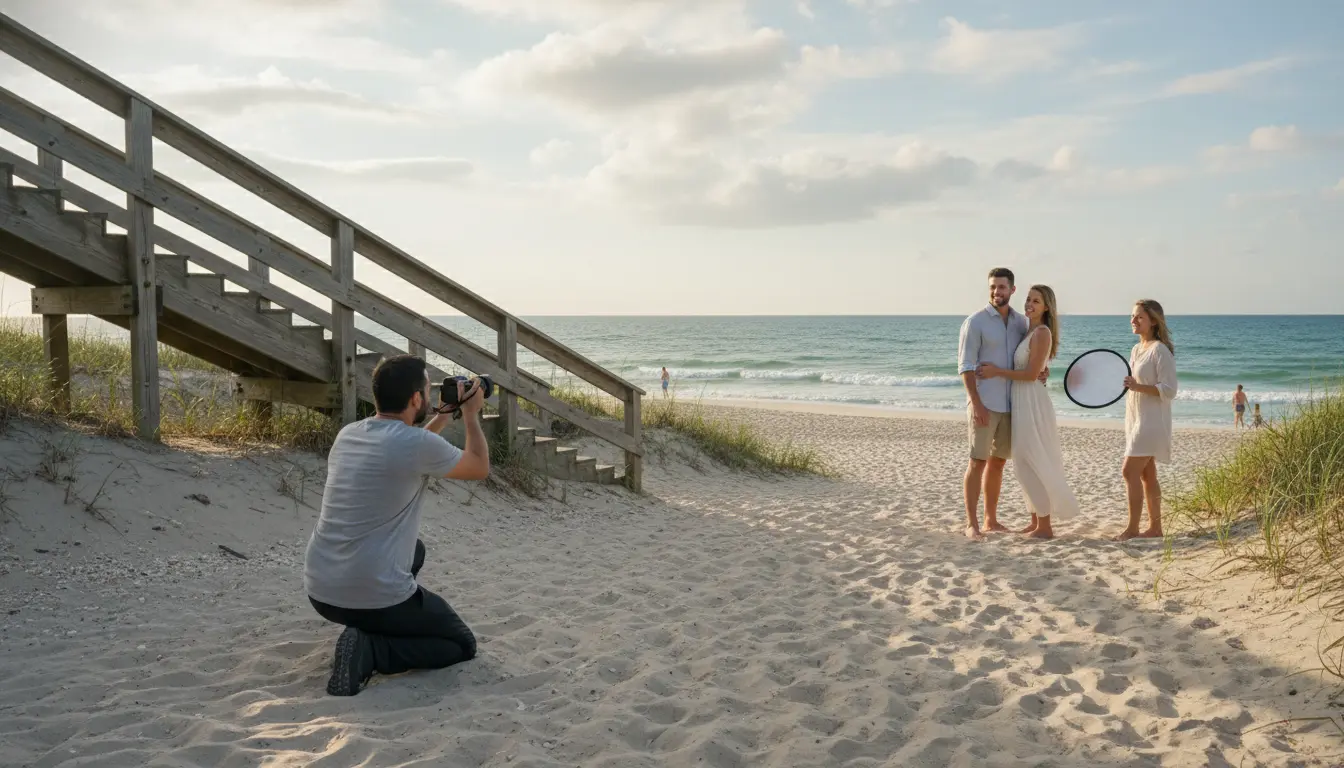
Shows a realistic beach access point where wedding sessions occur, with stairs, dune grass, and moderate background activity.
This image verifies that many couples are photographed not in the densest part of the crowd, but at intermediate access points where the sand is open, background structures are scaled back, and there is still a clear line-of-sight to the shoreline.
Comparing Busy Amusement Zones and Quieter Residential Blocks
Within just a few blocks, Coney Island shifts from amusement core to calmer residential corridors:
- Amusement zone core (Stillwell to roughly West 10th): Luna Park rides, Steeplechase Plaza, and nearby food stands stack vertically against the sky. Sound from rides, PA systems, and crowds bounces between structures, creating a constant hum. Shoots here are about embracing motion and background activity rather than isolating the couple.
- Western residential corridor (toward West 24th): Moving west from the amusement core toward Sea Gate, building heights drop and density thins. Side streets here feature more consistent brick and siding facades, stoops, and parked cars. It feels more like a typical Brooklyn residential block with the ocean just a short walk away.
- Eastern transition toward Brighton Beach: As you go east along the boardwalk, amusements fall away and the environment gradually aligns more with continuous apartment towers and waterfront housing that lead toward Brighton Beach. Couples who want fewer ride silhouettes but still want a boardwalk-and-water feel often favor this stretch.
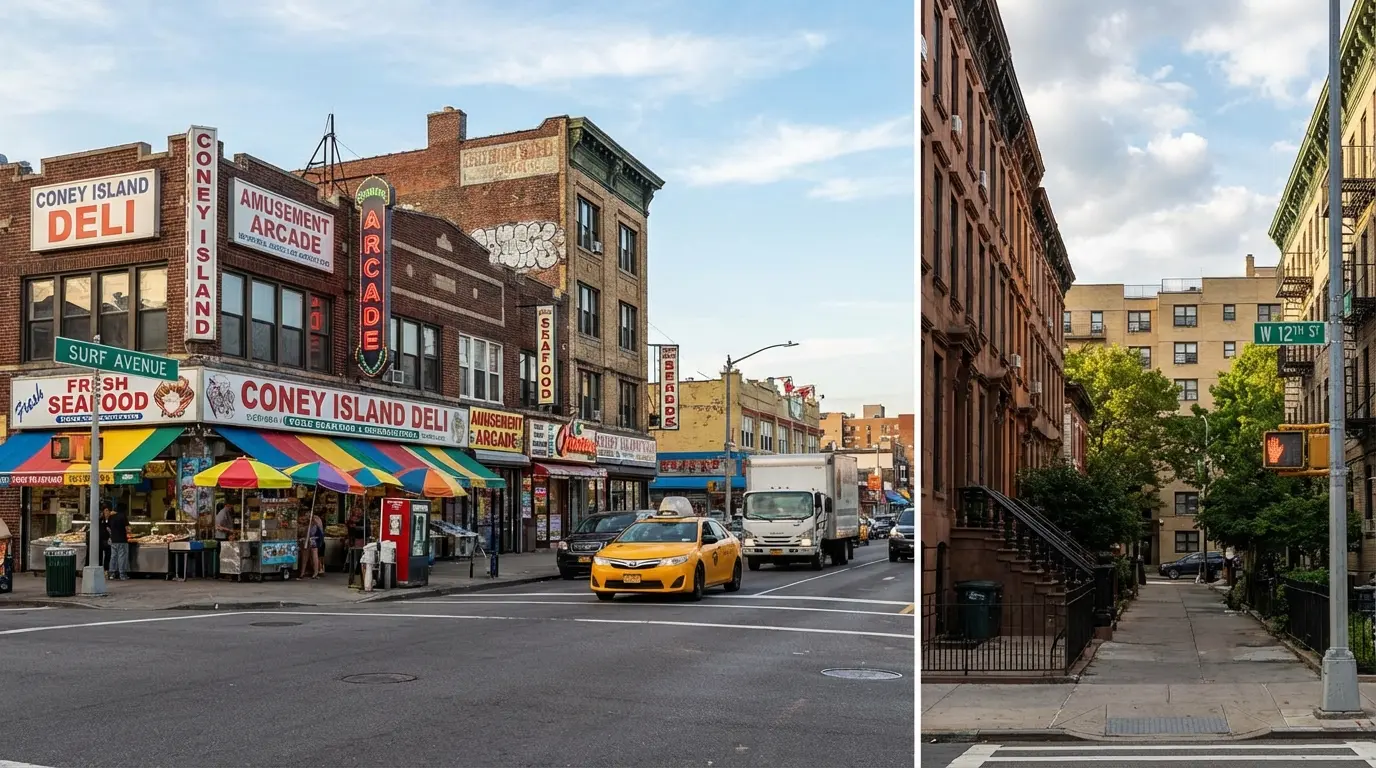
Contrasts Surf Avenue’s commercial activity with a quieter cross street and shows a community bulletin board as a local detail.
The photo confirms how a turn off Surf Avenue immediately lowers noise and crowd density, while the bulletin board captures one of the “community board” style elements that often appear at corners and bus stops.
How we serve Coney Island through Wedding photographer
Practical Logistics: Getting Gear from Street to Sand
Coney Island’s built environment introduces specific logistical steps between vehicle drop-off and shoot location:
- Limited direct beachfront access for vehicles: Trucks and cars generally stop along Surf Avenue or adjacent side streets. From there, crews move equipment by hand or cart through cross streets, then onto the boardwalk via ramps or stairs.
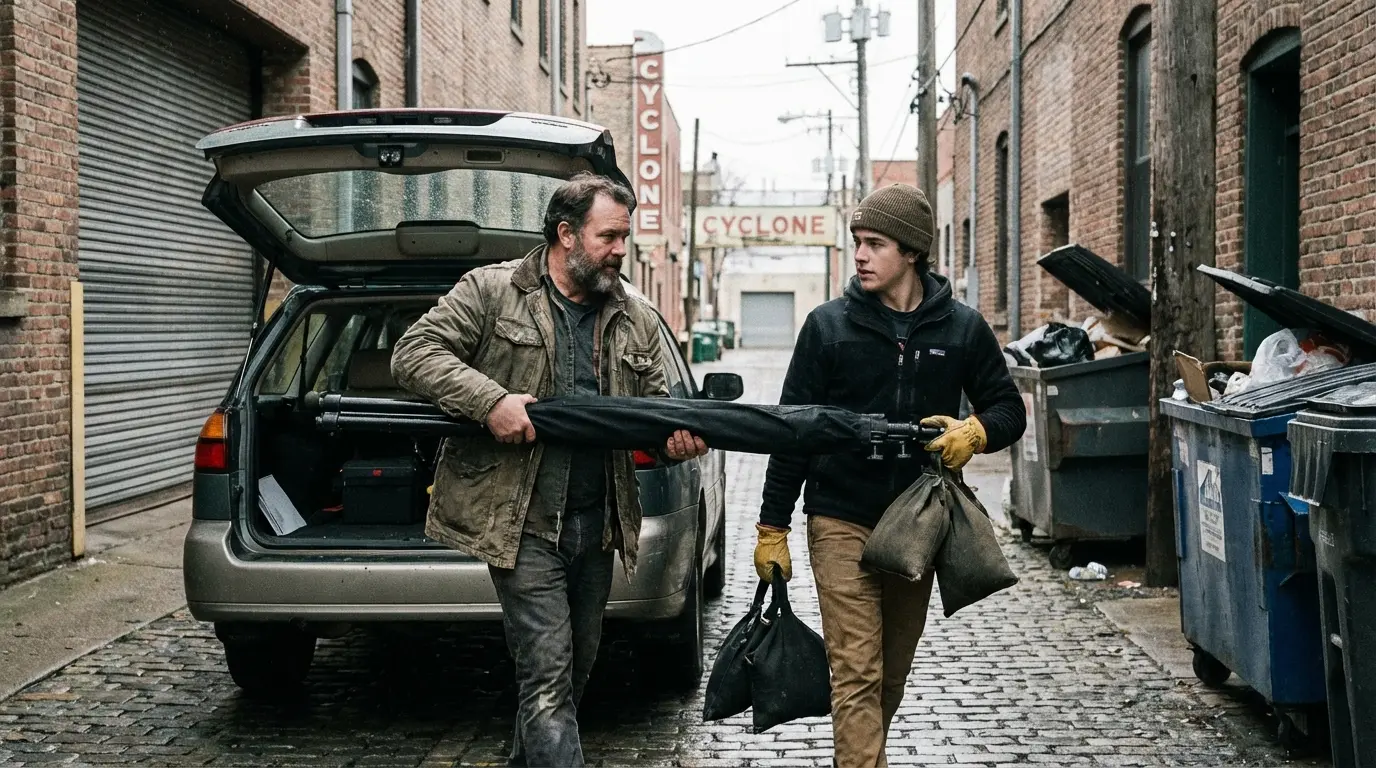
- Service lanes behind Surf Avenue: Narrow, often overlooked service alleys sit behind some Surf Avenue businesses. These spaces are active delivery corridors, with loading doors, dumpsters, and carts in motion. They can double as staging areas when sidewalk space in front is too congested, but they are shared with restaurant and vendor operations.
- Wind and sand considerations: Any gear that ends up on the beach needs sandbagging or similar stabilization. Light stands, reflectors, and decor are exposed to stronger gusts than on inland streets.
Shows equipment being moved through a back service lane and stabilized with sandbags before heading onto the beach.
This confirms the presence of alley and service lanes behind Surf Avenue storefronts and illustrates the practical step of anchoring stands against Coney Island’s coastal wind before committing to a beach setup.
Seasonal Rules, Wind, and Other On-Site Constraints
Because Coney Island is a public waterfront with layered jurisdictions, several constraints typically shape wedding and event shoots:
- Crowd cycles: From late spring through early fall, weekend afternoons on the boardwalk and near Luna Park are heavily congested. It can be difficult to hold a static position without foot traffic crossing through frames.
- Lifeguard and flag zones: Lifeguard towers and flagged swim areas carve up the beach. Certain portions are actively managed, and temporary barricades or marked access paths appear during peak season.
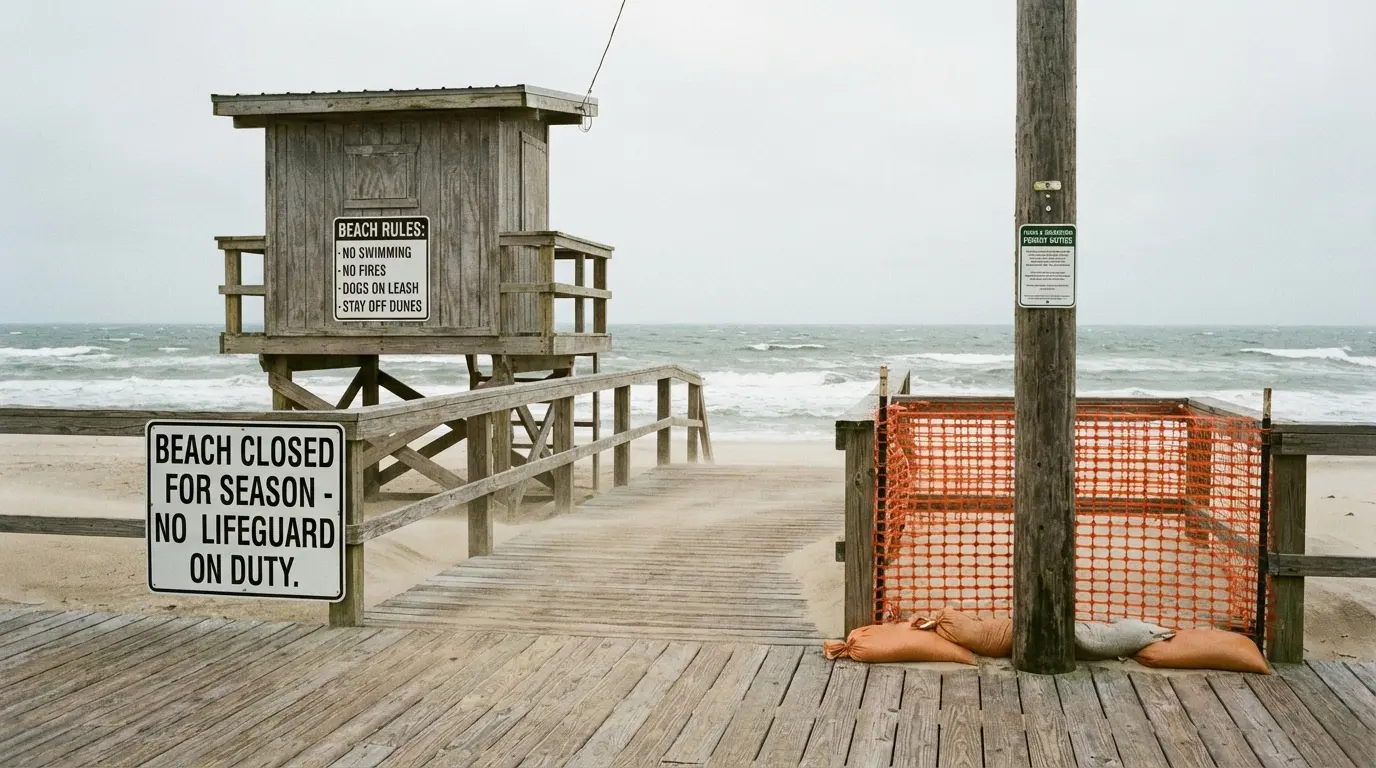
- Posted rules and potential permit requirements: Laminate notices on posts along the boardwalk and near access points outline rules for commercial activity and gatherings. Larger-scale setups, or anything that looks like a production, may require coordination with the relevant city agency.
- Sand and wind: On gusty days, sand is blown across the boardwalk itself, not just the beach. That affects footwear, equipment, and comfort for dressed-up couples.
Highlights lifeguard infrastructure, posted notices, and wind-driven sand on and near the boardwalk.
This photo verifies that seasonal signage, temporary barriers, and blowing sand are normal conditions, not edge cases, and that they directly influence where and how couples can stand or move during a session.
How Light Behaves on the Beach, Boardwalk, and Under the Rides
Coney Island’s southern exposure and open water create a specific light pattern that differs from inland Brooklyn:
- Morning: With the sun rising over the Atlantic, low-angle light hits the beach and boardwalk from the east. The horizon is unobstructed, so even early in the day, the sand and water kick back a lot of reflected light, filling in shadows under eyes and chins but also increasing overall brightness.
- Midday: Light becomes high and harsh, especially over the open beach. The white sand and water act like large reflectors, while the dark structures of rides and boardwalk kiosks punch deep shadows into the scene.
- Afternoon: As the sun swings west, amusement rides cast elongated, irregular shadows across sections of the boardwalk and Surf Avenue. Standing under or near tall structures can flip quickly from direct sun to deep shade with small position changes.
- Winter vs. summer: In winter, the sun tracks lower and sets earlier, so long shadows from rides fall across the boardwalk sooner in the afternoon. In summer, there is a longer window of bright conditions but often with strong glare from water and sand, particularly for south-facing frames.
These light behaviors are why the same boardwalk bench can look radically different in photographs taken an hour apart, especially when combined with moving clouds and constantly shifting pedestrian traffic.
What Finished Coney Island Wedding Images Usually Look Like
Finished images from Coney Island rarely resemble isolated studio work. Even when framed tightly, background elements typically include:
- Boardwalk planks with linear texture leading toward the horizon.
- Ride silhouettes, lattice supports, or signage partially in frame.
- Ambient bystanders or distant beachgoers, slightly blurred by depth of field.
- Specular highlights from the waterline or from bright sand.
Couples who choose Coney Island usually expect some of this environmental reality in their images: a mix of seaside openness and amusement-park structure, rather than a perfectly empty beach.
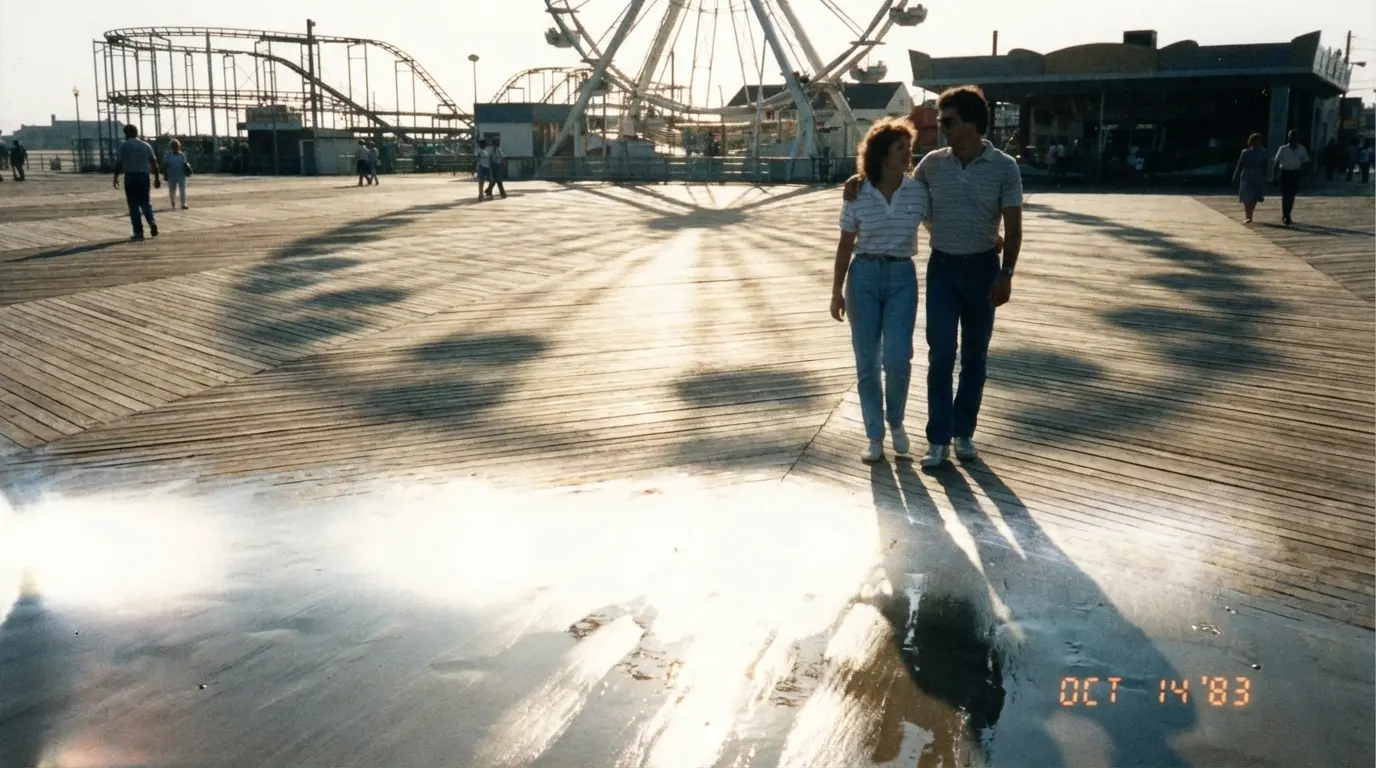
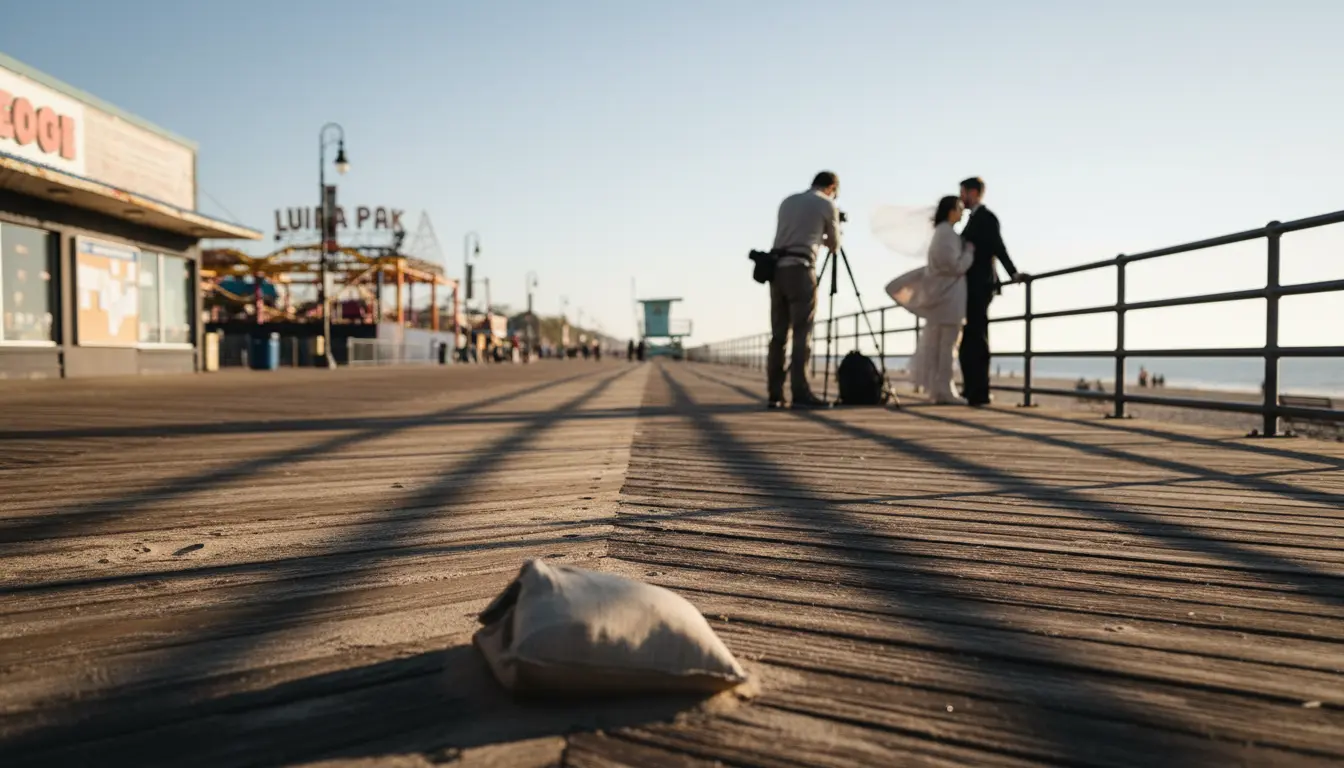
Shows a realistic boardwalk wedding image with ride shadows and seaside reflections rather than a fully isolated background.
This confirms how ride shadows cut across the couple’s feet and the planks, while distant pedestrians and water reflections still register in the frame, illustrating the typical level of environmental detail in final Coney Island images.
Local Chaos Factors to Expect Around Shoots
Several hyperlocal “messy” factors can affect timing and positioning on a wedding or event day:
- Subway rumble zones: Around the Stillwell terminal and along certain elevated track segments, low-frequency noise can interfere with quiet moments or audio if there is any video component.
- Alley and service-lane traffic: Behind Surf Avenue storefronts, service lanes can be unexpectedly busy with deliveries, grease-trap maintenance, and trash collection. These are functional spaces first; photographic use must adapt around their schedules.
- Street-by-street micro-shifts: Turning from West 12th to West 5th or West 8th can mean the difference between shoulder-to-shoulder foot traffic and a nearly empty block with a single deli and a line of parked cars. Planning often hinges on these specific cross streets rather than on the neighborhood name alone.
- Community boards and ad-hoc postings: Bulletin poles and informal noticeboards, especially near bus stops and subway entrances, accumulate layers of taped flyers over the season. They can either lend a gritty, local layer to images or require re-framing if they conflict with a couple’s aesthetic.
These factors do not prevent successful sessions, but they do make Coney Island a place where a block or even a half-block of movement can meaningfully change the usable environment.
Neighboring Areas in Brooklyn
Common Questions About Coney Island Wedding Shoots
When is the boardwalk quieter for wedding photos?
Early mornings outside of peak summer weekends are typically the calmest, especially east of the main amusement cluster. Even then, vendors setting up and joggers using the boardwalk mean it is rarely empty, but movement is more predictable.
How much does wind actually affect sessions here?
Wind is a constant factor on the open beach and can be strong enough to move sand and topple unweighted stands. On the boardwalk, nearby buildings and rides provide partial shielding, but gusts still funnel down side streets and open gaps.
Are there truly private spots on the beach or boardwalk?
Fully private areas are rare because the beach and boardwalk are public, and amusement areas are privately controlled with their own access rules. More “private-feeling” spots do exist on quieter beach segments or inland side streets a few blocks from Surf Avenue, but they remain within public view.
How do guests typically reach a Coney Island ceremony or session?
Many arrive by subway to Stillwell Avenue due to the terminal’s multiple lines and clear signage, while others drive and park farther inland toward Gravesend or along side streets north of Surf Avenue. From there, they walk down cross streets to the boardwalk or event spaces.
Does beach access change over the year?
Yes. During the main season, lifeguard zones, flagged swim areas, and temporary barricades direct where people can enter the water or cross the sand. Off-season, some access points may feel more open but can be affected by maintenance work and rougher weather.
How noisy are the rides and games during a ceremony or shoot?
Near Luna Park and the amusement core, ride operators’ announcements, music, and screaming riders are clearly audible. Sound levels drop noticeably within a few cross streets, so ceremonies or portraits planned away from the rides experience less constant noise.
Are permits always required for wedding photos on the boardwalk or beach?
Small, lightly equipped sessions that look like personal use may proceed without issue, but larger setups, productions, or anything involving stands, lighting rigs, or blocking of pathways may trigger permit requirements. Posted notices on-site outline rules, and it is wise to treat any production-scale plan as subject to coordination.
What happens if the weather changes quickly on the day?
Coney Island’s open exposure means light and wind can shift fast, especially with passing cloud cover. Alternate spots under rides, near the ballpark structures, or on more sheltered inland blocks are commonly used as backup locations when beach conditions become uncomfortable or unsafe.