
Crown Heights in Brooklyn as a setting for wedding photography sessions
Where Crown Heights Sits and How the Edges Function
Crown Heights runs across central Brooklyn on a gentle east–west axis, with Eastern Parkway acting as its organizing spine. To the west, the neighborhood transitions into Prospect Heights around the parkway and museum area; to the north, the feel shifts toward Bedford-Stuyvesant as you cross Atlantic Avenue or move off Park Place. East of Utica Avenue, blocks stretch out and gradually read more like Brownsville and eastern Brooklyn.
Official descriptions of Crown Heights, Brooklyn emphasize the same anchors—Eastern Parkway, major north–south avenues, and residential side streets—so when couples describe “Crown Heights brownstones” or “near Brower Park,” they are usually referring to this central band between Atlantic Avenue and Empire Boulevard.
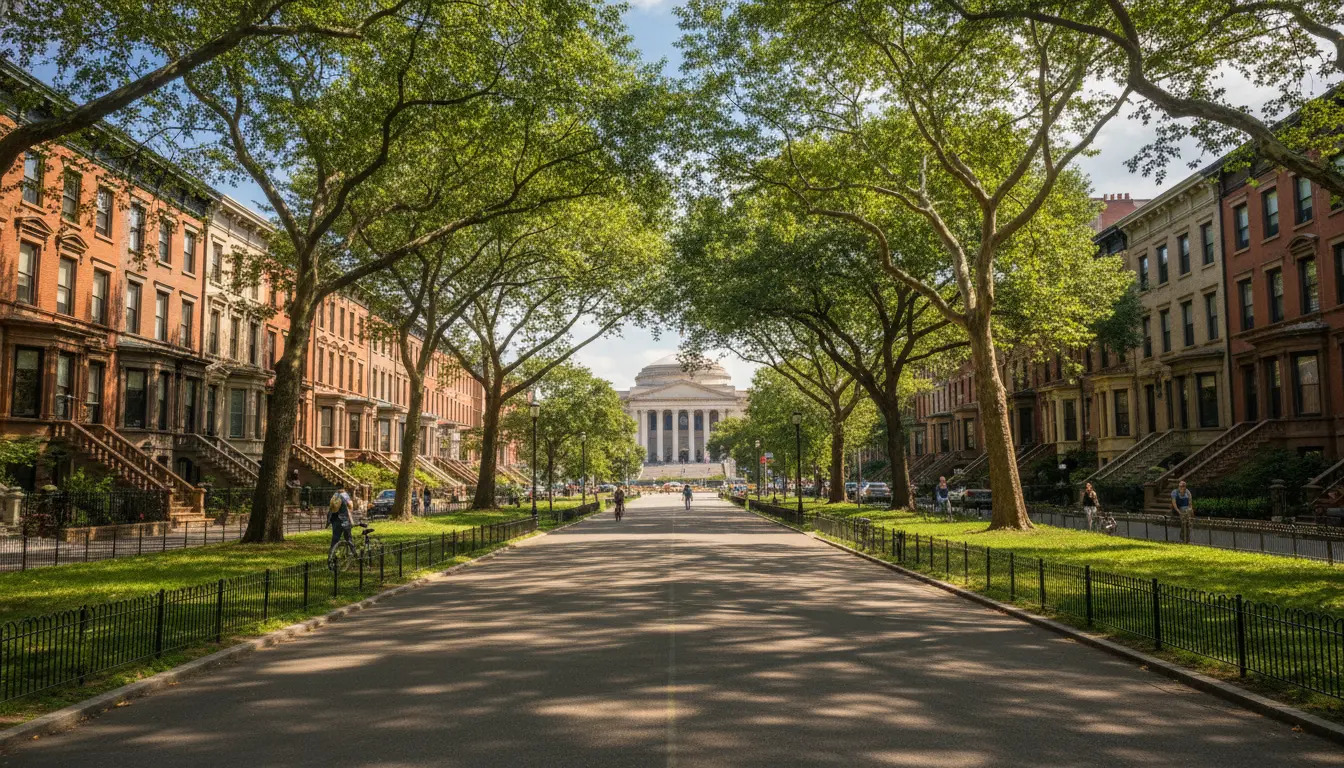
Shows Eastern Parkway’s wide median, tree shadows, and adjacent brownstones so a buyer can verify the primary east–west spine and typical light/shade patterns.
This image confirms how wide Eastern Parkway actually is, with its tree-lined malls, long shadows, and brownstones set back from the traffic lanes. It also verifies the amount of sky exposure and how trees and taller buildings create alternating bands of light and shade that directly affect session timing.
Moving Through Crown Heights: Trains, Avenues, and Timing
Mobility in Crown Heights is structured around a few predictable lines. The 2/3/4/5 subway lines concentrate people at Franklin Avenue, Kingston, and Utica stations; these corners get noticeably busier at commute and school-release hours, which matters if you’re hoping for quieter frames right outside a station.
North–south, Franklin Avenue and Nostrand Avenue carry most of the commercial activity, but sidewalks are narrow and curb space is tight. Deliveries, ride-share pickups, and informal double-parking on these strips can squeeze the usable space for any on-street setup. Rogers Avenue’s one-way southbound traffic changes how easily cars can pull up and drop off near a session, especially if you’re trying to coordinate multiple arrivals.
East–west, Eastern Parkway stays relatively predictable, but its openness makes it more exposed to wind and weather shifts than the brownstone side streets. In contrast, deeper residential blocks like Park Place, St. Marks Avenue, and Dean Street feel sheltered; stoop overhangs and shallow building recesses become informal micro-weather shelters when a sudden rain cell passes through.
Streets, Parks, and Micro-Areas People Actually Use for Photos
Within Crown Heights, several micro-zones show up repeatedly in session planning:
-
Western Crown Heights, near the Brooklyn Museum border: Here, Eastern Parkway’s setback and open sky give more breathing room than the tighter interior blocks. The parkway malls provide greenery without having to enter a full park, while the nearby institutional buildings can cast long, even shadows across the sidewalks.
-
Central brownstone belts (St. Marks Ave, Park Place, Dean Street): These are the “classic Crown Heights” blocks—rows of close-set brownstones, shallow front yards, and active stoops. Sidewalks are narrow, so positioning is more about angling along the block than backing far away. Evening stoop culture—neighbors sitting, kids on scooters—can be a feature or a distraction, depending on how much background activity you’re comfortable with.
-
Eastern blocks near Utica Avenue: The building spacing opens up, intersections widen, and there’s generally more sky. This can help when you want cleaner backgrounds and slightly less pressure from foot traffic, though bus routes and wider crossings still bring movement through the frame.
Green pockets like Brower Park and the Eastern Parkway malls function as relief valves from the street grid. Brower Park is especially useful around its perimeter paths, where the tree canopy softens midday sun while nearby benches and play areas remind you that this is an everyday community park, not a secluded garden.
How Light Behaves on Crown Heights Blocks
Light in Crown Heights is shaped by the long east–west run of Eastern Parkway and the vertical walls of brownstones just south and north of it.
On the brownstone side streets, morning sun tends to skim over the tops of facades, leaving stoops in deep shadow until later in the morning. By late afternoon, light threads directly across the street, catching upper stoop levels while lower steps and entryways stay cooler and darker. This contrast is noticeable in finished images: faces can be well-lit while doorways behind them fall off into shade.
Along Eastern Parkway, the wide corridor brings strong directional light from both east and west. Tall trees and apartment buildings on either side throw long, dappled shadows onto the malls. At certain times, especially near golden hour, that mix produces alternating bright and shaded patches every few steps, so simply moving five meters can change the exposure.
On Franklin Avenue, a mix of older brick buildings and newer glass storefronts creates reflective “hot spots.” Glass and light-colored façades can bounce late-afternoon sun back onto the sidewalk, which is helpful on overcast days but can produce unexpected flare in lenses on clear ones. Rogers Avenue, with its longer east-facing storefront runs, can form morning glare zones—particularly on clear days when the low sun lines up with the avenue.
After dark, lighting interior glow from restaurants and bars on Franklin and Nostrand spills onto the sidewalks. That warm window light acts like a natural softbox, adding amber tones to faces while the street behind falls cooler and darker. This can be useful for end-of-day portraits that still clearly read as Crown Heights, thanks to recognizable storefronts and stoops in the background.
Crowds, Permissions, and Weather Limits to Plan Around
Crown Heights is busy, but the intensity varies by corridor and time:
- Franklin Avenue fills up from late afternoon into the night, especially Thursdays through Sundays. Sidewalks here demand nimble setups and quick adjustments as people pass through.
- Eastern Parkway hosts runners, dog walkers, and commuters at morning and evening peaks. The central malls can feel almost empty mid-morning on weekdays, then considerably busier at the end of the workday.
- Brower Park is usually calm on weekday mornings, but after-school hours and weekends draw families, school groups, and pickup games, especially around the playground and open lawns.
As a public park, Brower follows standard NYC Parks expectations. The city lists it as Brower Park – NYC Parks, and any structured or larger-scale setups there may draw attention from Parks personnel. That doesn’t automatically mean you need a permit for a small, low-impact session, but it is important to avoid blocking paths, playground access, or park features.
Private stoops are typically controlled by the residents of each building. Even where stoop culture is friendly and people linger on their front steps, it’s not safe to assume access for posed photos without clear permission. Rooftops, meanwhile, are tightly controlled by building management across Crown Heights; using them responsibly means coordinating with whoever manages the property and understanding that restrictions are common.
Wind and sudden showers are another factor. Eastern Parkway’s long open run can channel gusts strong enough to shift stands or veils, while the tighter brownstone rows across the neighborhood create sharp temperature drops the moment you step into shade. Micro-weather shelters—under stoop overhangs, small recessed building entries, or café awnings—often become quick regroup points during passing drizzle.
Where Wedding Photography Fits into Everyday Crown Heights
Crown Heights functions less like a “destination” backdrop and more like a lived-in environment that couples and families already move through. For local couples considering Wedding Photography in the neighborhood, the appeal is usually about familiarity with these specific streets and the way they look in real daylight.
- Brownstone-lined blocks around Park Place, St. Marks, and Dean Street are well-suited for intimate portraits or small groups. The repeating stoop patterns help create a consistent visual language, even as people come and go on their own steps.
- Eastern Parkway works for motion-friendly frames—walking sequences along the malls, or wider shots that include the full breadth of the roadway, trees, and benches without feeling like you’re in a closed park.
- Small café and storefront edges on Franklin and Nostrand often host quick pre- or post-ceremony portraits, especially when interior window light adds that warm glow to faces at dusk.
- Brower Park offers greenery while still reading as a neighborhood park: people on benches, kids crossing the background, and bikes cutting through. The park-edge paths are especially useful when you want trees and grass without getting deep into weekend crowds.
For families or individuals, the same locations double as realistic backdrops for portraits that register instantly as “Crown Heights” to anyone who lives nearby.
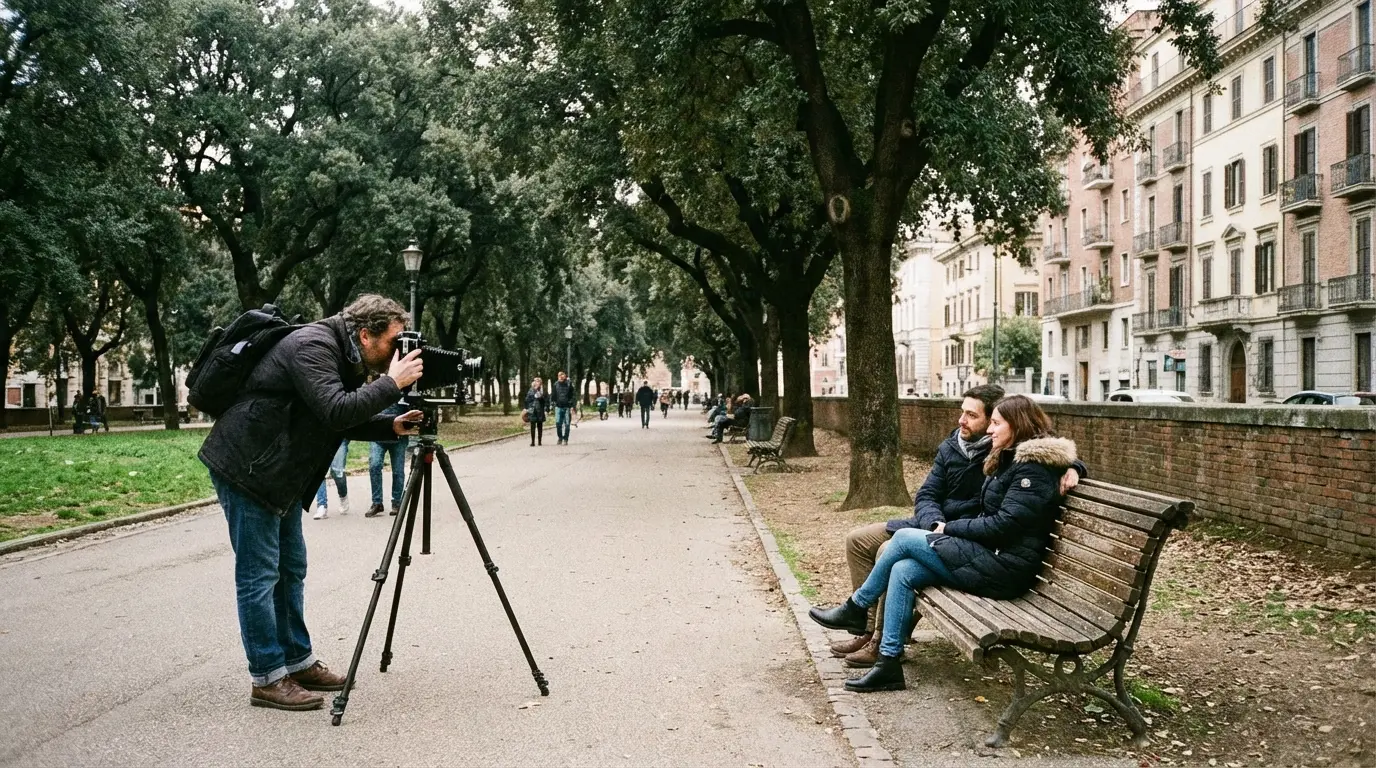
Illustrates a realistic park-edge portrait session in Crown Heights, showing usable park areas, nearby foot traffic, and canopy shade for buyer evaluation.
This photograph confirms what a park-edge setup at Brower Park actually looks like: mixed sun and shade from the canopy, passers-by visible but not overwhelming, and enough space for a small reflector or light without blocking paths.
Wedding Photography Services in Crown Heights
Comparing Commercial Strips and Quieter Blocks for Sessions
Choosing between a commercial corridor and a quieter side street in Crown Heights affects both the look and the logistics of a session.
On Nostrand Avenue and Franklin Avenue, you get visual energy—shopfronts, signage, people moving in and out of businesses—but you also get narrow sidewalks and frequent interruptions. Delivery vans often stand in bus lanes or double-park, pushing pedestrians closer to any camera setup. Street noise is constant, and it’s common to pause mid-sequence so someone can pass through the frame.
On residential brownstone blocks, activity is softer but still present. Neighbors sit on stoops, kids play in front yards, and people wheel strollers past. These blocks offer more privacy than a commercial strip, but stoop culture means you’re rarely truly alone on the street. Late afternoon is usually when stoops feel most active, with conversations and music spilling onto the sidewalk.
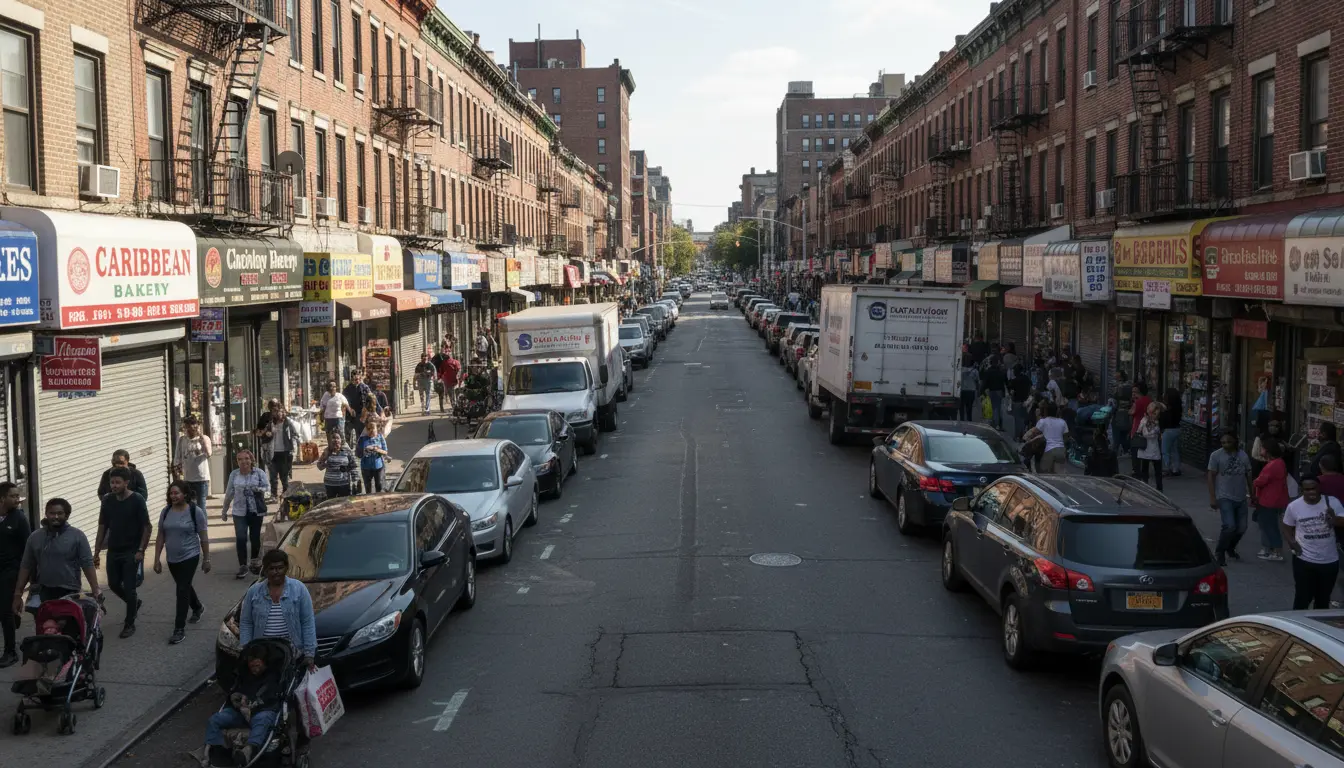
Shows a typical commercial corridor in Crown Heights with narrow sidewalks and frequent curb activity so buyers can compare access, scale, and likely privacy trade-offs versus residential blocks.
The Nostrand Avenue image verifies how little spare width exists between storefronts, parked cars, and passing pedestrians. It highlights why commercial strips require flexible timing and compact setups compared with quieter side streets.
On-the-Day Flow: Moving Through a Crown Heights Shoot
A typical Crown Heights session tends to move in small hops rather than large relocations. Couples may meet near a subway station or recognizable corner, then walk one or two blocks onto calmer streets for the first set of portraits. From there, it’s common to alternate between slightly busier avenues and side streets to vary the backdrop without losing time in transit.
On brownstone blocks, stoops become natural staging areas—but only when access is clearly permitted. Space on a stoop is limited: a couple, a photographer, and one assistant with a reflector or small light can fit, but additional people quickly spill onto the narrow sidewalk, competing with neighbors coming and going. Because of active stoop culture, there’s also a need to work around everyday use—someone sitting on a neighboring stoop becomes part of the real street context.
In shifting weather, micro-weather shelters play a larger role than in open parks. A deep doorway or overhanging stoop can host a quick pause while a passing shower clears Eastern Parkway. Short moves like this keep the session going without forcing everyone onto a bus or into a cab at the first sign of rain.
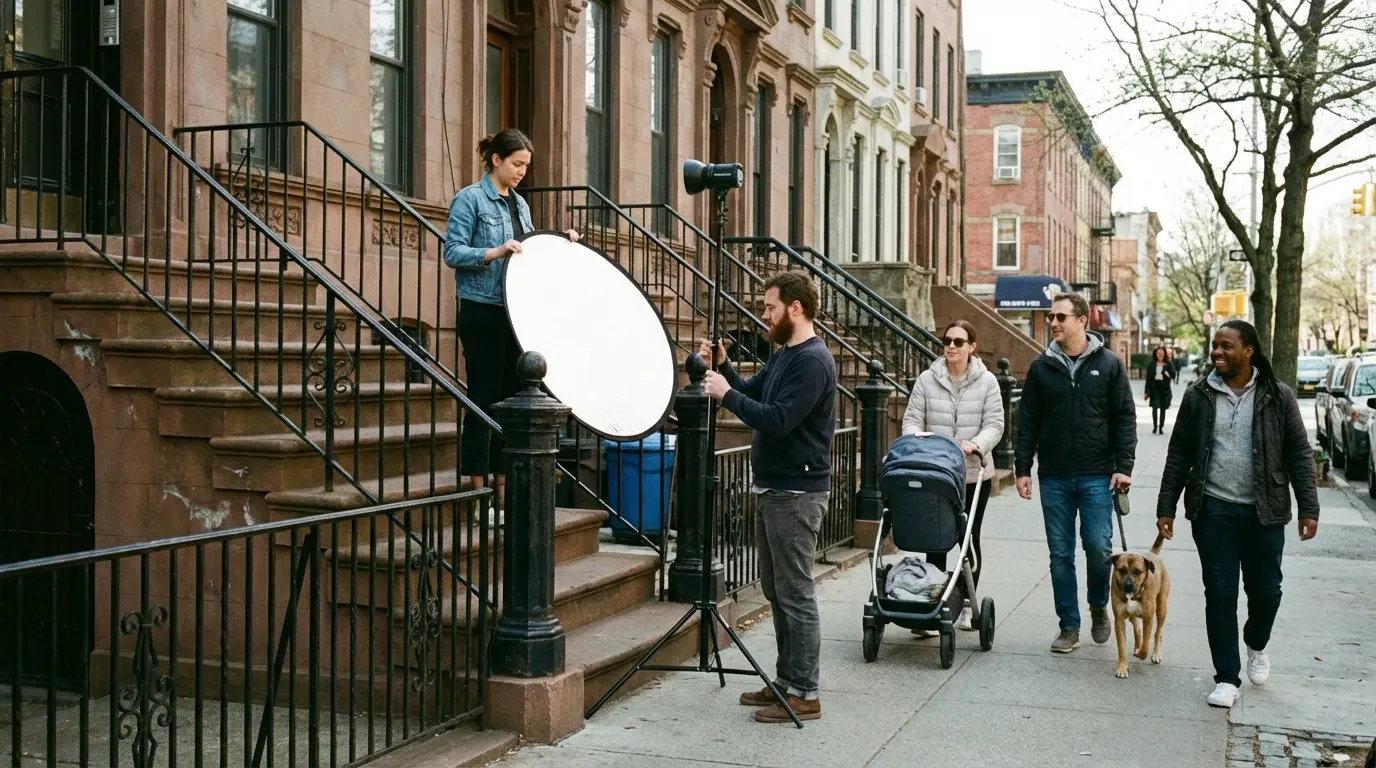
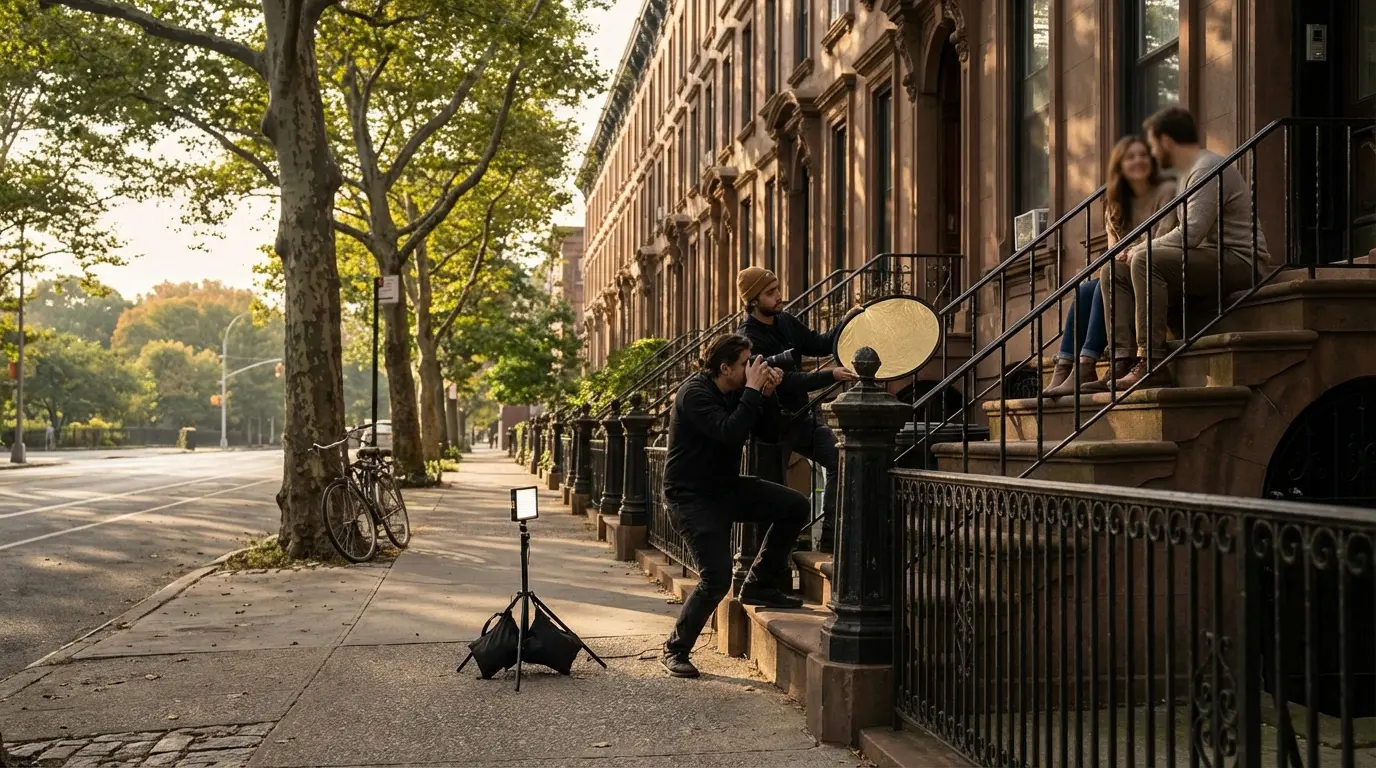
Documents how a small portrait setup fits on Crown Heights stoops, showing actual stoop dimensions, sidewalk clearance, and nearby pedestrian interactions that affect timing and staging.
This image demonstrates how a couple, photographer, and assistant realistically occupy a Crown Heights stoop, with just enough sidewalk left for pedestrians and neighbors using adjacent stairs.
Managing Risk on Open Corridors and Park Malls
Open corridors like Eastern Parkway introduce a different set of risks than tighter side streets. Wind can pick up along the mall, tugging at dresses, veils, and light modifiers. Lightweight stands or umbrellas are particularly vulnerable here; without proper weighting, they can tip toward joggers or into bike lanes.
Because Eastern Parkway’s central malls and nearby green pockets fall under NYC Parks oversight, there is also a layer of permit awareness. Even with a small setup, setting out large stands or obvious equipment near park signage or high-traffic paths can invite questions from staff. Keeping gear compact and well-controlled—and staying clear of designated running and bike paths—reduces the chance of disruptions.
On the plus side, there are long sightlines in both directions. That helps anticipate sudden group arrivals, passing running clubs, or school groups using the malls, giving enough time to pause and reframe.
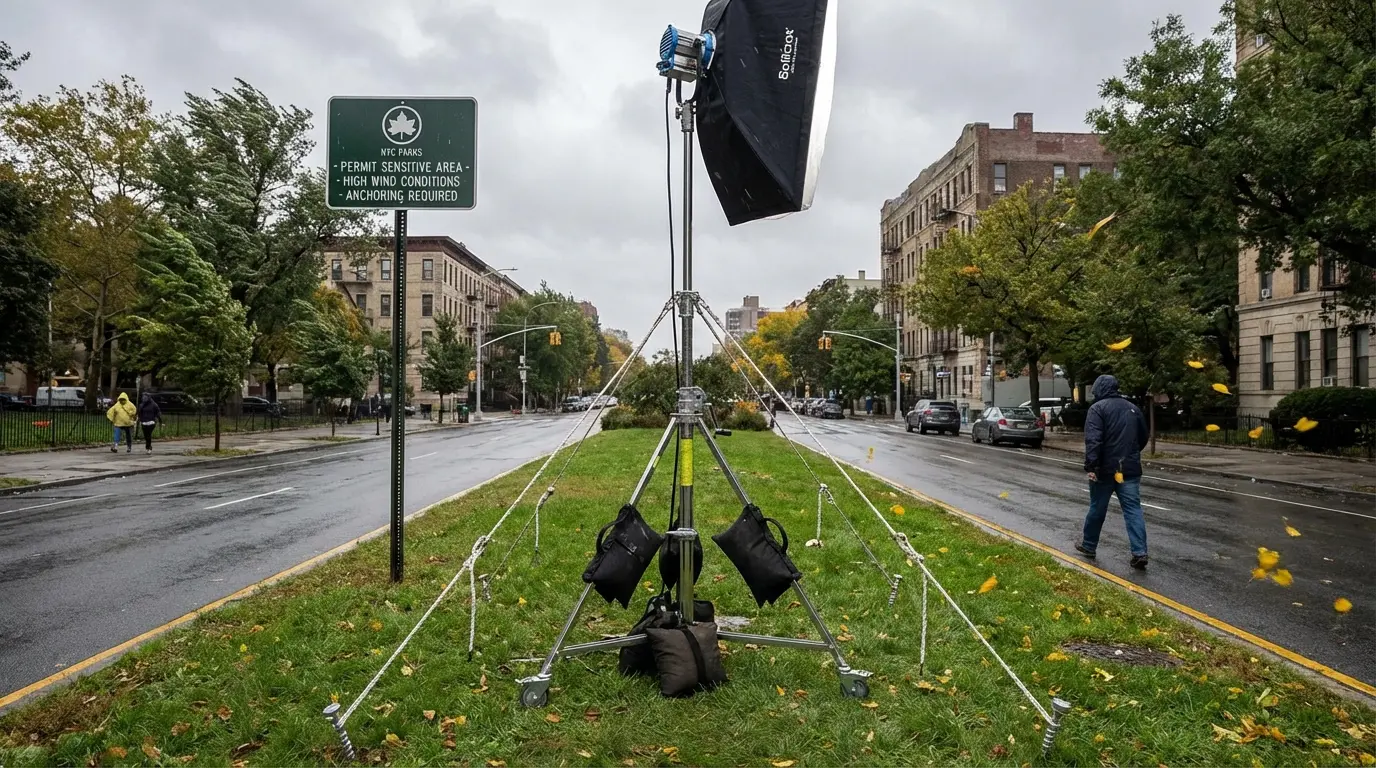
Shows how small equipment is secured on Crown Heights open corridors and highlights nearby public-park signage so buyers can see wind exposure and permit-awareness points.
The sandbagged stand on the Eastern Parkway mall confirms the need to secure equipment against corridor winds and illustrates how close typical setups sit to NYC Parks signage and passing runners.
Specific Local Anchors Clients Often Reference
When people describe where they want to be photographed in Crown Heights, a few anchors come up repeatedly:
- Weeksville Heritage Center perimeter: The low fence, signage, and surrounding townhouses mark a clear cultural and geographic reference point in eastern Crown Heights. The outer sidewalks here mix heritage context with typical residential textures.
- Medgar Evers College area: Large campus buildings throw long, consistent shadows across adjacent sidewalks, creating broad, even light when the rest of the neighborhood is patchy.
- Kingston Avenue corridor: Lower-rise buildings and steady foot traffic give a more relaxed feel than Franklin or Nostrand, with room to pause at corners or storefronts without blocking flows.
- Brower Park edges: The park’s perimeter paths and crossings balance green backdrops with visible street life just beyond the fence line.
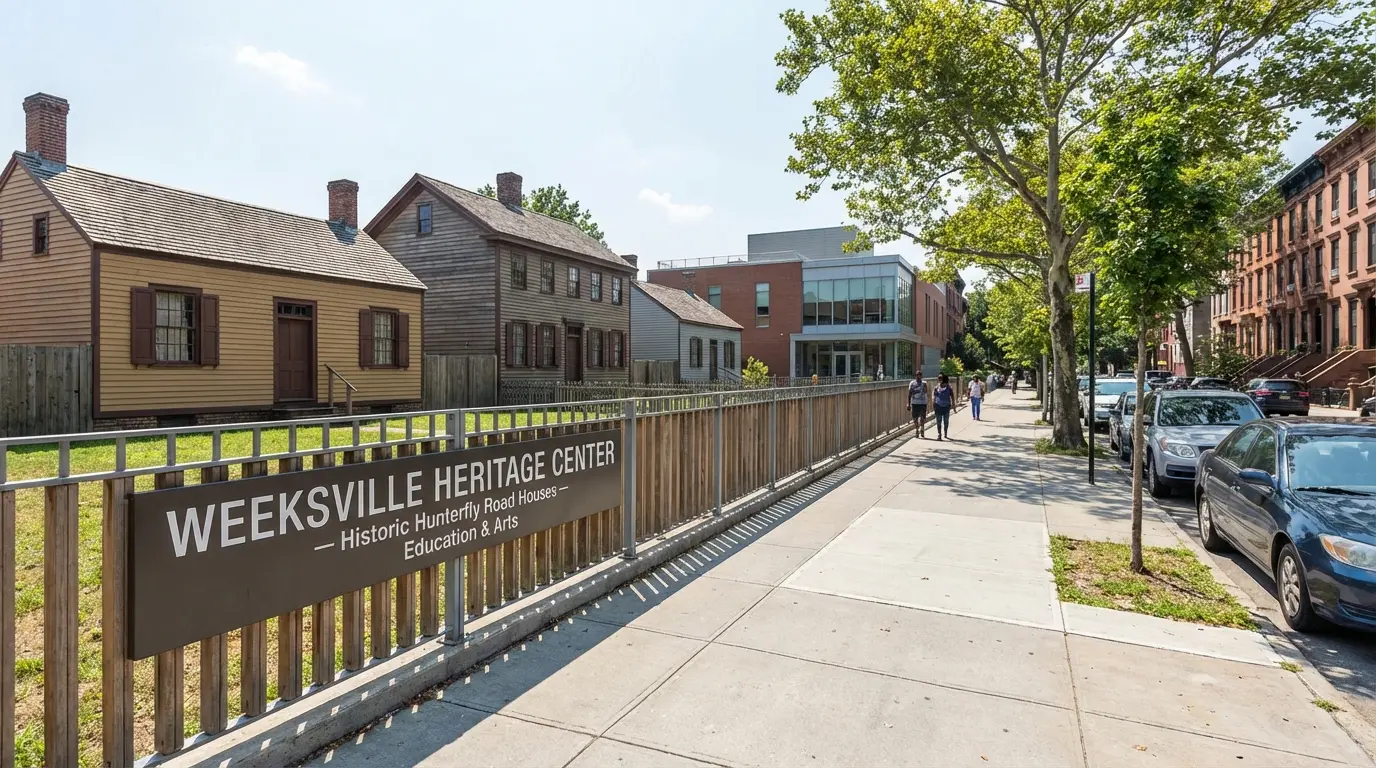
Provides an unambiguous Crown Heights anchor by showing the Weeksville Heritage Center grounds and immediate streetscape so buyers can confirm location alignment with text references.
The Weeksville perimeter photo shows the exact mix of signage, fencing, and nearby housing that clients often describe, confirming how this micro-area sits firmly within the Crown Heights streetscape.
What Finished Crown Heights Images Usually Look Like
Delivered images from Crown Heights typically include a mix of controlled portrait moments and the neighborhood’s unavoidable background activity. On brownstone blocks, you’ll often see:
- Strong stoop shadows, especially on lower steps, with faces lit from a higher angle.
- Parked cars across the street and neighboring stoops with people on them in soft focus.
- Utility poles, tree trunks, and trash cans at the edges of the frame—real elements of the block that can’t always be removed without changing locations.
On commercial avenues, signage, awnings, and interior window light become part of the palette. The lighting interior glow from cafés on Franklin Avenue, for example, can wrap couples in warm tones while pedestrians and bikes streak through the background.
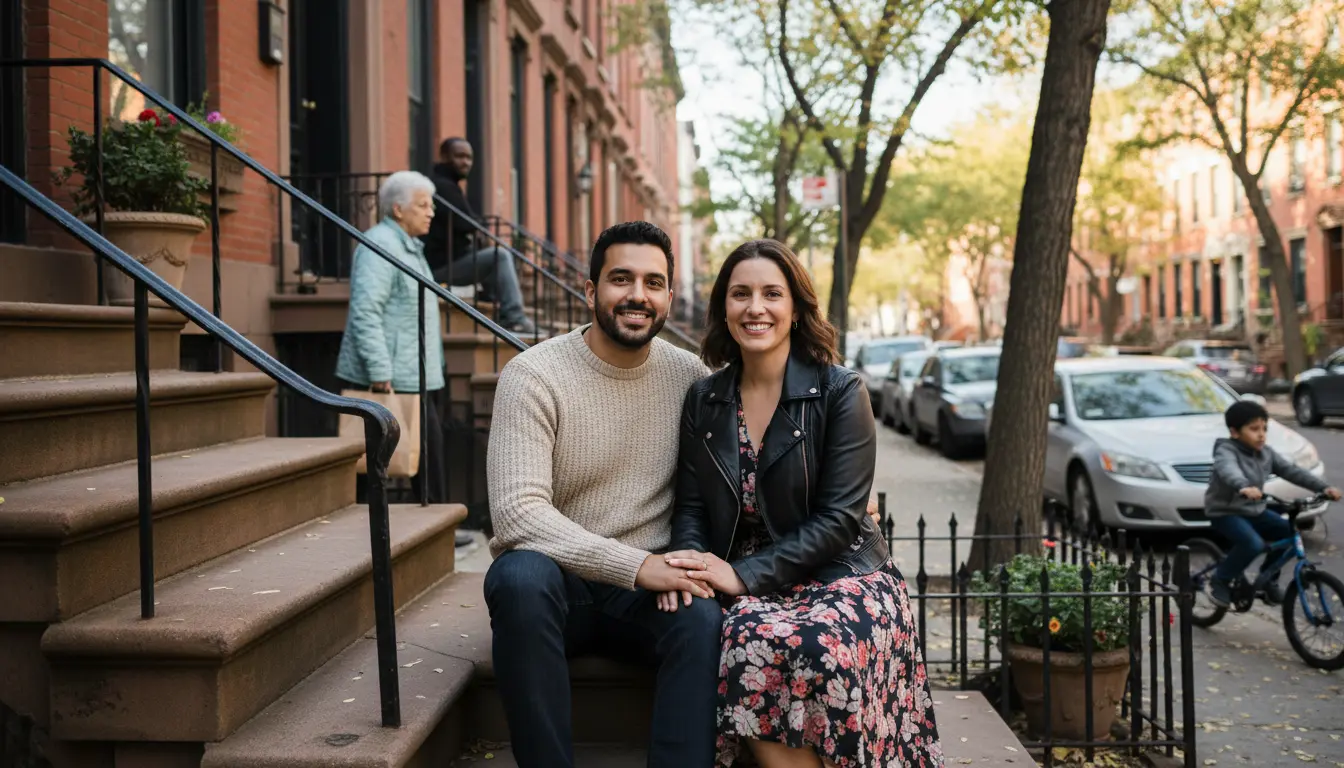
Represents a realistic delivered portrait from a Crown Heights session, showing typical background elements (stoop shadows, street activity) so buyers can set expectations for final images in this neighborhood.
This delivered portrait example confirms how stoop shadows, neighbors in the distance, and street elements naturally appear in finished Crown Heights images, rather than the fully cleared backgrounds you might find in more controlled locations.
How Crown Heights Relates to Other Brooklyn Photo Areas
Crown Heights often sits in the middle of a larger day plan across Brooklyn. Couples might start with residential brownstones here, then move west toward Prospect Heights or north toward Bed-Stuy for a slightly different take on similar architecture.
From a search and planning standpoint, Crown Heights aligns with the broader “Brooklyn brownstone” idea, but the neighborhood has specific constraints—narrower sidewalks, very active stoops, and defined crowd peaks—that differ from quieter side streets elsewhere. When people look for a Wedding photographer familiar with this area, they’re usually trying to balance that recognizable housing stock with realistic expectations about foot traffic and available space.
Adjacent Neighborhoods we serve near Crown Heights
Common Crown Heights Wedding Photo Questions
When is light most predictable in Crown Heights?
Mid-morning on side streets and late afternoon on Eastern Parkway tend to be the most consistent. Brownstone blocks need time for the sun to clear building roofs, so very early morning often leaves stoops in heavy shadow. By late afternoon, facades and upper stoops catch softer light while lower steps remain cooler.
Are there truly quiet blocks, or will there always be people around?
There are calmer residential segments—especially deeper into the central brownstone belt and some streets east of Kingston—but this is a dense neighborhood. Expect dog walkers, kids, and neighbors on stoops rather than empty streets. For the least activity, weekday mid-mornings are generally better than evenings or weekends.
Can we use any stoop we like for portraits?
No. Most stoops are private, even if they look accessible from the sidewalk. Using them respectfully means relying on buildings where access is clearly permitted or pre-arranged, and avoiding setups that block entrances or interfere with residents’ daily use.
What about parks—do we need permits for Brower Park or the Eastern Parkway malls?
Small, low-impact sessions that don’t block paths or bring large equipment often proceed without issue, but Brower Park and the malls are under NYC Parks oversight. For anything that looks like an event or uses larger stands or props, it’s wise to assume permit rules may apply and plan accordingly rather than improvising on the day.
How does weather affect sessions in Crown Heights?
Sudden showers are common, and the contrast between open corridors like Eastern Parkway and tight brownstone rows can create noticeable temperature swings. Micro-weather shelters—stoop overhangs, café awnings, and recessed entries—are important for short pauses, but they don’t replace having a simple backup plan if the forecast looks unstable.
Is street noise a problem for photo or video on Franklin and Nostrand?
Those corridors are noisy: buses, music from storefronts, conversations, and occasional construction. For stills, noise is less of a concern; for video with live audio, it’s more limiting. Many couples capture portraits along these avenues, then move to quieter side streets for any spoken vows or audio-dependent moments.
How busy does Brower Park get, and will it feel too crowded?
Weekday mornings are usually spacious, with pockets of activity. After-school hours and weekends see more families, sports, and group gatherings, especially near playgrounds and open fields. The park edges and less central paths tend to remain usable even at busier times, though you should expect people in the background.
Is transit or parking easier to work with for a Crown Heights session?
Subway access via the 2/3/4/5 makes it straightforward for people arriving from other parts of the city. Street parking is possible but inconsistent; blocks around Franklin, Nostrand, and major intersections fill up quickly. For timed arrivals, car services often drop at corners, with a short walk to the chosen block.
Are rooftops a realistic option in Crown Heights?
Rooftops are generally only available through specific buildings with clear management approval. Many are off-limits, and rules vary widely. Treat rooftop access as a special case that requires prior coordination, not as something that can be decided on the fly.
How do morning glare zones affect scheduling?
On avenues like Rogers and some east-facing storefront runs, strong low-angle sun in the morning can create harsh glare and squinting. If you want to use those corridors, pushing the start time later—after the sun has risen higher—or choosing the shadier side of the street helps maintain more comfortable, usable light.