

Event Video in Brooklyn
Evaluating Event Video Production for Your Brooklyn Event
Event Video in Brooklyn spans a range of providers visible through Google Maps and local directory listings, from dedicated video production companies to photography studios that also offer event coverage. For buyers actively comparing options, the evaluation challenge is determining which provider’s capabilities, production workflow, and local familiarity match the specific format and scale of the event being planned. Listings in local search results may include businesses with different primary specializations, so understanding how to read beyond a headline category is a practical first step when narrowing your options. This page presents verifiable details about Vera Starling’s event video production service alongside the neutral evaluation criteria that typically matter most to Brooklyn event planners.

What Event Video Production Covers
Event video production encompasses the planning, filming, and editing of video content captured during live events. The scope of any given project depends on the event type, venue conditions, and deliverable requirements agreed upon between the client and provider. Below is an overview of what this service category typically includes:
- Pre-production planning — Timeline coordination, venue walkthroughs, shot list development, and equipment selection based on the event format
- Single or multi-camera capture — On-site filming using one or more camera positions to cover speakers, guests, performances, and venue atmosphere
- Audio recording — Dedicated audio capture from podiums, PA systems, or ambient room sound, depending on the event setup
- Post-production editing — Assembly of raw footage into a finished video, which may include highlight reels, full-length event documentation, or both
- Delivery of final files — Completed video files provided in agreed-upon formats and resolutions
Specific inclusions such as drone footage, live-streaming capability, same-day edits, or extended multi-day coverage vary by provider and should be confirmed during inquiry. Buyers evaluating event video services alongside still photography may want to ask whether Vera Starling coordinates Event Photographer coverage in tandem with video production for unified event documentation.

How to Compare Event Video Providers in Brooklyn
Selecting an event videographer involves evaluating several factors that affect both production quality and logistical fit. The following criteria, drawn from common buyer evaluation patterns, can help structure your comparison across providers:
-
Event type alignment — Confirm whether the provider has demonstrable experience with your event format. Conference video coverage involves different equipment and workflow than a gala or outdoor community event. Buyers planning corporate functions in Downtown Brooklyn or formal events in Brooklyn Heights should ask to see examples that match the venue type and scale.
-
Multi-camera capability — Events with multiple simultaneous areas of activity—a stage, a reception floor, breakout rooms—may require more than one camera operator. Ask how multi-camera coverage is coordinated and whether crew size is adjustable based on the event scope.
-
Audio capture approach — Poor audio is one of the most common quality issues in event video. Evaluate whether the provider uses dedicated audio recording equipment such as lavalier microphones, wireless receivers, and direct board feeds rather than relying solely on camera-mounted microphones.
-
Deliverable specifications — Clarify what the final output includes: resolution, file format, number of edited pieces (highlight reel, full event recording, social media cuts), and whether raw footage is available. Providers who also offer Commercial photography alongside video may be able to produce coordinated photo and video assets for corporate use.
-
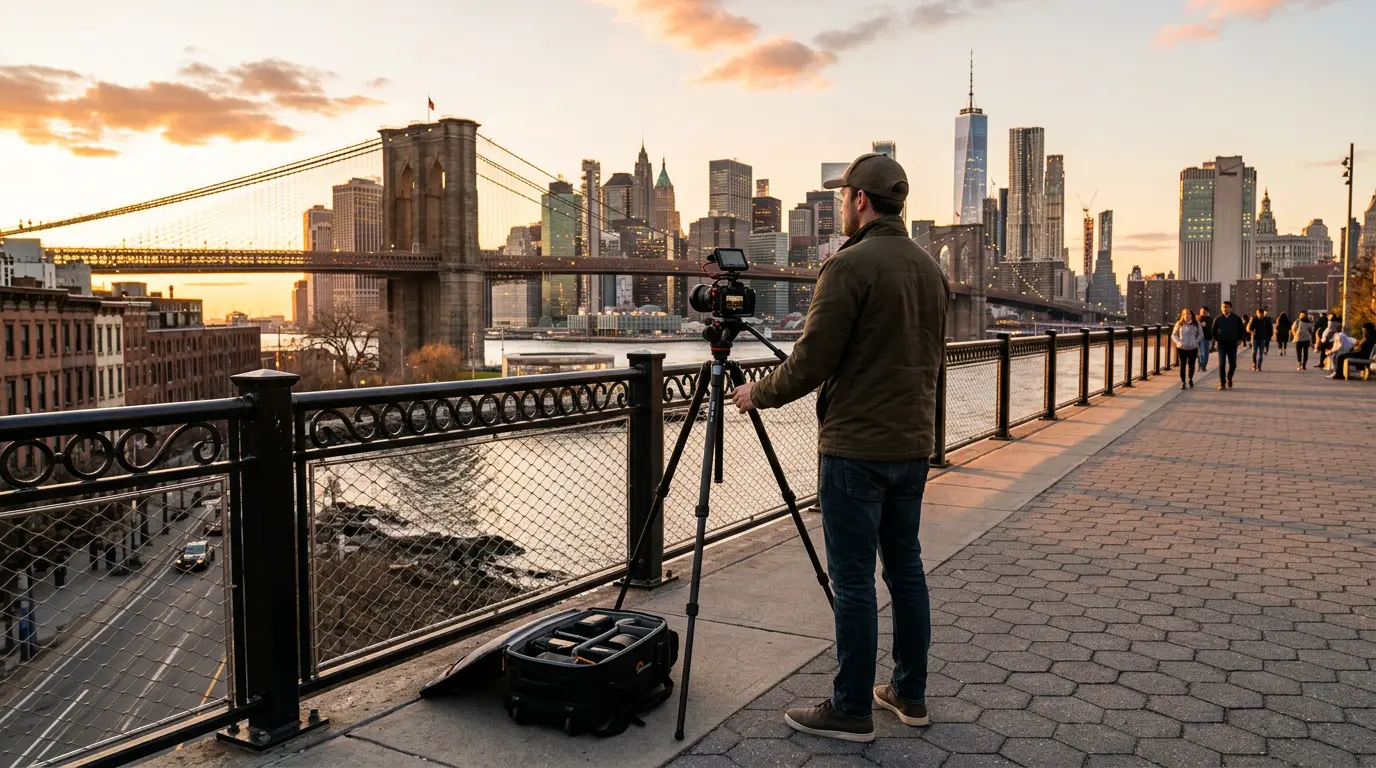
Golden hour and lighting considerations — For outdoor events or venues with significant natural light, timing affects visual quality. Golden hour—the period of warm directional light shortly before sunset—is valued for outdoor event recap footage, particularly at Brooklyn waterfront locations. Confirm whether the production team plans camera placement and scheduling around available light conditions.
-
Indoor venue contingency — Weather-dependent outdoor events may require a backup plan that changes the production setup entirely. Indoor backup venues involve different lighting requirements, audio considerations, and camera angles. Ask how a provider adapts when venue conditions shift on short notice.
-
Weekend vs. weekday availability — Corporate events typically occur on weekdays, while social events cluster on weekends. Crew availability, venue access windows, and pricing structures may differ depending on the day of the week, so confirm scheduling flexibility and any related pricing variations early.
-
Post-production timeline — Turnaround time for edited event video varies by provider and project complexity. Establish delivery expectations and ask whether expedited options are available if you have a deadline.
-
Local venue familiarity — A provider with prior experience in Brooklyn venues may navigate load-in logistics, lighting conditions, and permit requirements more efficiently than one arriving at a venue for the first time.
How Event Video Production Is Typically Delivered
The event video production process generally follows a sequence from initial booking through final file delivery. While specific workflows vary by provider, the following stages represent the typical structure buyers can expect.
Booking and consultation — The process usually begins with an inquiry about the event date, format, venue, and intended use of the final video. This initial conversation helps both parties determine whether the project scope, timeline, and budget are aligned. Buyers who need both still photography and video for the same event can ask whether Photography And Videography packages are available as a coordinated service.
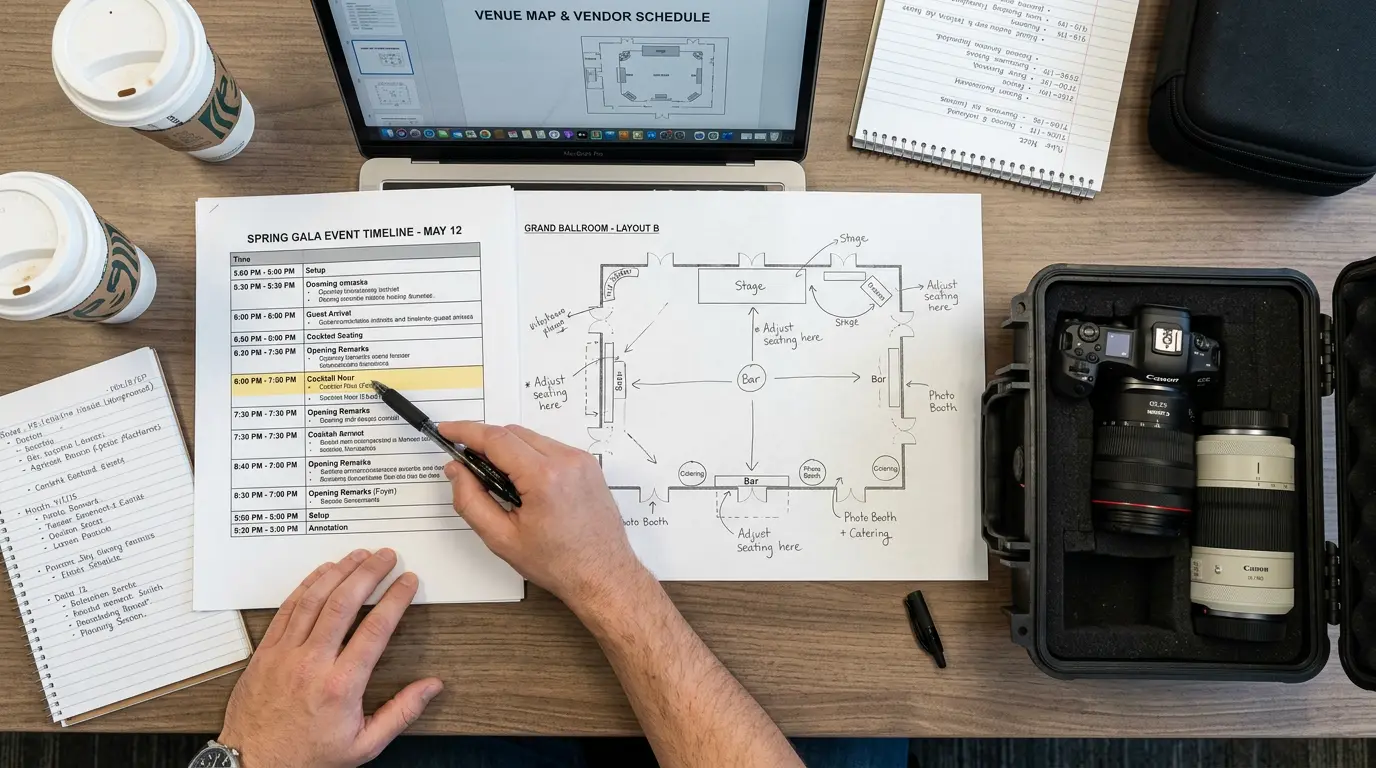
Pre-production planning — Once the project is confirmed, the production team typically reviews the event timeline, conducts a venue walkthrough when possible, develops a shot list, and prepares equipment. For events with complex schedules or multiple locations within a venue, this stage may also involve coordination with event planners, venue managers, or AV teams.
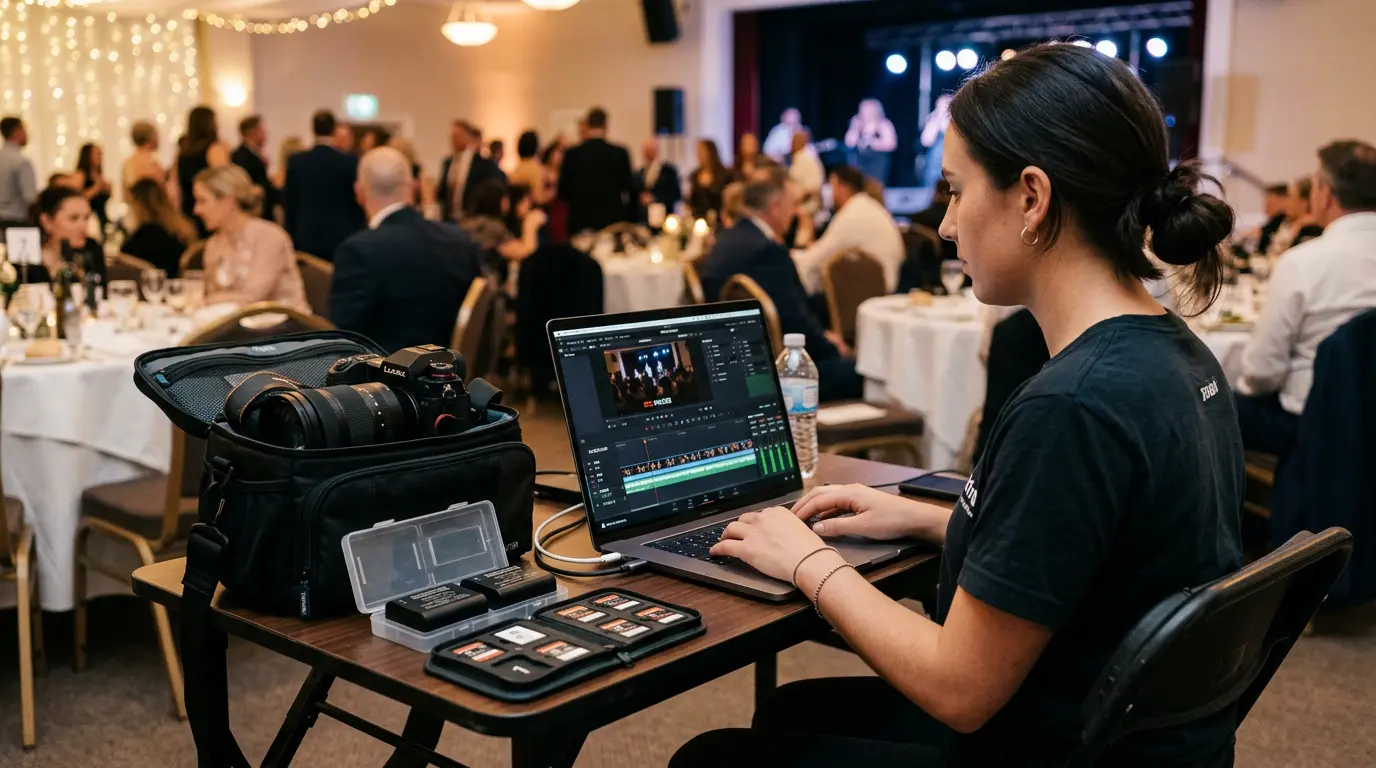
On-site production — On the day of the event, the crew arrives with planned equipment, sets up camera positions, and begins coverage according to the shot list and event timeline. Adjustments are made in real time based on event flow, lighting changes, and schedule shifts. For outdoor events, providers should be prepared for changing light conditions—particularly during late-afternoon golden hour, when warm directional light shifts rapidly and requires responsive exposure management.
Post-production — After the event, raw footage is reviewed, organized, and edited into the agreed-upon deliverables. This stage includes color correction, audio mixing, titling, and any graphics work specified in the project scope. Turnaround timelines should be confirmed before booking.
Delivery — Completed files are typically provided via digital download, physical media such as an external hard drive or USB, or both. For providers who also handle Wedding videography, the delivery workflow for social events may follow a similar structure with adjustments for event-specific content organization and client needs.
Reducing Risk When Hiring an Event Videographer
Hiring a video production provider for a one-time event carries inherent risk: the event cannot be restaged if coverage falls short. The following information is organized by evidence tier to help buyers distinguish between what can be verified independently and what should be confirmed through direct communication with the provider.
Verifiable business facts (Tier 1)
- Business name: Vera Starling
- Address: 2483 E 22nd St, Sheepshead Bay, Brooklyn
- Phone: +1917-386-8509
- Website: video-nyc.com
- Primary GBP category: Wedding photographer
- Additional GBP categories: Commercial photographer, Photographer, Photography service, Video production service
- Listed services in related categories: Baby Photography, Family and Group, Maternity and Newborn, Newborn Photography, Portrait Photography
Note that “Video production service” appears as an additional category on the Google Business Profile, confirming the business is listed under this service type. The primary category is Wedding photographer, so buyers specifically evaluating event video capabilities should use the confirmation steps below to assess fit.
What buyers should confirm during evaluation (Tier 2 / Tier 3)
- Event video portfolio: Request samples of completed event videos that match your event type—conference, gala, community event, or corporate function. Portfolio evidence is the most direct way to evaluate production quality and style fit.
- Equipment and crew details: Ask about camera models, audio equipment, lighting rigs, and whether backup equipment is brought on-site. Redundancy measures such as spare camera bodies, extra memory cards, and backup batteries reduce the risk of equipment failure during live coverage.
- Insurance and permits: Confirm whether the provider carries liability insurance and whether they handle NYC film permits for outdoor locations, if applicable to your event.
- Contracts and cancellation terms: Request a written agreement that specifies deliverables, timeline, payment schedule, and cancellation or rescheduling policies.
- References or reviews: Ask for references from previous event video clients in Brooklyn, or check third-party review platforms for feedback specifically related to video production work.
- Post-production revision policy: Clarify how many revision rounds are included and what constitutes a revision versus additional editing work beyond the original scope.
- Delivery format and archival: Confirm resolution, file format, delivery method, and how long raw footage is retained after the project is completed.
- Rescheduling flexibility: For weather-dependent outdoor events or events subject to date changes, confirm the rescheduling policy and whether deposits transfer to a new date.
Vera Starling’s Location and Brooklyn Service Area
Vera Starling operates from 2483 E 22nd St in the Sheepshead Bay section of Brooklyn. The Sheepshead Bay station on the B and Q subway lines is the nearest transit stop, providing direct connections along the Brighton Line to neighborhoods throughout Brooklyn and into Manhattan. This Sheepshead Bay location serves as a convenient base for event video production clients across multiple Brooklyn neighborhoods.
Vera Starling’s event video production service covers neighborhoods across Brooklyn, including the following areas:
-
Brooklyn Heights — A historic waterfront neighborhood with brownstone architecture and Manhattan skyline views, Brooklyn Heights hosts private galas, nonprofit fundraisers, and corporate dinners at intimate venues. The Brooklyn Heights Promenade provides an outdoor filming location where golden hour light creates warm directional conditions particularly valued for event recap footage.
-
Downtown Brooklyn — Brooklyn’s commercial and civic center is home to conference facilities, cultural institutions, and large-scale event venues. Multi-camera setups and dedicated audio capture are often necessary here due to the size and acoustic characteristics of modern venue spaces. Weekday corporate events and conferences are common in this area, while weekend scheduling patterns differ for social gatherings.
-
Bay Ridge — A community-oriented neighborhood in southern Brooklyn, Bay Ridge hosts cultural celebrations, community gatherings, and local business events. The Verrazzano-Narrows Bridge provides a recognizable backdrop for outdoor event footage along the waterfront, and the neighborhood typically offers more flexible parking and load-in conditions than many north Brooklyn locations.

Using Visual Evidence to Evaluate Event Video Production
The images included throughout this page are intended to function as evaluation tools rather than promotional material. Each photograph documents a specific stage of the event video production process or a specific Brooklyn location, allowing buyers to observe equipment, venue conditions, crew positioning, and deliverable formats directly.
When reviewing visual materials from any event video provider, focus on observable details: the type of cameras and support equipment visible, the scale of production relative to the event size, the diversity of event types and venues represented, and the format of final deliverables. These specifics are more informative than stylized portfolio reels alone when assessing a provider’s operational capability and production scope.

Buyers should also request to view completed event video samples—not just production stills—to evaluate editing style, pacing, audio quality, and color grading before making a hiring decision. Comparing a provider’s work across multiple event types helps confirm whether their approach adapts effectively to different formats and venue conditions.
Frequently Asked Questions About Event Video in Brooklyn
1) What types of events does event video production typically cover?
Event video production can encompass conferences, corporate functions, galas, fundraisers, community events, cultural celebrations, grand openings, and other organized gatherings. The specific event types a provider covers should be confirmed during inquiry, along with examples of completed work in that format.
2) How does event video production differ from wedding videography?
While both involve filming live events, wedding videography typically follows a more predictable timeline and emphasizes romantic or cinematic storytelling. Event video production may involve more variable schedules, multiple simultaneous areas of coverage, and deliverables oriented toward corporate communications, social media, or archival purposes. Some providers who also offer Wedding Photography may handle both categories but use different production approaches for each.
3) How many cameras are typically used for event coverage?
The number of cameras depends on the event size, venue layout, and number of simultaneous activities. A single-camera setup may suffice for a small gathering, while conferences or galas with multiple rooms and stages may require two or more operators. Confirm crew size and camera count during the booking discussion.
4) What should I ask about audio recording quality?
Audio quality is one of the most common areas of concern in event video. Ask whether the provider uses dedicated audio equipment—lavalier microphones, wireless receivers, direct board feeds from the venue’s PA system—rather than relying only on camera-mounted microphones. Dedicated audio capture is especially important for events with speeches or panel discussions.
5) What deliverables should I expect after the event?
Typical deliverables may include a highlight reel, a full-length event recording, social media edits, or individual session recordings. The specific deliverables, resolution, file format, and whether raw footage is included should all be defined in the project agreement before the event takes place.
6) How long does post-production typically take?
Turnaround time varies by provider, project complexity, and the number of deliverables involved. It is reasonable to ask for an estimated delivery window during the booking stage, as well as whether expedited editing is available for time-sensitive projects. Specific timelines should be confirmed directly with the provider.
7) Does golden hour timing affect outdoor event video quality?
Golden hour—the period of warm directional light shortly before sunset—can significantly affect the visual character of outdoor event footage. For events at Brooklyn waterfront venues, rooftop spaces, or park locations, scheduling key moments during this window may enhance the final video. However, golden hour is brief and season-dependent, so the production team should plan camera positions, exposure settings, and backup lighting in advance.
8) What happens if weather forces an outdoor event indoors?
Moving to an indoor backup venue changes production requirements. Lighting conditions, audio acoustics, and available camera positions may differ substantially from the original outdoor plan. Ask your provider how they handle last-minute venue changes and whether they bring additional lighting or audio equipment to accommodate indoor environments on short notice.
9) Is there a difference between weekend and weekday event production?
Corporate events, conferences, and business functions are more commonly held on weekdays, while social gatherings and community events tend to occur on weekends. Crew availability and scheduling logistics may differ, and some providers structure pricing differently for weekend versus weekday coverage. Confirm any scheduling-related pricing variations when you make your initial inquiry.
10) What backup equipment should a provider bring on-site?
Redundancy is important for live event coverage because the event cannot be restaged. Ask whether the provider brings backup camera bodies, spare batteries, additional memory cards, and backup audio equipment. On-site footage monitoring—reviewing captured material in real time during the event—is another risk-reduction measure worth confirming.
11) How are completed event video files delivered?
Delivery methods typically include digital download links, external hard drives, USB drives, or a combination. Confirm the delivery format, whether physical media is included, and how long the provider retains project files after delivery in case additional copies are needed later.
12) How can I evaluate whether a provider knows Brooklyn venues well enough?
Ask for a list of Brooklyn venues where the provider has previously worked, or request sample footage from events held at venues similar to yours. Familiarity with a venue’s layout, lighting conditions, load-in logistics, and any permit requirements can reduce setup time and improve overall coverage quality on the day of the event.
How to Begin the Event Video Production Process
Event video production with Vera Starling begins with a consultation, which can be arranged by contacting the Sheepshead Bay studio directly. Inquiries about availability, event scope, deliverables, and scheduling are handled by appointment.
- Phone: +1917-386-8509
- Website: video-nyc.com
During the initial conversation, be prepared to share the event date, venue location, event format, estimated guest count, and intended use of the final video. This information allows the provider to assess project fit and outline an appropriate scope of work.
Vera Starling’s primary listing category is Wedding photographer, with event video production offered under the additional Video production service category. Buyers whose events also require still photography coverage or who are evaluating providers across multiple service types should ask about coordination between photo and video teams during the initial inquiry.