
Flatbush in Brooklyn as a practical setting for wedding photography
How Flatbush sits inside Brooklyn and where sessions tend to cluster
Flatbush runs through central Brooklyn as a dense, largely residential neighborhood with commercial corridors cutting north–south and east–west. In practice, most couples use the stretch of Flatbush Avenue south of the Prospect Park edge, plus the Church Avenue and Nostrand Avenue corridors, as their reference points.
Formally, the area described in Flatbush, Brooklyn covers several overlapping local definitions, but on the ground you feel it in the transition from Prospect Lefferts Gardens to the north (closer to the park), through the older apartment buildings and schools around Erasmus Hall, down toward the lower-rise edges near Ditmas Park and Midwood. Eastward, the built density continues into East Flatbush with only subtle changes in block width and traffic volume.
For wedding-day or engagement coverage, Flatbush isn’t a neighborhood of big plazas; it’s a sequence of workable pockets:
- Slightly wider corners along Flatbush Avenue and Ocean Avenue with enough space to pause between bus stops.
- Narrower east–west side streets where stoops and brick facades become the main backdrops.
- Border-adjacent open areas like the Prospect Park Parade Ground that function as breathing room without technically being “inside” Flatbush for every map.
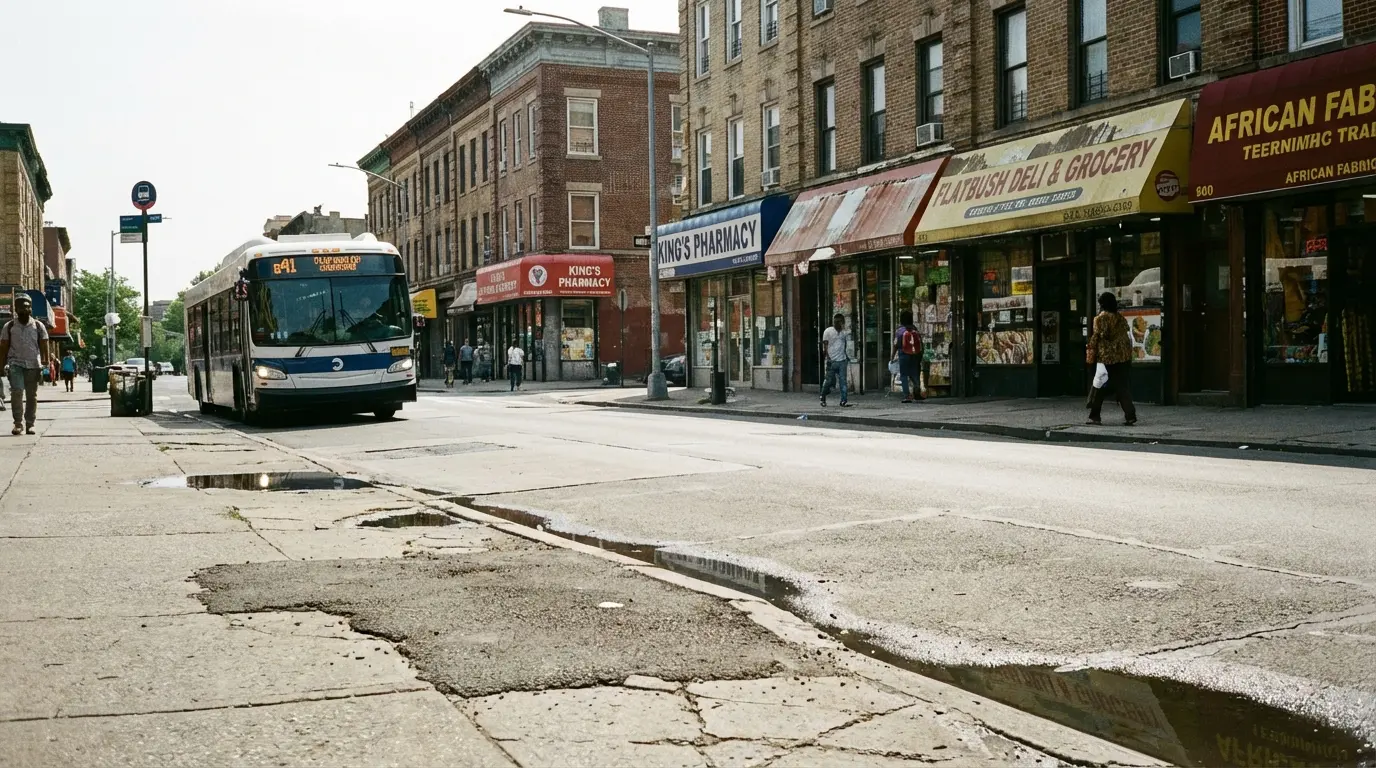
Verifies transit activity, sidewalk width and condition, and the mixed-storefront textures (awnings and brick) a photographer will encounter on Flatbush Avenue. The visible bus, cracked sidewalks, and stacked awnings are exactly the conditions that shape where a couple can comfortably pause for photos.
Moving through Flatbush: trains, buses, and walking patterns
Mobility in Flatbush is dominated by the north–south spine of Flatbush Avenue, with frequent buses and heavy traffic. Church Avenue and Nostrand Avenue create cross-currents of pedestrians, deliveries, and bus routes; foot traffic rises sharply in the late afternoon as schools let out and shops get busy.
Subway access that actually matters for sessions usually comes from the Q line transitions around Beverley Road and Cortelyou Road to the west, funneling couples in from other parts of the city. From those stops, people often walk east toward Flatbush Avenue, passing through slightly calmer blocks before hitting the busier commercial runs.
For couples coming from deeper in Brooklyn, routes from Midwood or East Flatbush feed in on broader residential streets that feel quieter but still lack large open squares. Walking between locations is usually done in short hops: a corner here, a side street there, rather than long continuous “stroll” sequences.
Micro-areas that frequently show up in couple sessions
Within Flatbush, a few micro-areas come up repeatedly in wedding-day and engagement coverage because they balance realism with manageability:
- Erasmus Hall High School area – Dense foot traffic during school hours, but the surrounding blocks offer recognizable signage and a strong sense of “this is Flatbush” without needing to include large crowds in frame.
- Church Avenue retail corridor – Busy, visually noisy, but useful for couples who want market signs, storefront glass, and movement in the background.
- Victorian Flatbush fringe (north of Ditmas Park) – Transitional pockets where rows of detached or semi-detached homes soften the look while still reading as central Brooklyn rather than suburban.
For quick portraits, photographers often cut a block or two off the main avenues onto residential streets where parked cars, trees, and stoops replace shopfronts and bus shelters. These are not empty backlots—neighbors, deliveries, and kids heading home from school remain part of the environment—but they give more control over how much of that appears in the frame.
Brick, gates, and storefronts: the materials that define Flatbush backdrops
Flatbush’s built environment is dominated by 1920s-era brick apartment buildings and mixed-use structures with narrow storefronts at street level. That brick provides a consistent, textured background for portraits, offset by:
- Metal security gates rolled up or down depending on time of day.
- Inconsistent awning colors—greens, reds, bright blues—particularly along Church Avenue.
- Occasional patchwork repairs where new brick meets older stone or concrete.
These materials make the neighborhood feel visually dense. Long, clean sightlines are rare away from Flatbush Avenue and Ocean Avenue; most frames are layered: a couple on a stoop, then parked cars, then another building face a short distance away. For wedding photography, that means compositions often rely on shallow depth of field to soften the layers while still leaving traces of the neighborhood—gate patterns, window grilles, and awning edges—to show where the moment happened.
How light behaves on Flatbush avenues and side streets
Light in Flatbush is strongly influenced by building height and street orientation:
- North–south avenues (Flatbush, Ocean) – Taller residential blocks cast long shadows in the late afternoon. You can have strong overhead sun mid-day, then a rapid shift to shade as the sun drops behind a building mass.
- East–west side streets – Closer building spacing causes quicker light drop-off. Once the sun starts moving down, those interior blocks lose direct light earlier than you might expect.
- Reflective surfaces – Church Avenue’s glass storefronts can produce brief, sharp reflections around midday, creating hot spots on clothing or faces if a couple stands too near the windows.
For planning, this means that “golden hour” on the calendar doesn’t automatically translate to soft, even light on the street. Edges near Prospect Park or wider intersections may keep usable natural light a bit longer, while interior side streets can feel like evening much earlier.
Where wedding photography realistically fits into Flatbush
Most Flatbush wedding or engagement coverage uses a mix of three environment types:
- Residential side streets with brick stoops and modest trees, where couples can pause without blocking commercial doorways.
- Commercial edges of Flatbush Avenue or Church Avenue for a few frames with buses, markets, and signage in the distant background.
- Park-adjacent borders near the Prospect Park Parade Ground or small playgrounds, used for short stretches of open space rather than full park sessions.
Apartment courtyards and school grounds are usually treated as semi-private and not assumed to be available without specific permission. Because of that, the default plan is to work on public sidewalks and stoops, adjusting based on time of day and who is using the space.
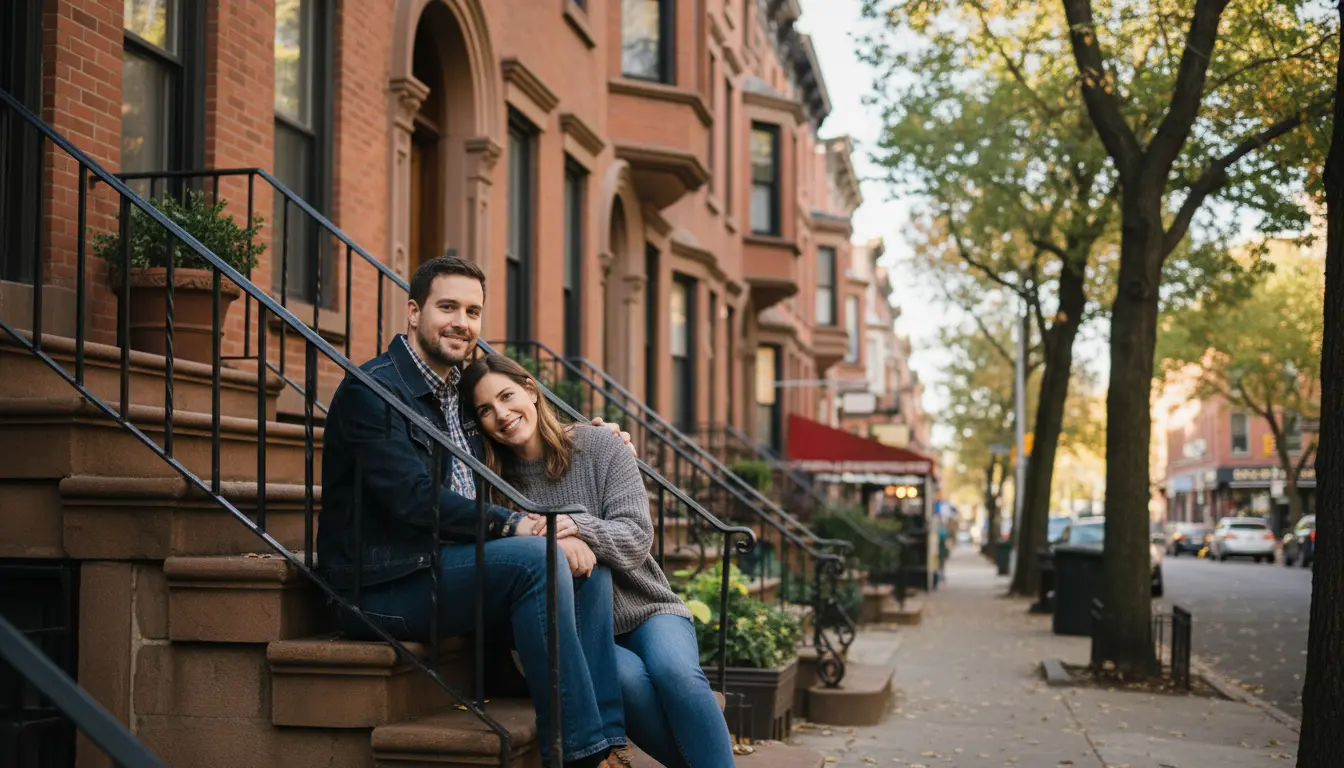
Shows the typical stoop/backdrop scale, proximity of neighboring buildings, and available natural light on quieter Flatbush side streets used for sessions. The close spacing of stoops and parked cars in the background illustrates how little empty space there usually is around a couple.
Choosing between commercial corridors and quieter pockets
Couples often decide whether they want Flatbush to appear busy and commercial or more residential and contained. That choice usually comes down to how comfortable they feel with people nearby:
- Church Avenue and Flatbush Avenue provide movement—buses arriving, storefronts changing, pedestrians crossing. These are good for a few fast, candid-style frames, but not for long posed sequences during peak hours.
- Side streets off Nostrand or Flatbush offer enough distance from storefront noise while still keeping the neighborhood context in frame. These are better for vows recaps, small family groupings, or first-look moments.
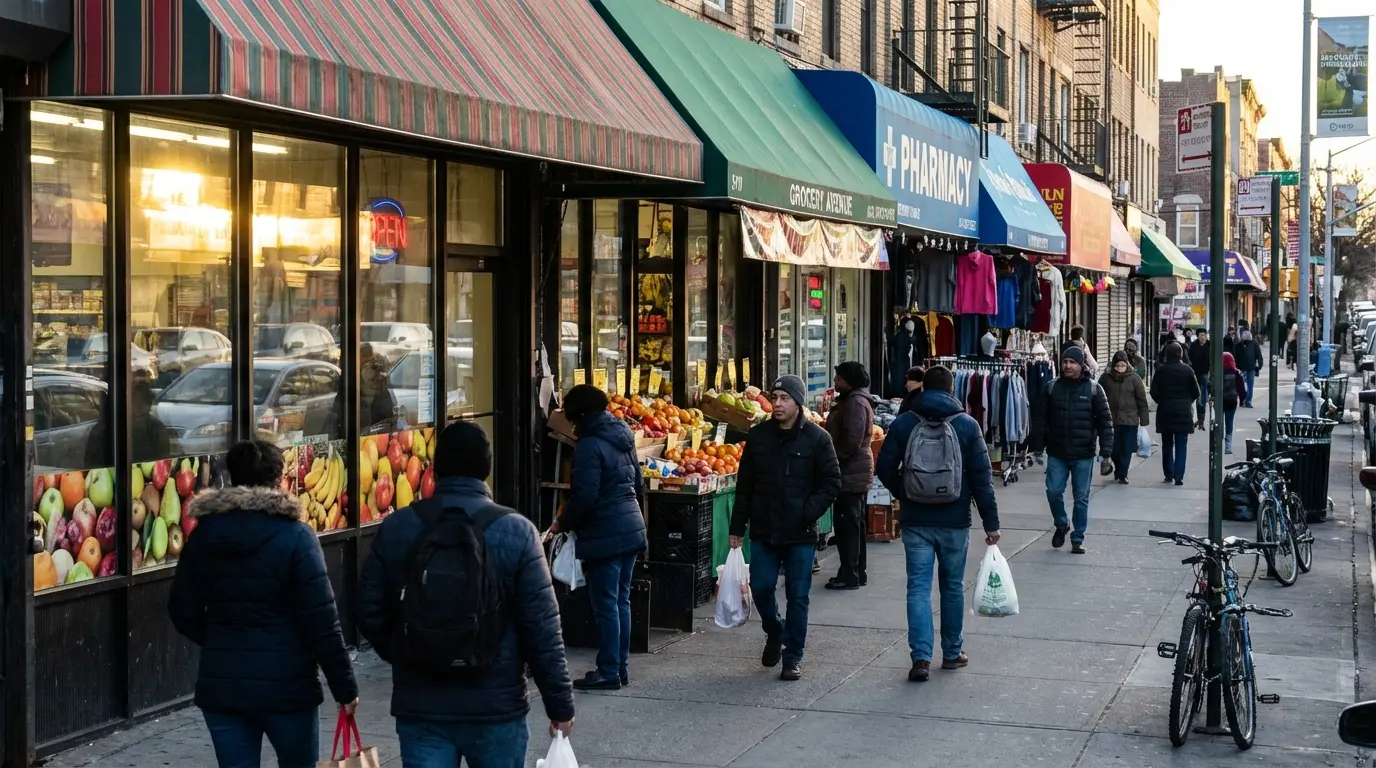
Helps compare crowd levels, reflective surfaces that affect lighting, and typical sidewalk clutter on Church Avenue for selecting shoot timing and framing. The delivery crates, litter, and glass reflections here are typical conditions that shape posing options.
When couples want Flatbush to feel like the “real” neighborhood they live in, rather than a polished backdrop, photographers often use both environments: a few frames on the avenue to show the energy, then a shift to a quieter block where expressions and details can be the focus.
How we serve Flatbush through Wedding photographer
These related services often branch off from Flatbush-based plans—whether it’s a small product shoot in the same apartment where a couple is getting ready, a beach ceremony outside the neighborhood to escape dense backdrops, or a proposal that starts on a familiar side street.
Working process on Flatbush sidewalks
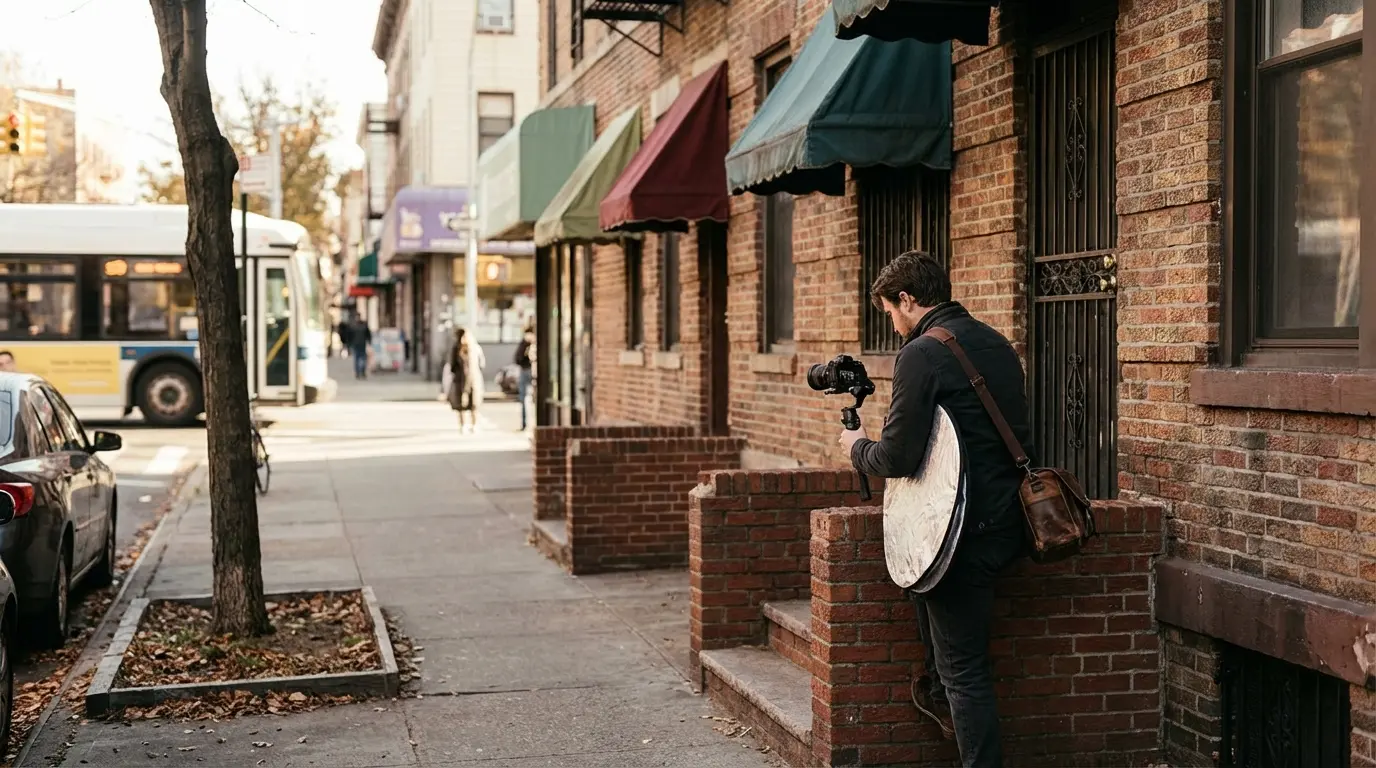
Most Flatbush sidewalks were not designed for tripods, rolling cases, and light stands. They are narrow, interrupted by tree pits, bike racks, and cellar doors, and shared with steady foot traffic.
Because of this, on-street setups are kept deliberately compact: shoulder bags instead of large carts, handheld reflectors instead of big frames, and brief stops instead of long, fixed positions. Posing often happens a step or two up from the sidewalk on a stoop or at a building entrance so passersby can keep moving.
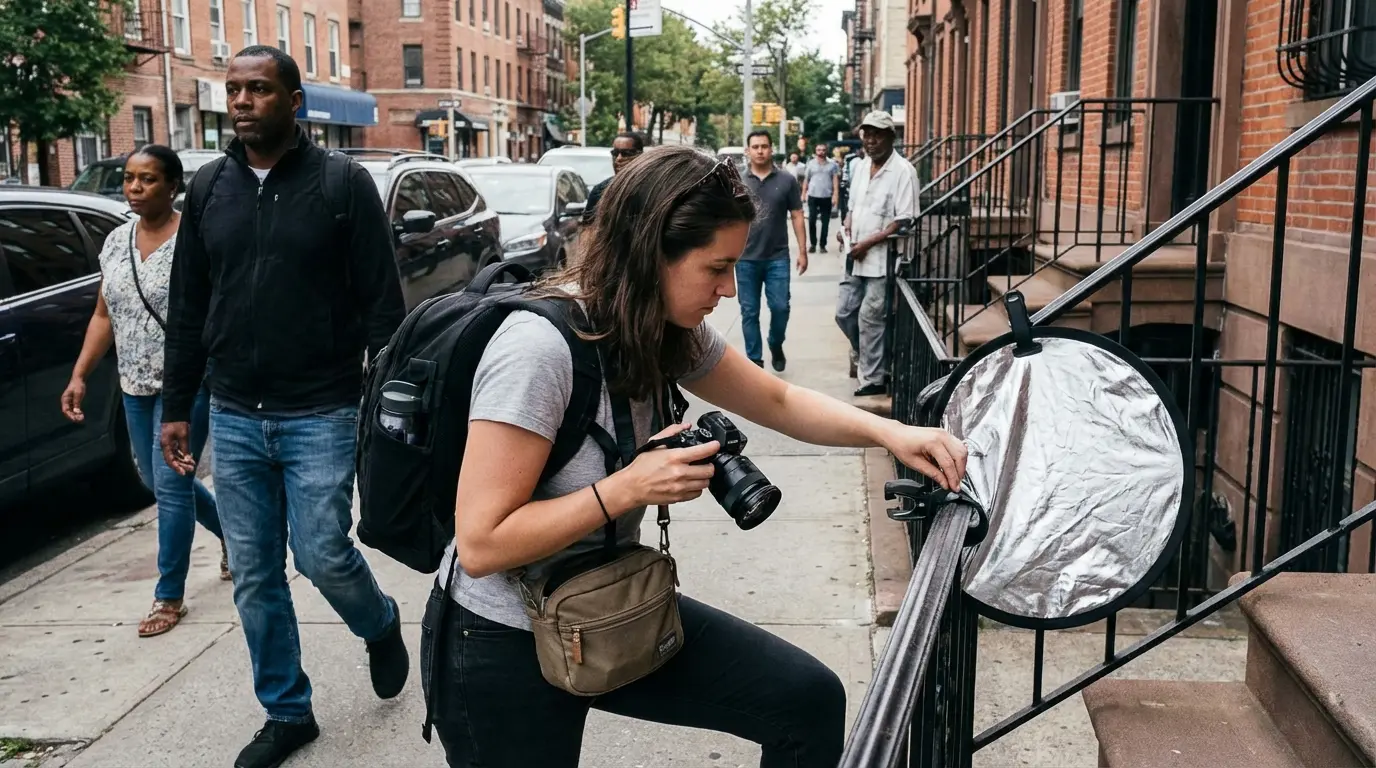
Verifies the need for low-footprint gear and how pedestrian flow impacts setup choices on Flatbush sidewalks. The proximity of pedestrians and storefronts shows why equipment stays small and mobile here.
Constraints: crowds, wind, and semi-private spaces
Flatbush has a few consistent constraints that shape how, where, and when wedding coverage happens:
- Crowd density – Church Avenue and Flatbush Avenue are highly congested during school start/dismissal and early evening shopping. Quieter windows tend to be mid-morning on weekdays, before lunchtime and before schools release.
- Wind tunnels – On wider parts of Flatbush Avenue near major intersections, taller building walls can create funnelled gusts that hit unexpectedly, especially in cooler months.
- Access rules – School grounds, church steps, and many apartment courtyards are effectively off-limits without prior permission. Even where a stoop is visible from the street, it may be treated as private space.
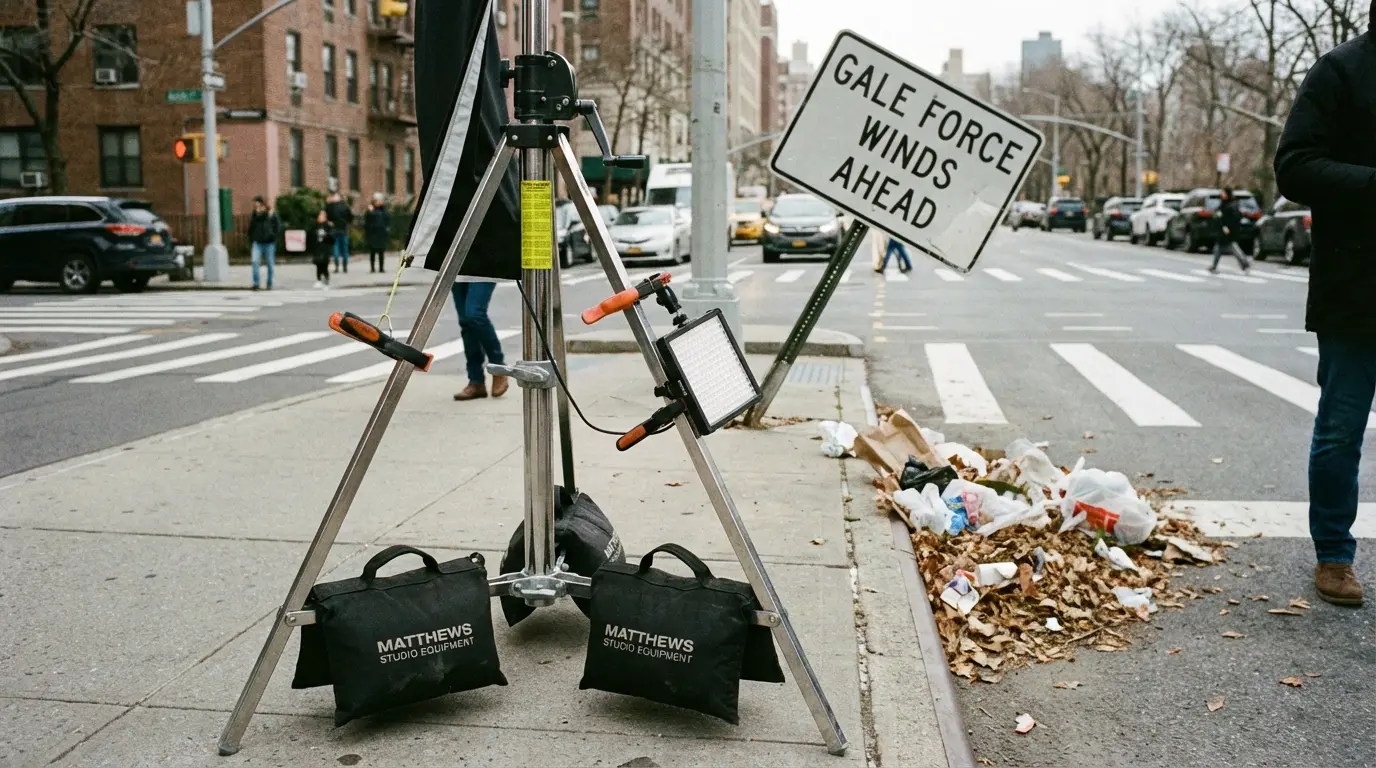
Shows how gusts and sidewalk clutter appear on major corners and what basic equipment-securement measures may be necessary to reduce risk. The sandbags, blown newspaper, and trash bags awaiting pickup are all common features at these corners.
For any plan that leans on park-adjacent areas or larger organized setups, it is important to be aware that Parks Department or property-management oversight may apply. The approach in Flatbush is generally to assume public sidewalks and park borders are usable for small-scale, low-footprint photography, and to treat anything beyond that as requiring coordination.
Everyday “chaos” details that still appear in Flatbush photos
Beyond traffic and buildings, Flatbush has a set of smaller, repeating details that quietly shape how images look:
- Unexpected color pockets – A row of neutral brick storefronts on Church Avenue might suddenly be broken by a bright turquoise awning or a hand-painted mural near Flatbush Avenue. Those saturated accents can become either a focal point or something to frame around, depending on a couple’s preferences.
- Materials palette – Brick dominates, but it is constantly interrupted by galvanized metal gates, chain-link fences, and aging wooden railings on some stoops. In close-up portraits, those materials show up as blurred patterns and lines, subtly changing the feel of the background from block to block.
- Trash pickup patterns – On many commercial stretches, bagged trash stacks up in the early evening ahead of nighttime pickup. Morning sidewalks are usually clearer, except near the busiest retail doors where cardboard and crates appear early. This changes where it’s realistic to place a couple without needing to step around piles.
- Local smells – Around Caribbean groceries and bakeries, you often get a mix of spice, fried foods, and sweet pastry smells; near the larger intersections, vehicle exhaust is more noticeable. While smells don’t show in photos, they affect how long people are comfortable staying in one spot.
These “chaos” elements are part of why Flatbush reads as lived-in rather than staged. They are managed through positioning and timing rather than removed entirely.
Recognizable Flatbush meeting spots and landmarks
When groups need a clear meeting point before moving into smaller streets, they usually choose something instantly recognizable:
- The frontage and gates around Erasmus Hall High School.
- Corners where Flatbush Avenue intersects Church Avenue or nearby major streets.
- Civic spots like the local Flatbush Library, which can serve as a quieter waiting area a short walk from busier blocks.
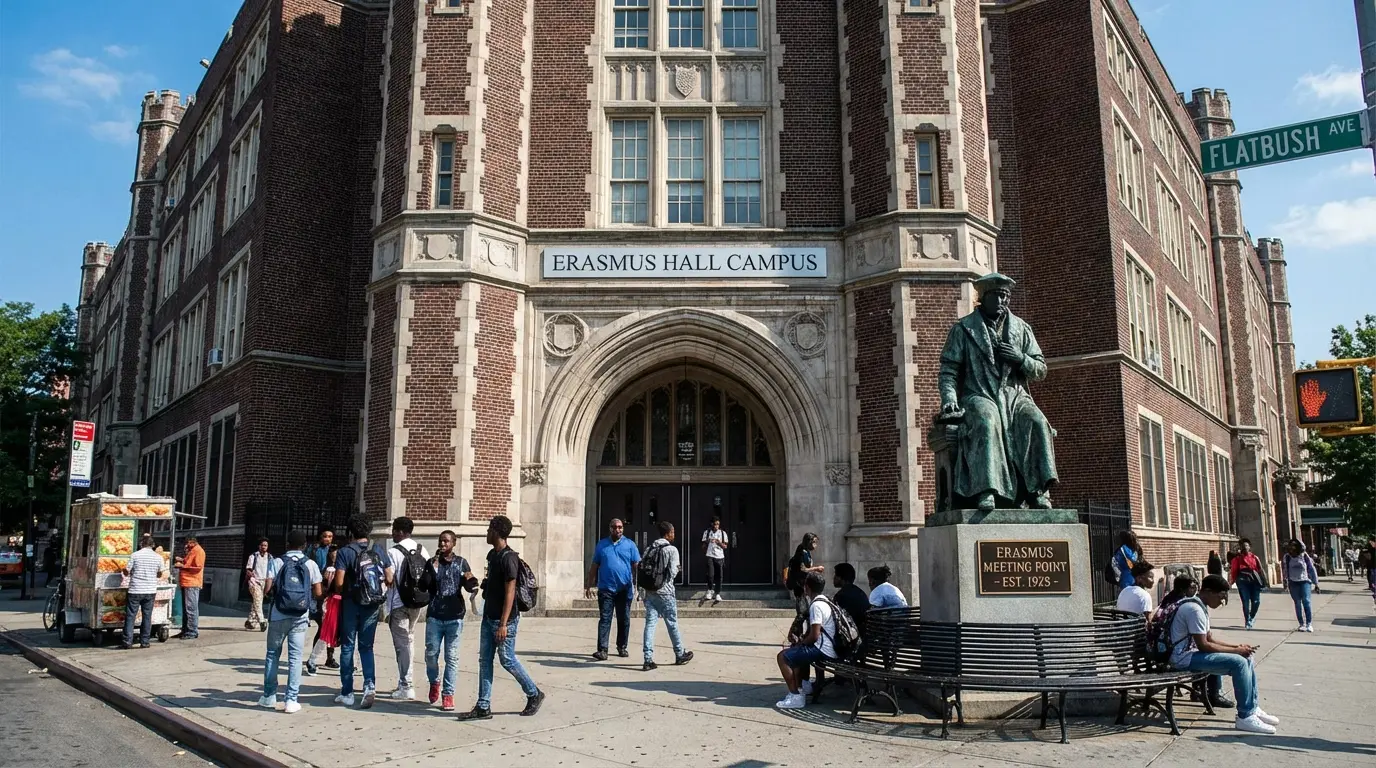
Confirms a recognizable Flatbush anchor and shows nearby sidewalk and transit access, useful for planning meeting points and understanding local foot traffic. The crosswalks and bus stop in frame illustrate why this area is practical for gathering before walking to quieter blocks.
These anchors also help orient anyone unfamiliar with the neighborhood; from there, it’s straightforward to describe “one block over” side streets for more private portraits.
What finished Flatbush images usually look like
Completed Flatbush wedding or engagement images almost always carry some trace of the neighborhood:
- A brick pattern or metal gate line in the background.
- A bus stop sign, market awning, or parked car edge at the frame’s periphery.
- Mixed light where part of the couple is in open shade from a building and part is catching reflected light from a storefront.
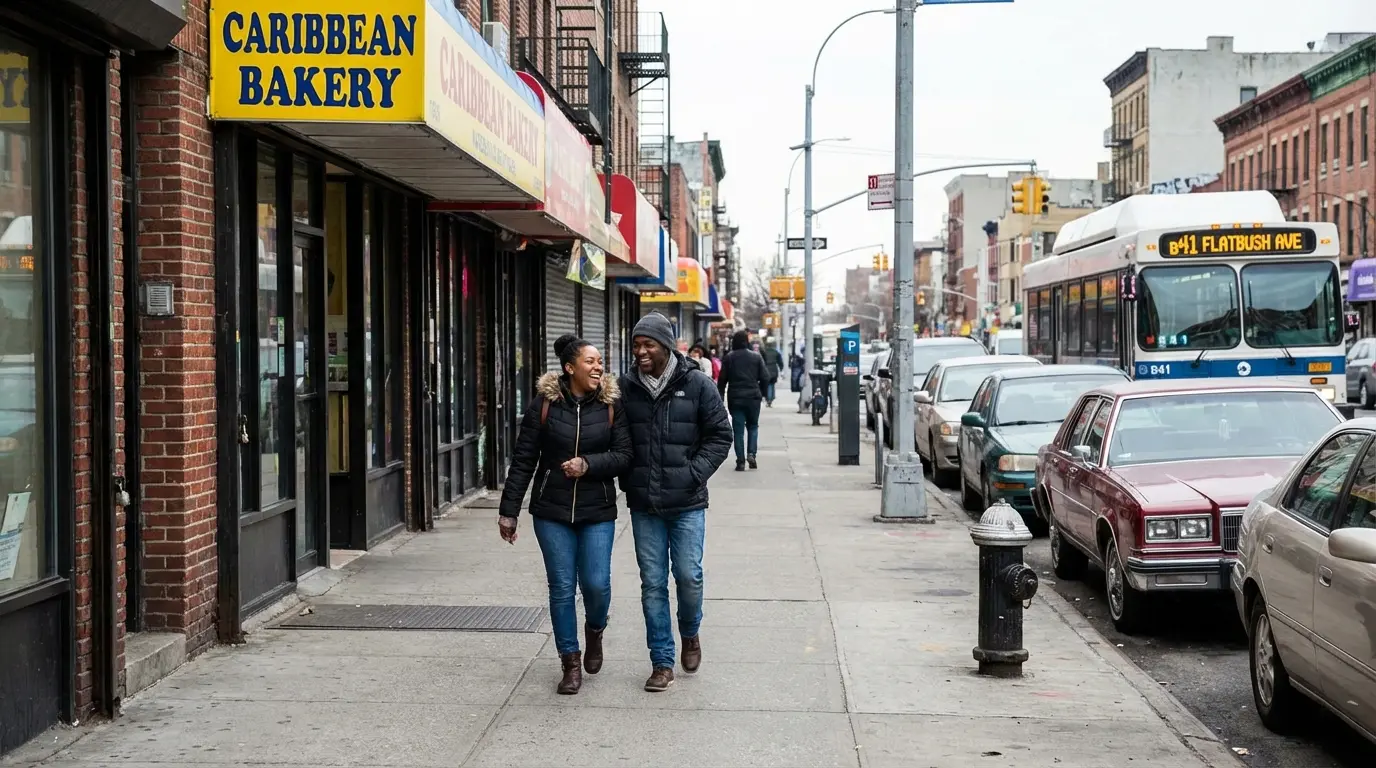
Illustrates a realistic final image that includes identifiable neighborhood context and urban elements buyers should expect in Flatbush-delivered photos. Storefronts, awnings, and municipal fixtures remain visible, even when focus is on the couple.
Rather than hiding these elements, many couples choose Flatbush precisely because their daily environment is visible. The goal is usually to balance clean composition with honest context.
Using Flatbush within wider Brooklyn wedding plans
Flatbush rarely exists in isolation on a wedding day. It often connects to other parts of Brooklyn via quick subway or car hops, especially when couples are getting ready here but marrying elsewhere.
A couple might book a local Wedding photographer to cover getting-ready moments in a Flatbush apartment, step outside for stoop portraits with family, then travel to a ceremony in a different neighborhood. Others may pair Flatbush streets with a larger park or waterfront location when they want at least one set of images without dense buildings in the background.
Because of transit access and the way blocks change character over short distances, Flatbush works well as the “home base” portion of a broader day, providing authenticity and familiarity before or after more open, destination-style settings.
Adjacent Neighborhoods we serve near Flatbush
These nearby areas often come into play when couples want quieter streets, different housing stock, or a small change in backdrop while staying close to Flatbush.
FAQ for planning wedding photography in Flatbush
Where is a practical place to meet before starting a Flatbush session?
Common meeting spots include the sidewalks near Erasmus Hall High School, the Flatbush–Church Avenue intersection, or outside the Flatbush Library. All are easy to describe and accessible by bus or subway, with quick transitions to quieter side streets.
When does Flatbush lose usable natural light on the streets?
Side streets running east–west lose direct light earlier than the official sunset time because of close building spacing. North–south avenues keep some light longer, but tall buildings cast deep shadows late in the day. For most of the year, mid- to late-afternoon is safer for consistent natural light than relying solely on the last hour before sunset.
Which parts of Flatbush are most crowded, and when?
Church Avenue, Nostrand Avenue, and Flatbush Avenue see the highest pedestrian density during school arrivals and dismissals, lunchtime, and early evening shopping. Mid-mornings on weekdays are typically the least crowded; weekends vary based on deliveries and local events.
Are there any places in Flatbush where we should assume we can’t shoot?
School grounds, many church steps, and apartment courtyards are often treated as private or semi-private. Unless someone in the wedding party has permission from property management or staff, it is safer to plan on public sidewalks, stoops where you have a clear connection, and park-adjacent borders rather than interior lawns or yards.
How do weather and wind affect Flatbush sessions?
On major corners along Flatbush Avenue, wind can be stronger than the forecast suggests because buildings create a canyon effect. Light stands or veils can move unexpectedly, so photographers usually keep equipment weighted and choose more sheltered side streets for longer posed segments if the day is gusty.
What should couples unfamiliar with Flatbush expect in the background of their photos?
They should expect real city elements: brick facades, metal gates, awnings, parked cars, and occasional trash bags if shooting near evening pickup times on commercial blocks. With thoughtful positioning and timing, these elements can be minimized or used intentionally, but they remain part of the neighborhood’s honest visual story.