Finding the Right Food Photographer in Brooklyn’s Local Results
Food Photography in Brooklyn appears across Google Maps listings, local directories, and search results that show multiple providers side by side \u2014 making it necessary for restaurant owners and food business operators to compare options carefully before booking. The decision involves more than finding a photographer who owns a camera and lists food work. It requires assessing whether a provider can deliver images formatted for your specific channels, handle the logistics of shooting in your venue, and produce results consistent with how your food actually looks and is presented.
This page covers the food photography service offered by Vera Starling, a photography and videography business based in Sheepshead Bay, Brooklyn. The information below is organized to help you evaluate this provider by outlining what the service covers, how it is typically delivered, and what to verify before making a decision.
What Food Photography Services Typically Cover
Food photography for restaurants, food brands, and food-related businesses in Brooklyn can involve several distinct types of work. The specific scope of a session with Vera Starling should be confirmed during inquiry, but the general categories of food photography available in this market include:
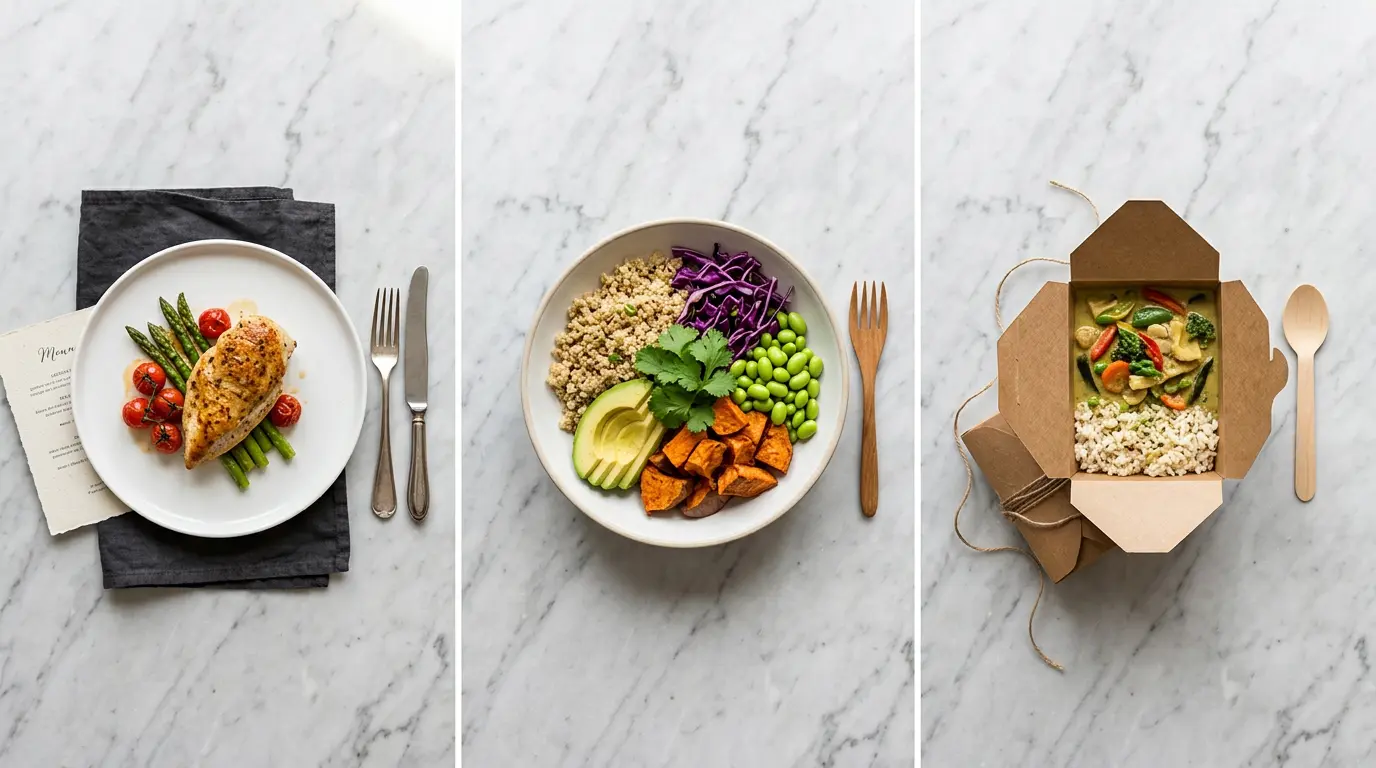
- Menu photography \u2014 individual dish shots composed and lit for printed menus, menu boards, or digital menu displays
- Delivery platform images \u2014 photographs cropped and formatted to work as thumbnails and hero images on platforms such as UberEats, DoorDash, and Grubhub
- Social media content \u2014 images framed in square, vertical, or horizontal proportions for Instagram, Facebook, or similar platforms
- Restaurant interior and ambiance shots \u2014 photographs of the dining space, bar area, or kitchen environment used alongside food imagery on websites and marketing materials
- Food brand and product photography \u2014 packaged goods, ingredients, or branded items shot for e-commerce listings, packaging design, or wholesale presentations
- Editorial and publication photography \u2014 styled food images intended for press features, blog content, or food media outlets
A single session does not necessarily cover all of these categories. The number of dishes photographed, the number of final edited images delivered, and any format-specific outputs should be confirmed before a session is scheduled. Vera Starling is also listed under Commercial photography services, which may inform the scope of food-related work available through this business.
How to Evaluate Food Photography Providers in Brooklyn
Comparing food photographers requires looking beyond portfolio thumbnails. The following criteria can help you assess whether a specific provider is suited to your project:
1. Portfolio specificity \u2014 Check whether the photographer has food photography work in their portfolio, distinct from general commercial or event photography. Look for examples that align with your cuisine type, plating style, and intended output format. If a portfolio primarily shows weddings, portraits, or other non-food categories, request food-specific samples before proceeding.
2. On-location capability \u2014 Most Brooklyn restaurants and food businesses need photography done on-site, where the existing environment \u2014 surfaces, wall textures, ambient lighting \u2014 is part of the scene. Confirm whether a photographer can travel to your venue and is prepared to work within the constraints of your space, including tight kitchens and limited staging surfaces.
3. Output format range \u2014 A menu shoot, a delivery platform listing update, and a social media campaign all require different framings and file specifications. Ask whether the photographer can deliver images optimized for each format within a single session or whether separate sessions are needed.
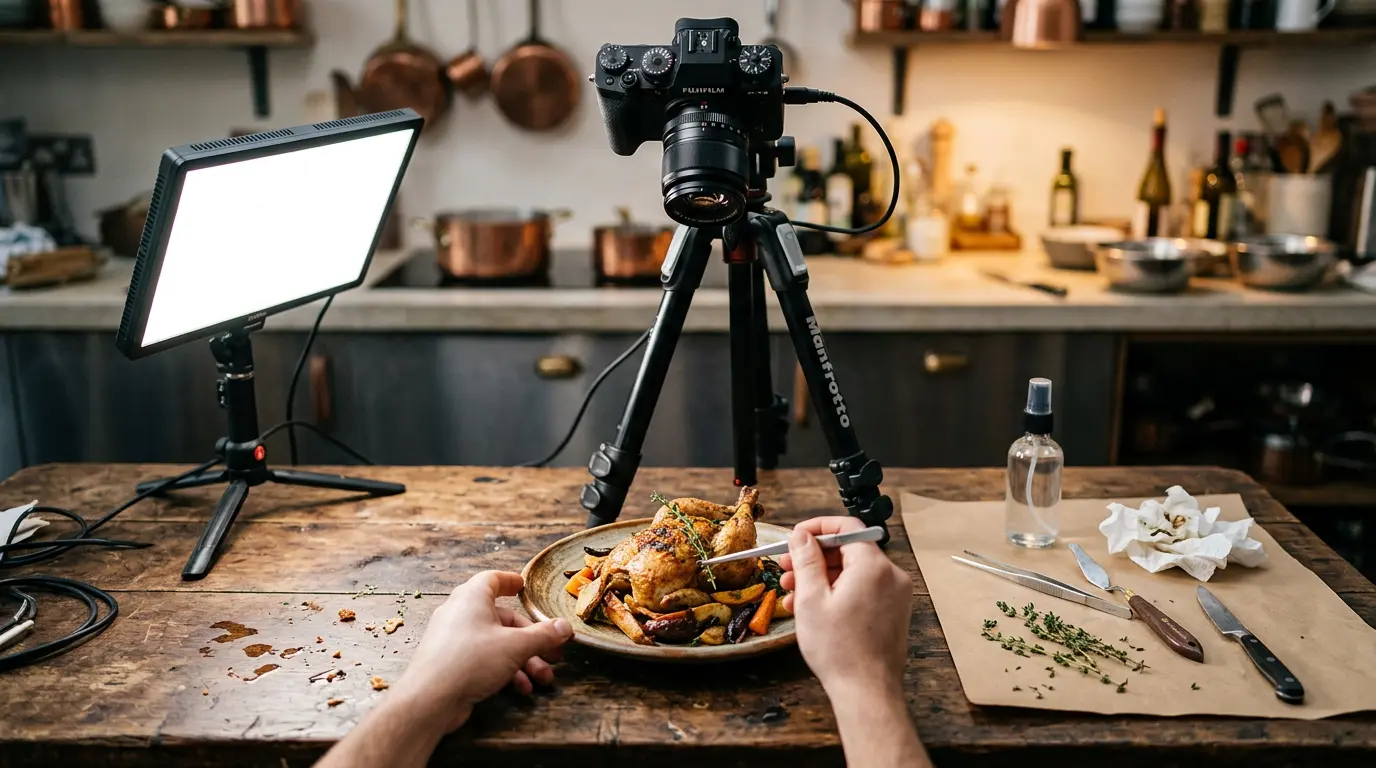
4. Food styling responsibility \u2014 Some photographers arrive with their own styling toolkit and adjust dishes during the shoot. Others expect the kitchen team to plate and present every dish camera-ready. Clarifying this division of labor prevents delays and confusion on shoot day.
5. Seasonal timing and menu cycles \u2014 Restaurants launching seasonal dishes may want to coordinate a shoot around ingredient availability or a menu rollout date. Spring bloom timing in Brooklyn can also affect shoots that incorporate outdoor patio or sidewalk-cafe settings, where greenery, flowering trees, and natural light shift noticeably between March and May.
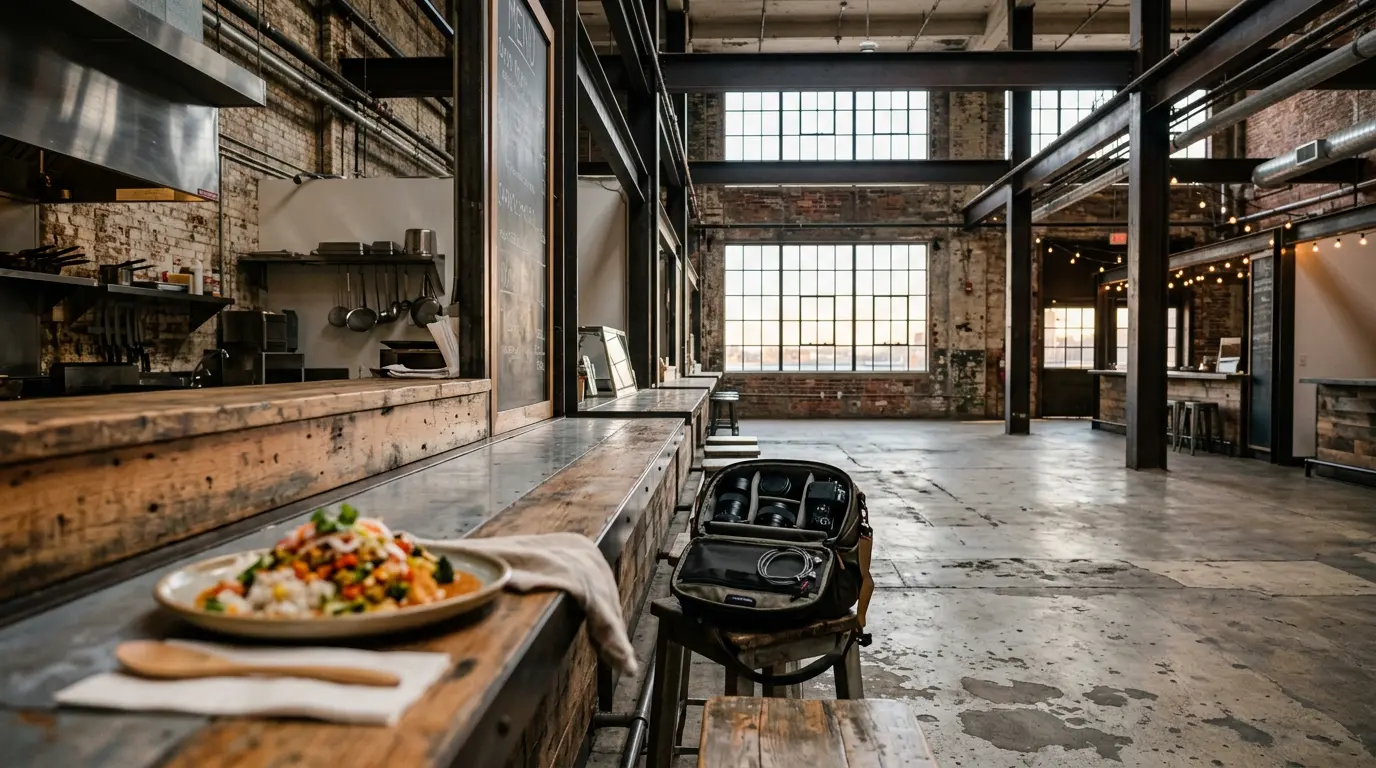
6. Venue environment experience \u2014 Brooklyn’s food scene spans a wide range of interior settings: industrial loft spaces in Williamsburg, warehouse-converted food halls in Bushwick, compact storefronts, and modern buildouts. A photographer familiar with varying conditions may adapt more quickly to difficult lighting, reflective surfaces, or low ceilings.
7. Outdoor and waterfront considerations \u2014 For food businesses with patios, rooftops, or outdoor seating near Brooklyn’s waterfront, wind conditions can displace napkins, lightweight garnishes, herbs, and small props during a shoot. Confirm whether the photographer has experience managing outdoor food setups and brings clamps or stabilizers when needed.
8. Deliverable and licensing clarity \u2014 How many final edited images are included? Are raw files provided? What is the expected turnaround? Are delivery platform crops billed separately? Are there restrictions on how or where you can use the images? These details vary significantly between providers and should be confirmed in writing.
What Happens During a Typical Food Photography Session
The specific workflow for a food photography session with Vera Starling should be confirmed during inquiry. The following describes the general phases that apply to most on-location food photography work in Brooklyn:
Pre-shoot planning \u2014 The photographer and client finalize the shot list: which dishes will be photographed, how many angles per dish, and what the images will be used for. Scheduling is coordinated around the restaurant’s service hours to avoid interfering with regular operations. For venues with limited counter or table space, staging logistics are also discussed.
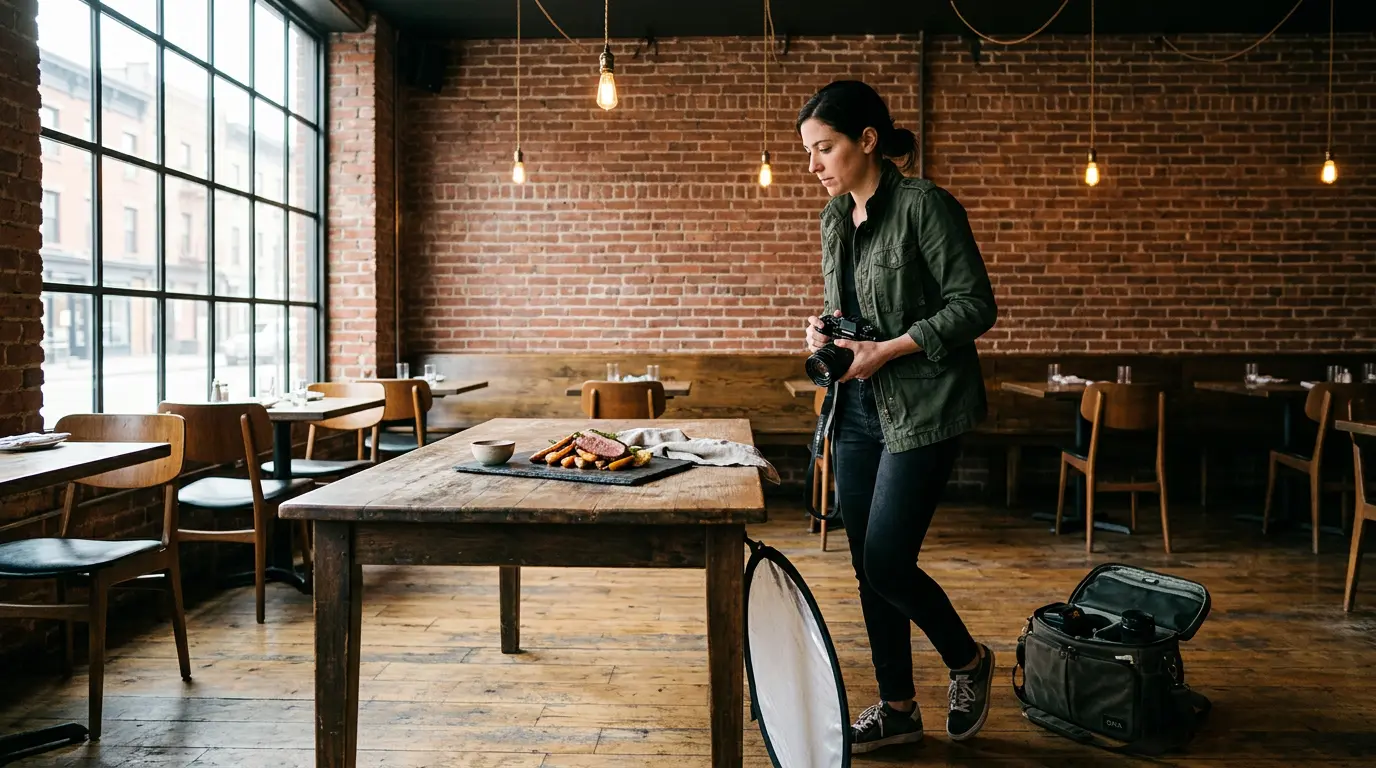
Setup \u2014 On shoot day, the photographer arrives at the location and sets up lighting equipment, camera gear, and any backdrops or reflectors needed. Setup time depends on the venue’s ambient light, ceiling height, and available surfaces. Spaces with large windows may allow the use of natural sidelight, while darker interiors typically require portable LED panels or strobes.
Active shooting \u2014 Dishes are plated by the kitchen team (or styled by the photographer, depending on the arrangement) and photographed according to the shot list. Multiple compositions may be captured per dish \u2014 an overhead angle for social media, a 45-degree angle for menu use, and a tight crop for delivery platform thumbnails. If restaurant staff or chefs will appear in any images, what they wear should be discussed in advance so that attire is consistent with the restaurant’s visual identity and does not distract from the food.
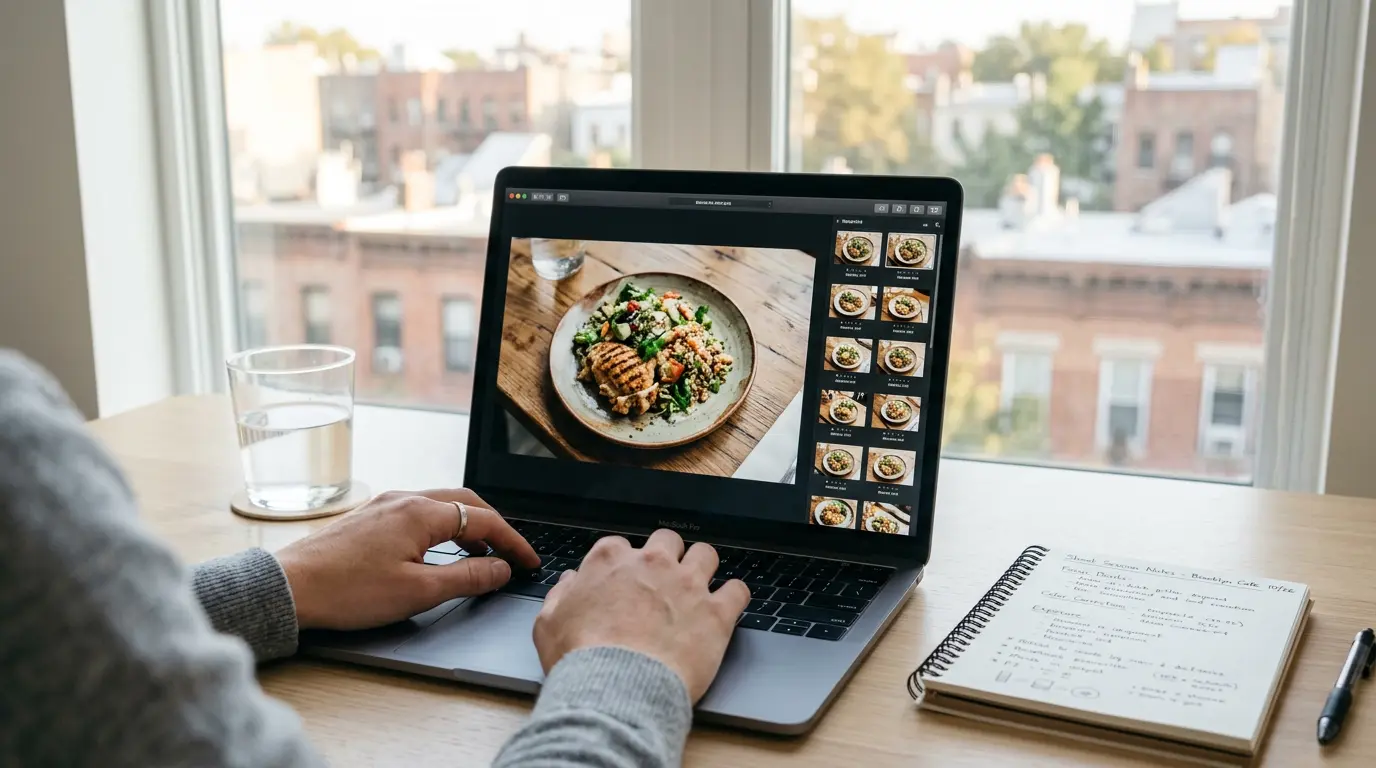
Post-production \u2014 After the shoot, the photographer selects the strongest images, applies color correction, performs retouching, and exports files in the required formats. Some photographers offer a client review stage before final editing, allowing the restaurant owner or manager to choose preferred shots from a larger set of proofs.
Delivery \u2014 Final edited images are typically made available through an online gallery, shared drive, or file transfer service. Confirm whether the delivery includes both print-resolution and web-optimized versions, and whether format-specific crops for delivery apps or social media are part of the standard package.
Reducing Risk When Hiring a Food Photographer in Brooklyn
Verifiable business facts
The following details about Vera Starling can be independently verified through the Google Business Profile and public listings:
- Business name: Vera Starling
- Address: 2483 E 22nd St, Sheepshead Bay, Brooklyn
- Phone: +1917-386-8509
- Website: video-nyc.com
- Primary Google Business Profile category: Wedding photographer
- Additional categories: Commercial photographer, Photographer, Photography service, Video production service
- Other listed services: Baby Photography, Family and Group, Maternity and Newborn, Newborn Photography, Portrait Photography
Food photography is presented as a subcategory under the primary Wedding photographer listing. The business’s Google-facing category designation reflects wedding photography as its primary classification \u2014 this is a factual observation buyers can verify directly.
What buyers should confirm during evaluation
The following details are not confirmed in the available listing data and should be verified directly with the business before booking:
- Whether food photography is a regularly performed service line with recent completed projects
- Portfolio examples of food photography work, separate from wedding, portrait, or event photography
- Number of final edited images included per session or per package
- Turnaround time from shoot day to final file delivery
- Whether food styling is provided by the photographer or handled by the client’s kitchen staff
- Licensing and usage rights for delivered images, including whether images can be used across all platforms without restriction
- Whether delivery platform-specific formatting (UberEats, DoorDash, Grubhub thumbnail specifications) is offered
- On-location availability throughout Brooklyn and any travel fees that may apply
- Rescheduling and cancellation policies
- Pricing structure \u2014 whether rates are per dish, per hour, per session, or per package
- Equipment and lighting brought to on-location shoots
Service Location and Brooklyn Neighborhoods Covered
Vera Starling is based at 2483 E 22nd St in the Sheepshead Bay section of Brooklyn. The Sheepshead Bay station on the B and Q subway lines is the nearest transit stop, providing direct connections from central Brooklyn and Manhattan for clients traveling to the studio location.
For food photography projects, on-location sessions at client venues across Brooklyn can typically be arranged \u2014 though availability, travel logistics, and any associated fees should be confirmed during scheduling. The following neighborhoods are highlighted as part of the service area for this page:
Williamsburg is Brooklyn’s highest-density restaurant neighborhood, with concentrations of upscale-casual dining, artisan bakeries, craft beverage programs, and food-forward cafes along Bedford Avenue, the North 6th Street corridor, and the waterfront dining cluster. Food photography sessions in Williamsburg often involve industrial loft interiors with exposed brick, pendant lighting, and factory windows \u2014 while waterfront patio settings in the area require attention to wind conditions that can shift napkins, lightweight garnishes, and small props during outdoor shoots.
Bushwick has emerged as a growing hub for experimental food ventures, pop-up kitchens, food halls, and diverse ethnic eateries clustered along corridors like Wyckoff Avenue and near Maria Hernandez Park. The warehouse-district aesthetic common in Bushwick restaurants \u2014 raw concrete, exposed ductwork, and minimally finished surfaces \u2014 creates a distinct set of lighting and staging conditions for food photography work.
Sunset Park is home to Industry City, a commercial and creative complex that houses food vendors, test kitchens, and food production businesses. The neighborhood also includes the 8th Avenue corridor and the 5th Avenue food corridor, where restaurants and food businesses serving diverse cuisines present a range of photography needs \u2014 from multi-dish menu shoots to individual product images for wholesale distribution. Spring seasonal menu launches in this area, when new ingredients and outdoor dining options become available, can drive the timing of photography sessions.
Visual Evidence to Support Your Evaluation
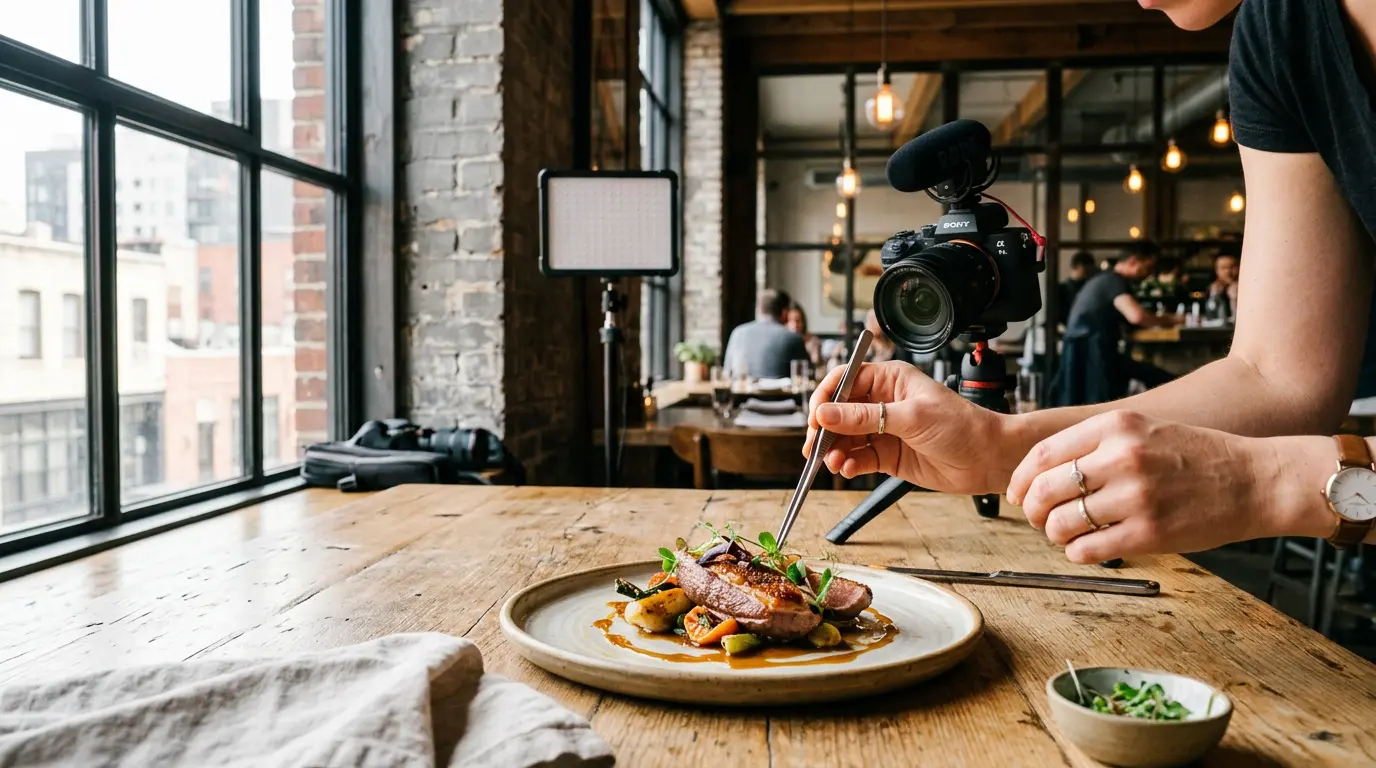
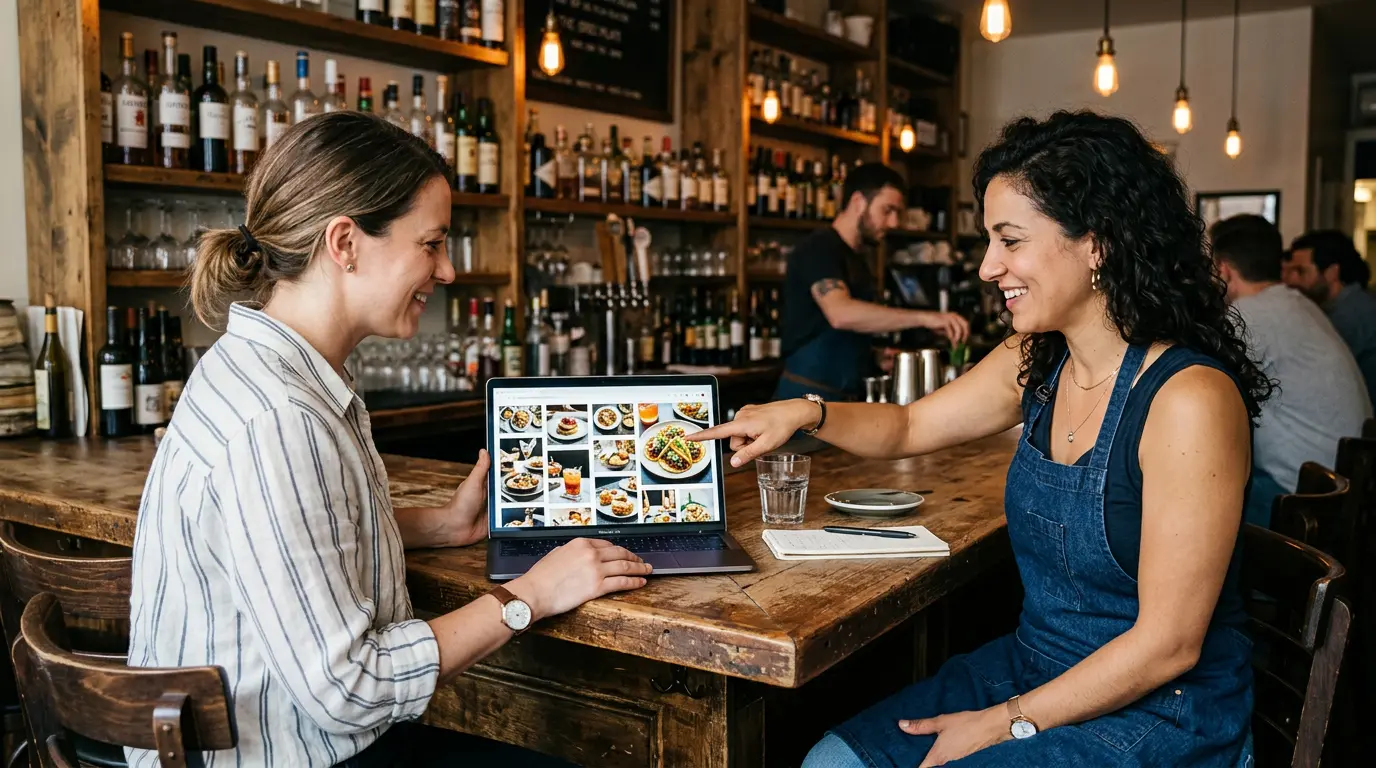
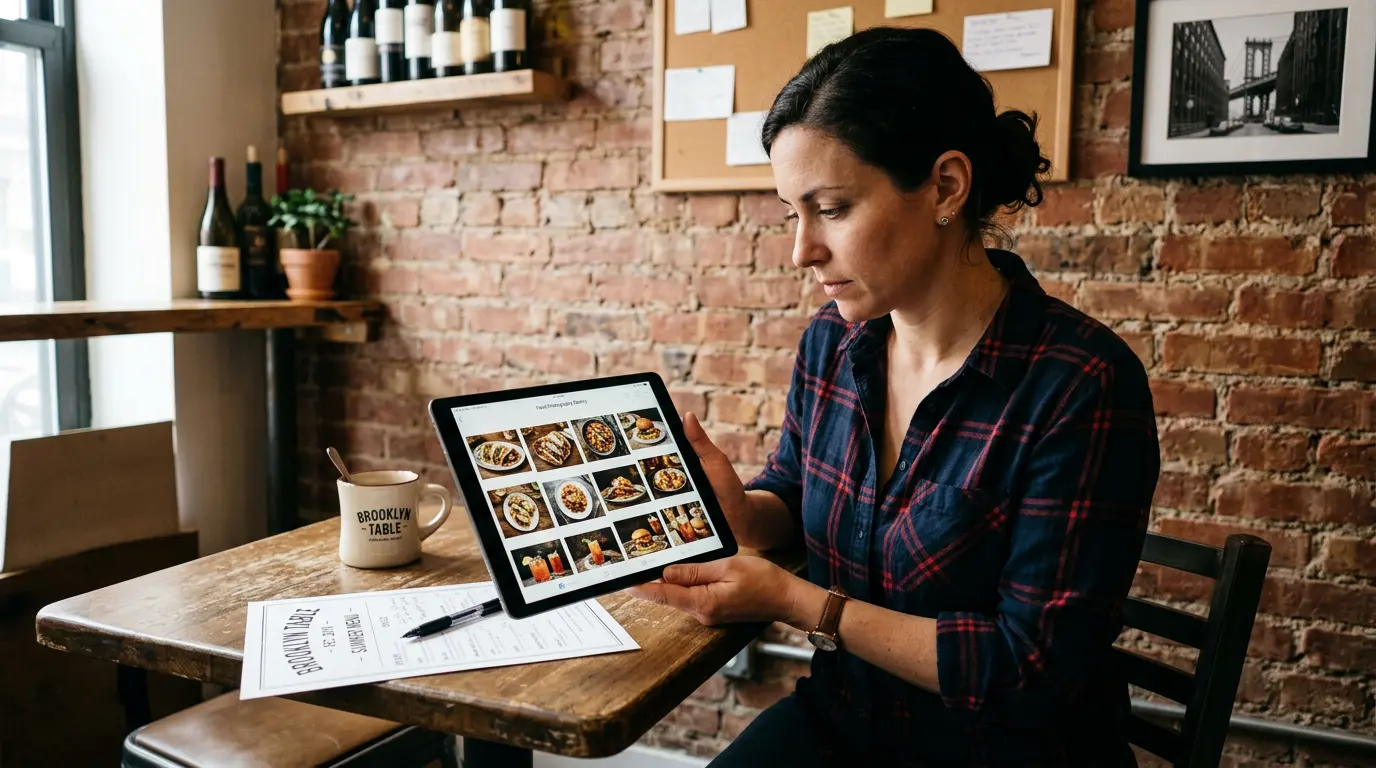
The photographs placed throughout this page document different phases of the food photography process: on-location setup in a restaurant environment, active shooting with lighting and styling equipment visible, a client review session for image selection, post-production editing and file organization, neighborhood-specific venue work, and final gallery delivery to the client.
These images are presented as process documentation rather than a finished portfolio of edited food photographs. When evaluating any food photography provider, examining both the working process and the finished output gives a more complete basis for comparison than either one alone. Requesting a dedicated food photography portfolio from Vera Starling during inquiry is recommended for assessing final image quality and style fit.
Frequently Asked Questions About Food Photography in Brooklyn
1) Does the photographer shoot on location at my restaurant, or do I need to bring food to a studio?
This depends on the provider and the project scope. Many Brooklyn food photography sessions are conducted on-location at the client’s restaurant or kitchen. Whether Vera Starling offers on-location sessions, studio-based sessions, or both should be confirmed during inquiry.
2) How can I tell if a photographer’s style matches my restaurant’s brand?
Review the photographer’s food-specific portfolio for dishes, plating styles, and lighting approaches similar to what you are looking for. If the available portfolio primarily shows wedding or portrait work rather than food photography, ask for food-specific samples before committing to a session.
3) How many edited photos will I receive from a session?
Deliverable counts vary by provider and session scope. Some photographers include a set number of final images; others base deliverables on the number of dishes or hours booked. This should be confirmed in writing before the shoot takes place.
4) Can images be formatted specifically for delivery apps like UberEats or DoorDash?
Delivery platforms have specific image dimension and quality requirements for menu listings. Not all food photographers include platform-specific crops as a standard part of their deliverables. Ask whether this formatting is included or available as a separate add-on.
5) Who is responsible for styling the food during the shoot?
The arrangement varies. Some photographers bring styling tools \u2014 tweezers, spray bottles, garnish kits \u2014 and adjust plating on set. Others rely on the kitchen team to present each dish camera-ready. Confirm this division of labor during the planning phase to avoid confusion on shoot day.
6) How long does it take to receive final images after the shoot?
Turnaround times range from a few business days to several weeks depending on the photographer’s workload, the number of images being edited, and the post-production process involved. Establish a delivery timeline before booking.
7) What usage rights come with delivered images?
Licensing terms differ between photographers. Some grant full commercial usage rights across all platforms and media types. Others may restrict usage to specific channels or time periods. Clarify licensing in the service agreement before the session.
8) How should my restaurant prepare for a food photography shoot?
Standard preparation includes finalizing the dish list with the photographer, confirming that ingredients for every dish will be available on shoot day, and ensuring the staging area is clean. If any staff members will appear in photographs, discuss what they should wear in advance \u2014 attire that aligns with the restaurant’s uniform or brand standards typically works best and avoids visual distractions in the final images.
9) Does weather affect food photography sessions?
For indoor restaurant shoots, weather is generally not a factor. For outdoor sessions \u2014 patios, rooftop dining areas, or sidewalk settings \u2014 rain and wind are the primary concerns. Near Brooklyn’s waterfront, wind conditions can be strong enough to displace napkins, lightweight menus, and small props. Scheduling outdoor food shoots during calmer morning hours or choosing sheltered table positions can help manage these variables.
10) When is the best time of year to schedule a food photography session for a new menu?
Timing depends on your menu cycle. Many Brooklyn restaurants schedule food photography when launching seasonal menus. For spring launches, coordinating the shoot to coincide with spring bloom timing in nearby Brooklyn parks and streetscapes \u2014 generally mid-April through May \u2014 can add natural greenery and color to any outdoor or patio shots that complement the main food imagery.
11) Is the photographer’s primary listing category relevant to food photography capability?
Vera Starling’s Google Business Profile lists “Wedding photographer” as the primary category, with “Commercial photographer” and “Photographer” as additional categories. This classification reflects how the business appears on Google rather than the full range of services offered. Evaluate food photography capability based on portfolio evidence and direct conversation, not on category labels alone.
12) What questions should I ask during an initial food photography inquiry?
Focus on: the number of final edited images included, turnaround time, pricing structure, usage rights, who handles food styling, whether on-location sessions are available across Brooklyn, and whether platform-specific image formatting is part of the service. Requesting food photography portfolio examples \u2014 separate from wedding or event work \u2014 is also recommended.
How to Inquire About Food Photography Sessions
Vera Starling’s business is located in Sheepshead Bay, Brooklyn, and photography sessions are scheduled by appointment. To discuss food photography availability, project scope, or to request portfolio examples:
- Phone: +1917-386-8509
- Website: video-nyc.com
Vera Starling is primarily listed as a Wedding photographer in Brooklyn, with additional service categories covering commercial photography and video production.
For clients whose projects involve food photography alongside event documentation, the business also offers Wedding Photography services that can be discussed during the initial conversation to determine whether bundled coverage is applicable to your needs.