
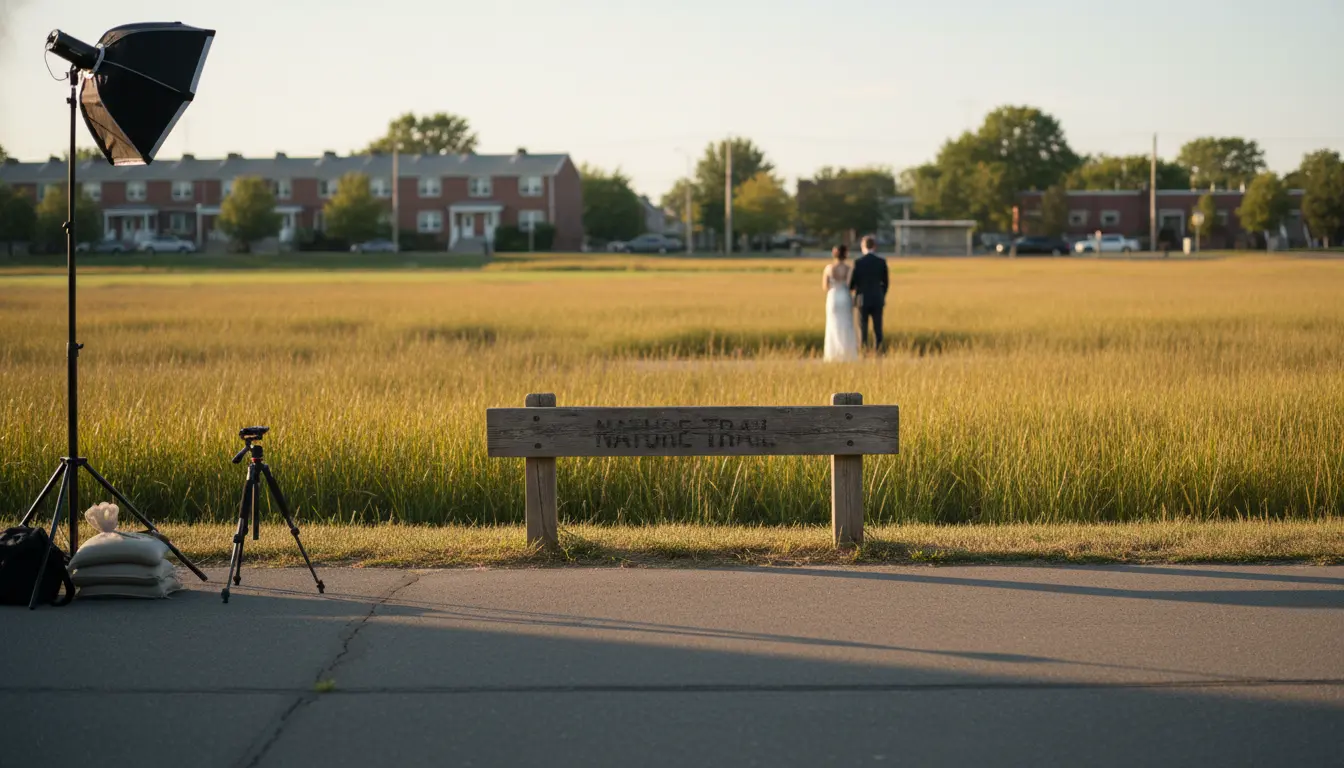
Marine Park in Brooklyn as a practical setting for photography sessions
Where Marine Park (Brooklyn) begins and ends
Marine Park is a low-rise residential pocket in southeast Brooklyn organized around the large Marine Park green space and the surrounding street grid. It is not a commercial district in the way nearby corridors are; instead, the park, schools, and single-family homes define how people move and gather here. Definitions of the neighborhood’s exact outline vary slightly—sources such as Marine Park, Brooklyn – Wikipedia generally place it around the namesake park and the residential blocks immediately north and west of it.
Within the broader Brooklyn layout, Marine Park sits south of Flatlands, with Midwood touching its northwestern edge around Avenue P and Gerritsen Beach forming a softer southern transition where the grid gives way to more water-facing streets. Flatbush and Canarsie lie a bit further away but still close enough that residents routinely cross those boundaries for errands, schools, or events.
The heart of the neighborhood is the park itself: ballfields, open lawns, and the Salt Marsh Nature Trail, framed by Fillmore Avenue to the north and Gerritsen Avenue along one long edge. Most outdoor sessions that want “Marine Park” in the background end up somewhere along these perimeters rather than deep inside tower blocks—because there are no towers here, only houses and low-built structures.
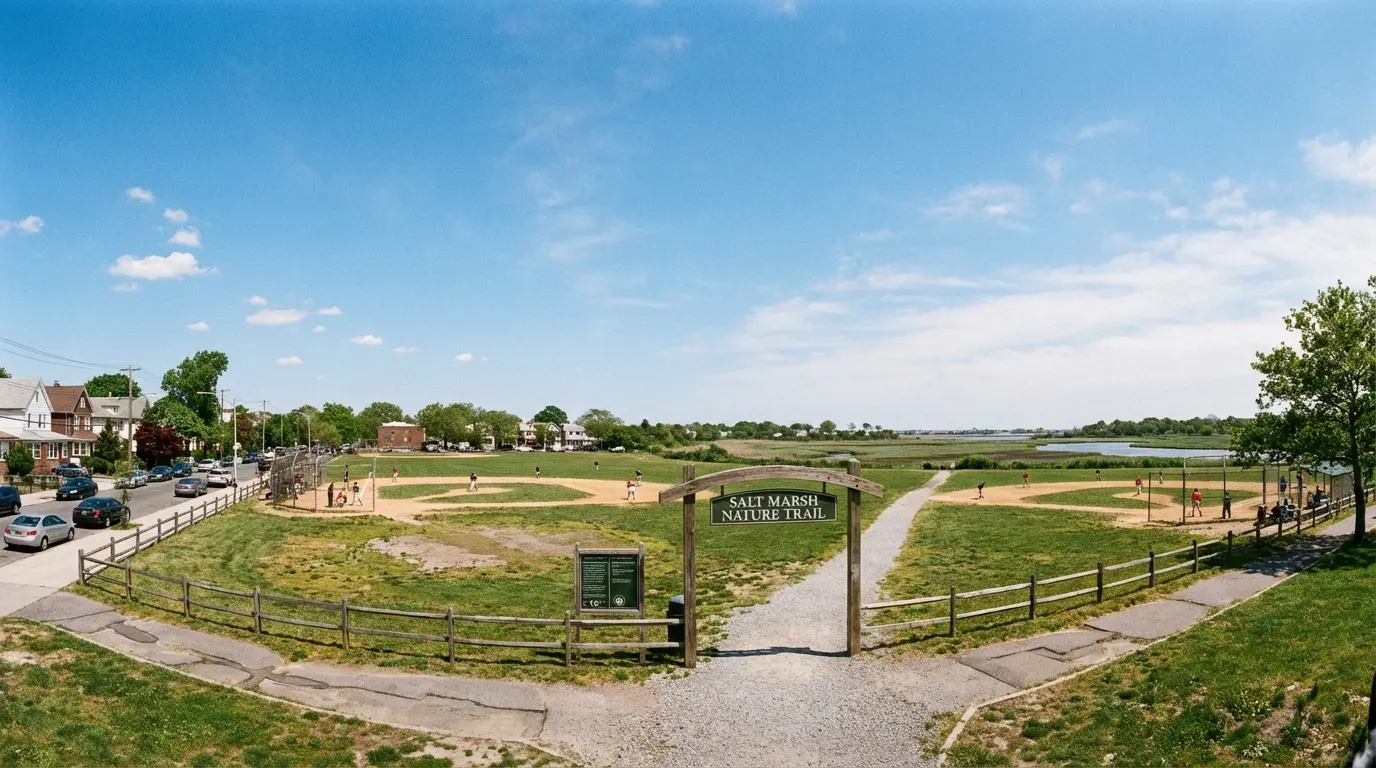
This view of the Marine Park ballfields opening toward the Salt Marsh entrance confirms the park’s scale and its open-sky character along Fillmore Avenue. You can see how close the curb cuts sit to the fields and paths, which is what makes quick access and recognizable backdrops feasible here.
Getting between Avenue U, Flatbush Ave, and the park interior
Avenue U is the main east–west spine through Marine Park. It carries buses, steady car traffic, and most of the neighborhood’s visible storefront activity. Intersections here are moderately busy, with turning vehicles, crosswalk signals, and occasional backups when a bus and a double‑parked vehicle overlap. For any session starting near the park and shifting to Avenue U storefronts, the main constraint is crossing these intersections with older relatives, strollers, or camera gear without being rushed by the light cycle.
Flatbush Avenue, a short distance west, provides connection to Kings Plaza and northbound transit. It’s more of a through-route than a backdrop, but it matters for how guests arrive, where drivers look for parking, and how long it takes to move between Marine Park and denser areas like Midwood or Flatbush.
Inside the neighborhood, side streets narrow and slow down. Residential blocks near schools often have irregular curb openings and school-drop-off surges that only last 20–30 minutes, but they can temporarily clog a block that looked quiet on a map. During weekday mornings, interior streets are mostly clear once school is in session; by late afternoon, traffic picks up around the park edges as practices and games begin.
Where small ceremonies and wedding sessions typically fit
Within Marine Park (Brooklyn), most wedding-related activity is small scale: park-side ceremonies, portrait sessions before or after a reception held elsewhere, or elopements with a tight circle of family. Wedding Photography sessions here typically settle on the park’s perimeter lawns along Fillmore Avenue or the Gerritsen Avenue edge, using the open fields and tree lines as simple, clean backgrounds.
The Fillmore Avenue side is common for setups because you can stage a small arch or chairs on the grass while keeping a direct sightline to the path for late arrivals. It’s also close enough to the curb that older guests or anyone arriving by car doesn’t have to cross long stretches of uneven ground. By contrast, deeper into the Salt Marsh trails you get more privacy and nature, but moving groups or props becomes slower and less predictable.
For very small ceremonies—just a couple, an officiant, and a few witnesses—people sometimes choose the quieter pockets near the Salt Marsh entrance, stepping off the main path only briefly. These are feasible so long as the group remains compact and doesn’t block public access.
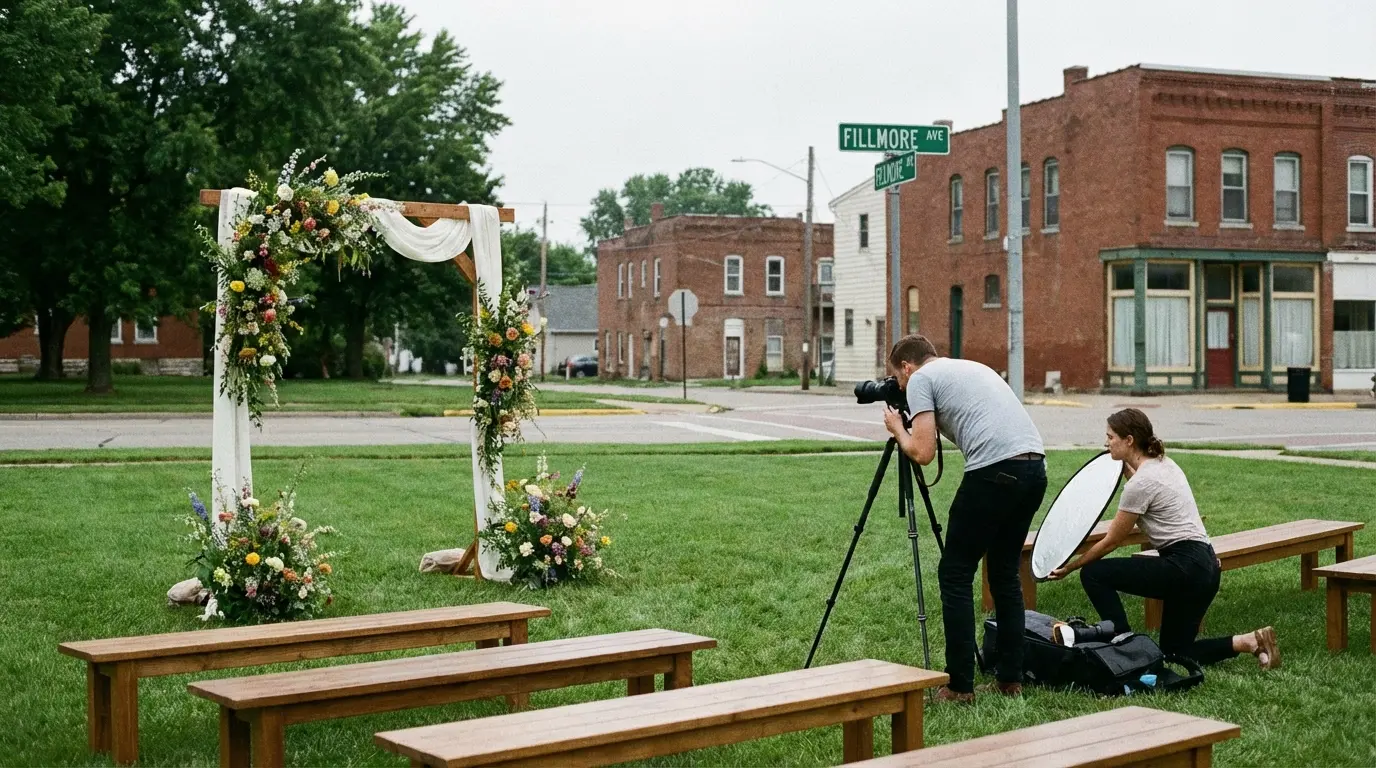
This small ceremony setup on a perimeter lawn near Fillmore Avenue shows how close the usable grass is to the path and benches. It verifies the kind of modest footprint that works here without overwhelming foot traffic or blocking through‑movement in the park.
Comparing park, Avenue U, and residential blocks as backdrops
Marine Park offers three main textures for photos: the park core, the Avenue U corridor, and the residential grid.
Park-perimeter blocks along Fillmore and Gerritsen give you immediate transitions between open fields, trees, and the street. These areas feel spacious in photos, with long sightlines across ballfields or toward the marsh, but you should expect background activity: kids walking home from school, dog walkers, informal games starting up behind a portrait frame.
Avenue U around East 36th–41st Streets introduces shopfronts, signage, and bus stops. It works for couples or individuals who want a quick nod to “everyday neighborhood life” rather than just grass and trees. The trade-off is interruption: morning and midday see delivery vans temporarily double‑parked, doors open, and hand trucks on the sidewalk, and buses idling at stops. This churn affects how long you can hold a clean frame before something pulls into it.
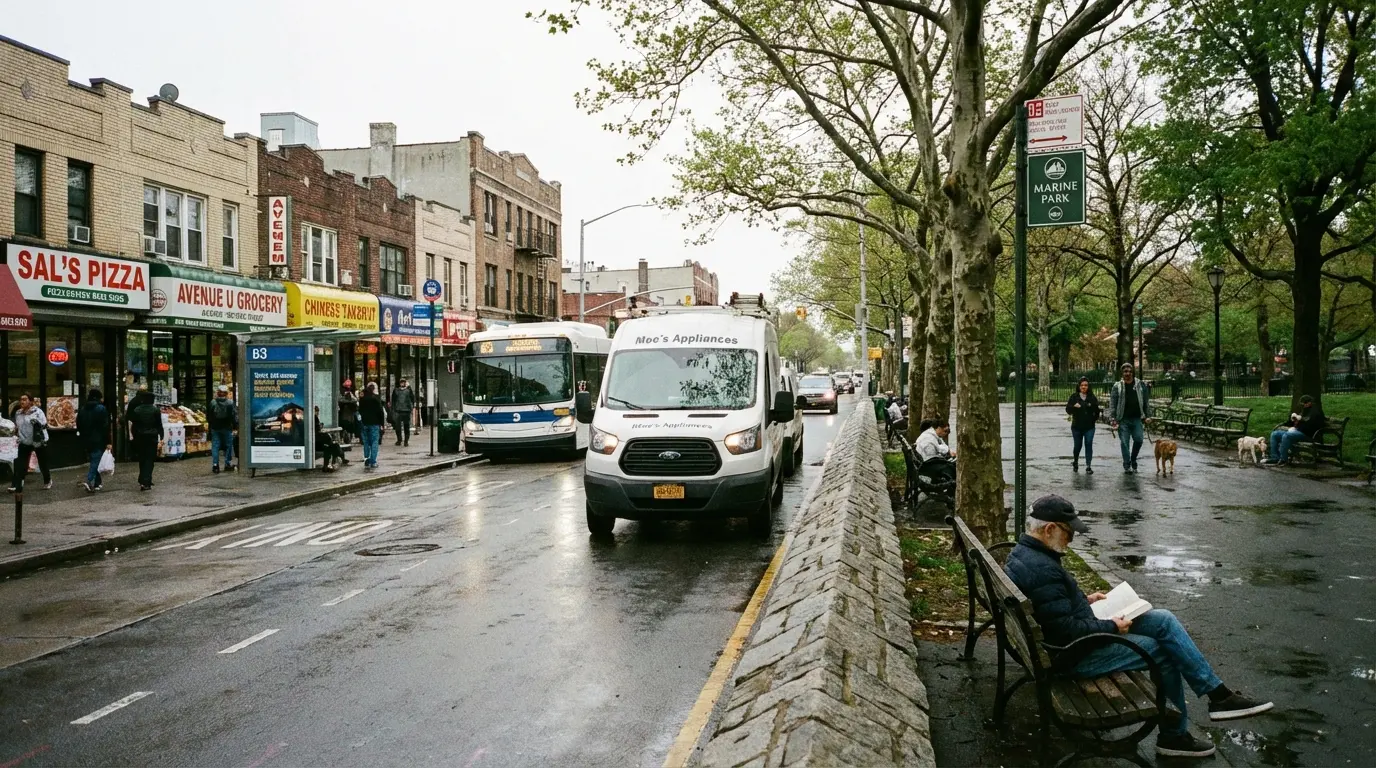
This Avenue U scene—with a bus at the curb, a double‑parked van, and pedestrians weaving through—shows how active the commercial ribbon can be. It confirms that while Avenue U can provide an urban edge in photos, delivery traffic and curb churn limit long, uninterrupted setups.
The residential interior—blocks lined with two-story homes, stoops, and driveways—offers a third option. These streets are usually quiet enough for lifestyle-style walking shots or front‑yard portraits, especially mid‑day on weekdays. However, when a neighbor has scheduled construction or a utility repair, crews may place cones and metal plates that suddenly add visual clutter or noise. It’s common to decide on two or three possible blocks in advance and choose on the day based on which one is clear.
On-the-day flow: loading in gear on residential streets
Many sessions in Marine Park begin or end at a home: getting‑ready photos, newborn sessions, or family portraits before walking over to the park. The neighborhood’s housing stock—mostly single-family or semi‑attached houses—means you’re dealing with driveways, short front walks, and relatively narrow sidewalks rather than large lobbies or loading docks.
Load‑in often happens directly from a car or SUV parked along the curb. On wider blocks, there is usually enough space to open doors fully without blocking through‑traffic, but you still need to watch for cross‑streets near schools where parents double‑park during pickup. Sidewalks can also be interrupted by utility plates or recent patchwork paving close to corners, which affects how and where you can roll cases or set up stands.
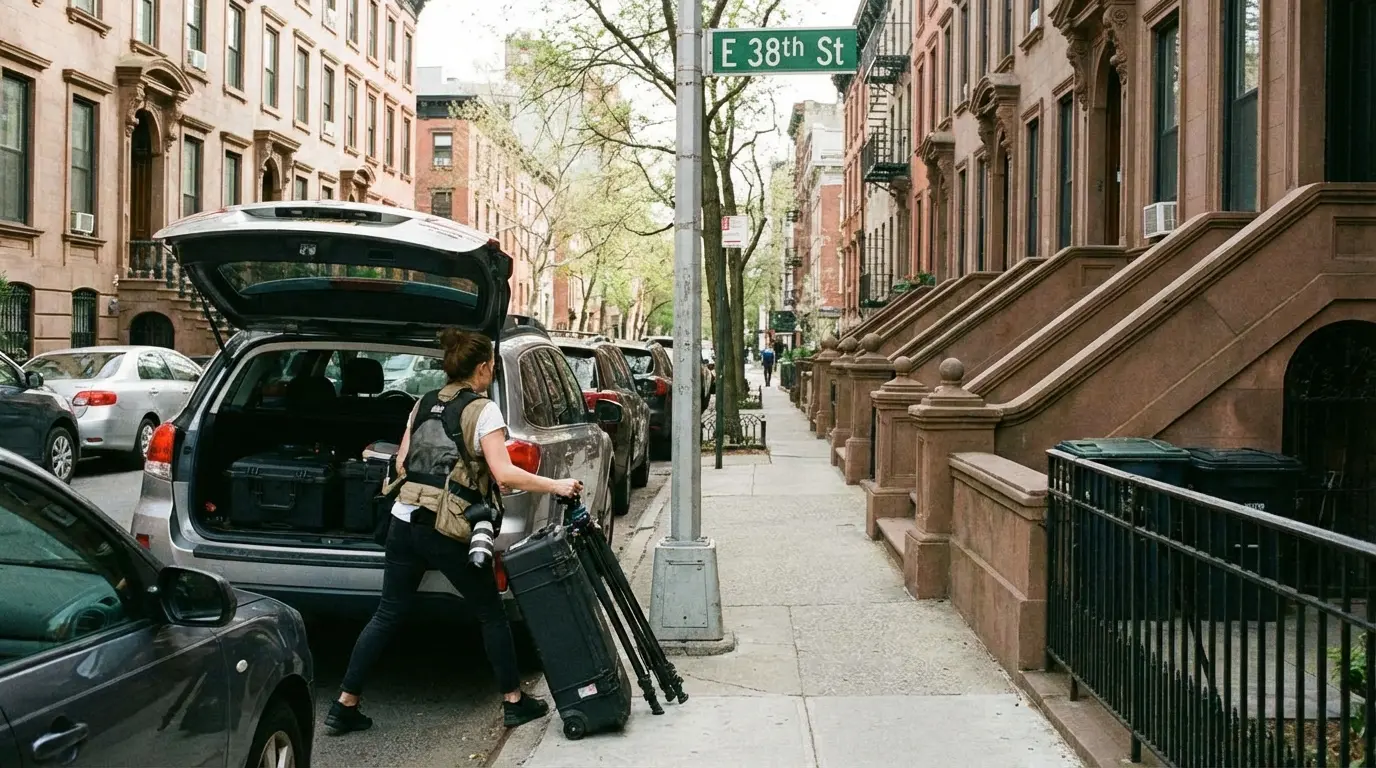
This load‑in on a Marine Park residential block shows typical conditions: a two‑story row of houses, curbside parking, and a temporary metal utility plate. It verifies how equipment actually enters homes here and why it’s important to plan for slight surface changes at the curb.
For newborn or at‑home sessions, that same residential layout is helpful: parents don’t usually need to navigate elevators or long interior corridors. Instead, the main constraints are driveway access (not blocking neighbors) and finding a curb spot that doesn’t overlap with scheduled street cleaning.
Wind, pavement conditions, and other on-site risks to plan around
The Gerritsen Avenue side of Marine Park is more exposed than it appears on a map. With open fields on one side and, farther off, the water, wind can be strong enough to knock over unsecured light stands or blow veils and hair in unpredictable directions. Sandbags or low, wide‑based stands become more than an optional precaution at these edges.
Street repairs are another quiet but real factor. Sections of Gerritsen Avenue and the roads around schools often show patchwork asphalt and occasional metal plates where utility work has recently taken place. For guests in heels, older relatives, or anyone with mobility concerns, these repairs influence exactly where you line up a processional or how you route people from car to lawn.
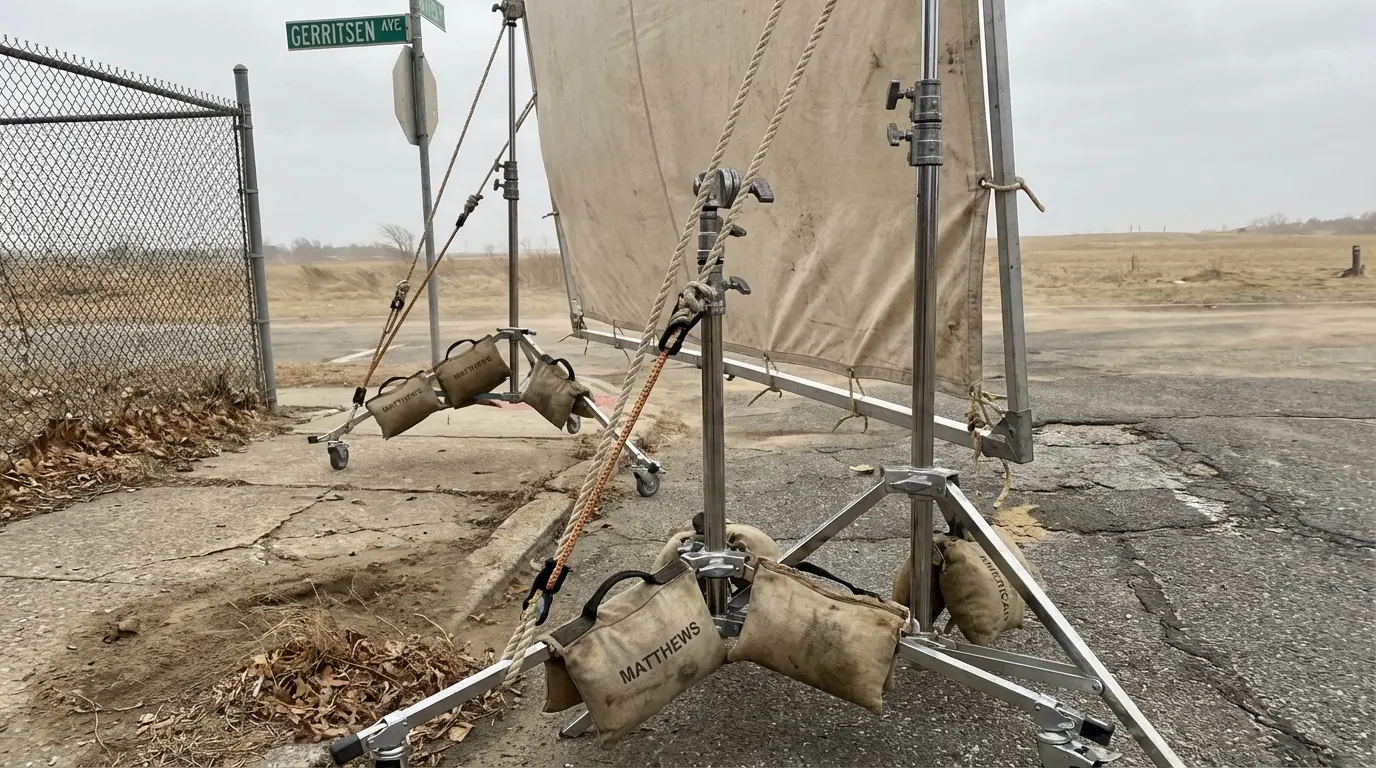
These sandbagged stands along the Gerritsen Avenue edge illustrate how exposed some park margins are to wind and how patched pavement sits right beside grassy areas. It confirms the need to account for gusts and ground irregularities when planning equipment and guest routes.
Crowds in Marine Park follow a consistent pattern: weekdays are relatively open until mid‑afternoon, while weekends load up the ballfields and picnic areas. Larger gatherings or any structured setup on the lawns should consider that the park is under NYC Parks management; staged or higher‑impact uses may require permits or confirmations through the official channels noted on Marine Park – NYC Parks. Residential stoops, driveways, and yards are private and used actively by homeowners, so any use there depends on explicit permission from the residents.
There are essentially no accessible rooftop vantage points in this low‑rise neighborhood unless pre‑arranged with a building owner, which is rare. Planning assumes ground‑level or slightly elevated stoop perspectives rather than sweeping high views.
Recognizable local landmarks that anchor Marine Park sessions
When people say they want photos “in Marine Park,” they typically mean specific, mappable spots rather than just the ZIP code. The ballfields near Fillmore Avenue, the main park sign, and the Salt Marsh Nature Trail entrance are all recurring meeting points because they are easy to describe and recognize.
The park-perimeter path that runs from the ballfields toward the Salt Marsh area gives a mix of open field on one side and trees or marsh grasses on the other. This is useful for couples or families who want to vary backgrounds without moving long distances. Meanwhile, the nature-center side is quieter, with more birdsong than ballgame noise, better suited to more introspective or low‑key portrait work.
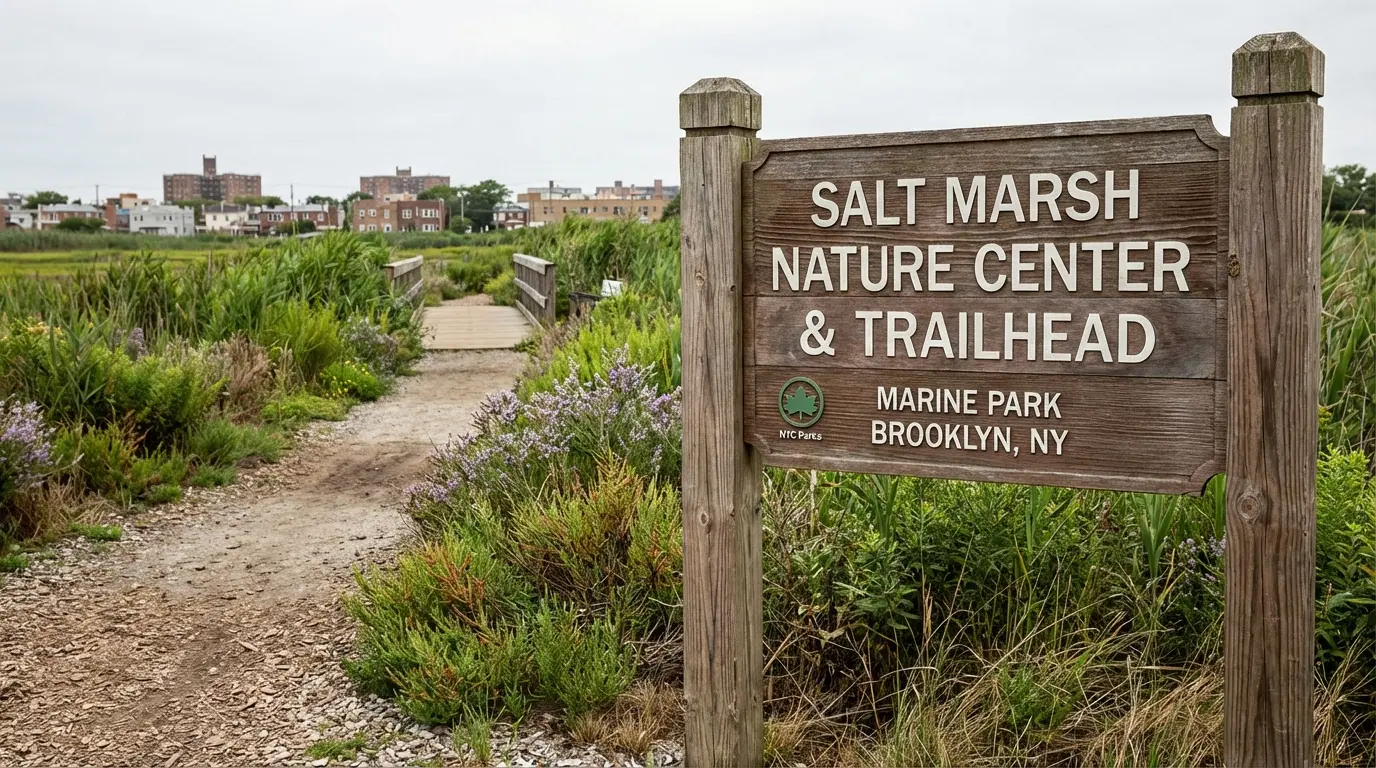
The Salt Marsh Nature Center trailhead sign provides a precise anchor that matches what appears on maps and wayfinding materials. Its surrounding vegetation and paved path confirm the transition from active play areas to the quieter marsh environment used for more secluded portraits.
These landmarks also help coordinate arrivals: guests can be told to meet “by the Salt Marsh sign” or “at the ballfield fence near Fillmore,” reducing the number of lost or late participants wandering the broader park.
How light shifts between open fields and side streets
Light in Marine Park behaves differently depending on how close you are to the park core versus the interior streets.
In the central fields and along the south‑ and east‑facing edges, there are almost no mid‑rise structures to block the sun. This produces long stretches of direct light early and late in the day, especially in the warmer months when the sun sits lower for longer. Morning sessions on the park’s east and southeast sides pick up usable light slightly earlier than shaded residential blocks.
By contrast, north–south streets just off Avenue U are lined with houses of relatively uniform height. In late afternoon, those rows cast longer shadows into the roadway and across sidewalks, causing usable light to drop off more quickly even when the sky is still bright. For headshots or portraits that rely on even, face‑level light rather than strong highlights, that difference of 30–45 minutes can matter.
Within the Salt Marsh area, surfaces are mostly non‑reflective: grasses, dirt or gravel paths, and low wooden structures. This creates softer, more diffuse light with fewer harsh, bouncing reflections than you’d see near glass or bright-painted facades. The result is a gentle, even look that suits both couple portraits and more subdued individual images.
What finished portraits from Marine Park usually include
Because Marine Park is an active public space, final images generally include subtle signatures of that shared use, even when framed carefully. Benches, trash cans, and distant walkers often sit at the far edges of a frame; ballfield fencing or goalposts may blur into the background behind a couple or family.
On days when Parks staff are active, a maintenance vehicle or worker may appear faintly in the distance. None of this usually dominates the scene, but it does shape the realism of the final images: this is clearly a neighborhood park environment, not a closed set. On Avenue U or nearby corners, parked cars, awnings, and bus shelters take the place of fields and trees as recognizable background elements.
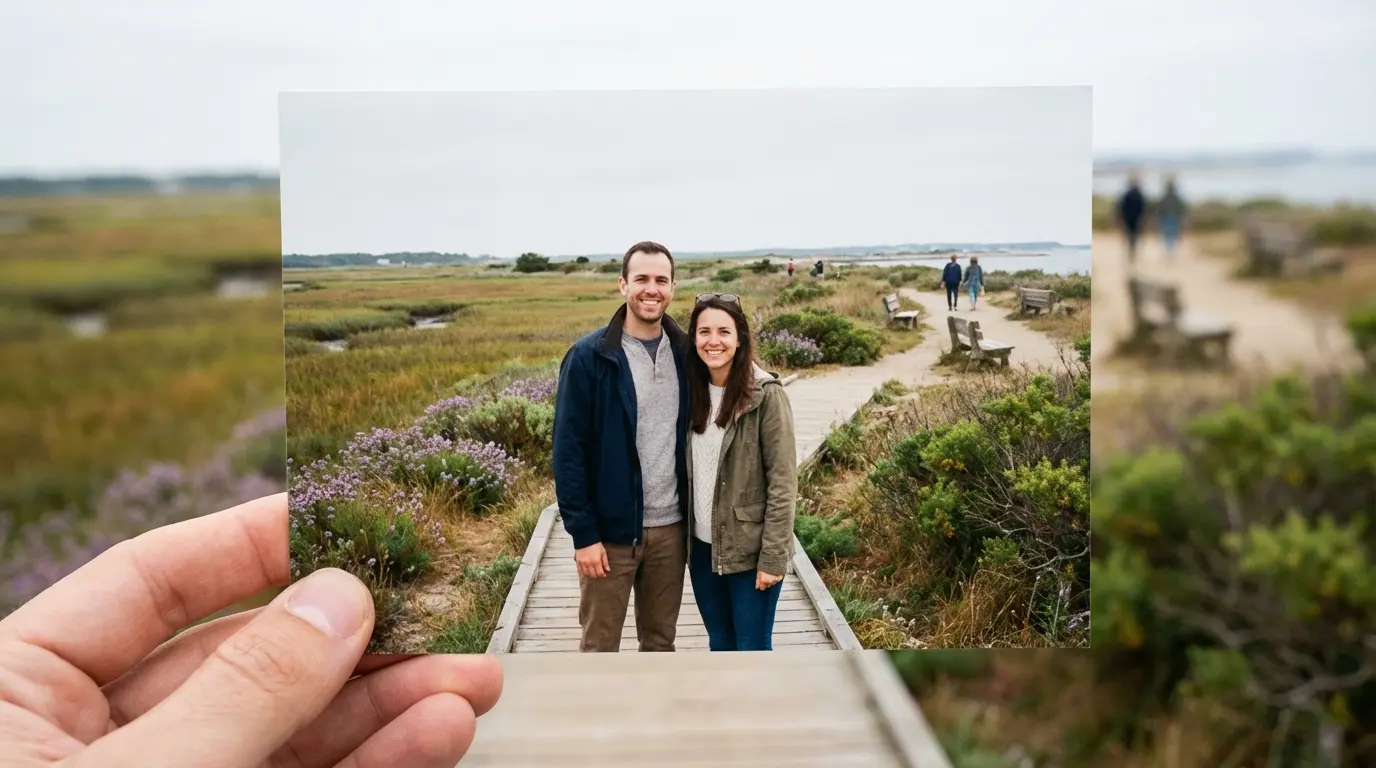
This portrait on a Marine Park path shows marsh grasses, benches, and faint park activity in the distance. It demonstrates the realistic balance between focused subjects and the everyday background elements that remain visible in delivered images.
Couples or families who want emptier frames often schedule for early weekday mornings, when dog walkers are present but ballfields and picnic areas haven’t yet filled. Weekend afternoons, by contrast, are when you are most likely to see groups and sports equipment in the far background.
How related photo services line up with Marine Park needs
Beyond weddings, the neighborhood layout shapes how other kinds of sessions tend to unfold. Home‑based newborn sessions rely on the easy curb access and short walks from car to front door that Marine Park’s single‑family housing provides. Video coverage for events hosted in backyards or nearby community spaces benefits from the relatively straightforward parking on residential blocks and the short drive times to and from the park itself.
Headshots and simple portraits often take advantage of park‑edge paths or quiet side streets, using trees, fences, or brick facades as neutral backdrops without needing elaborate setups. The same mobility realities—finding a safe loading point, checking for nearby street repairs, planning around school or park peaks—apply across all of these services.
How we serve Marine Park through Wedding photographer
Everyday frictions: traffic, repairs, and weekend crowd shifts
A few recurring patterns help set realistic expectations for movement and noise.
-
Intersection character: Avenue U’s signalized intersections juggle buses, turning cars, and pedestrians. Even when traffic volumes aren’t extreme, the stop‑and‑go rhythm can interrupt sequences of shots where subjects need to cross or stand in the crosswalk area briefly.
-
Delivery traffic: Morning and late‑morning windows see box trucks and vans servicing Avenue U businesses. Double‑parking is common, and drivers sometimes work with hazard lights on for extended periods. This matters if a planned storefront or awning is temporarily blocked, forcing a shift of a few doors down.
-
Street repairs: Patchwork paving is noticeable near Gerritsen Avenue and around some school perimeters. Temporary metal plates can create noise under passing cars and become small obstacles for tripods, rolling cases, and stroller wheels.
-
Weekday vs. weekend: On weekdays, park edges are calmest in the late morning to early afternoon; activity rises sharply after school lets out, as ballfields and playgrounds fill. Weekends reverse that calm: late mornings through sunset see overlapping games, barbecues, and gatherings, particularly in good weather.
These frictions don’t prevent sessions from happening, but they do shape timing, route choices, and how many backup spots it’s wise to have in mind.
Nearby neighborhoods often combined with Marine Park shoots
Marine Park residents and visitors frequently mix locations across nearby neighborhoods. A couple might host a ceremony near the park, then head toward Sheepshead Bay for water‑adjacent frames; another family might live near Flatlands or Midwood but use Marine Park as their main greenery. Canarsie and Flatbush come into play as alternatives when someone wants either more density or different waterfront textures than Marine Park itself provides.
Adjacent Neighborhoods we serve near Marine Park
Frequently asked questions about Marine Park for photo sessions
How early in the day does usable light start in Marine Park?
Along the open fields and south‑ and east‑facing edges, you get workable light slightly earlier than on nearby residential streets because there are no mid‑rises blocking the horizon. In practice, soft, directional light is common from early morning, while north–south streets off Avenue U may stay in deeper shadow until a bit later.
Where does parking usually work near Avenue U and the park?
Street parking is the norm. Around Avenue U, turnover is high due to shoppers and deliveries, so you may circle a few blocks before finding a spot. Closer to the park perimeters on Fillmore and residential side streets, spaces open more predictably, especially on weekdays outside school drop‑off and pickup times.
When is the park most and least crowded for photos?
Late mornings to early afternoons on weekdays are typically the quietest, with mainly walkers and dog owners on the paths. After school on weekdays and from late morning through evening on weekends, ballfields and picnic areas fill up, and it becomes harder to find empty backgrounds near the central lawns.
Do I need a permit for a small ceremony or photo session in Marine Park?
For simple, low‑impact shoots with a small group and minimal equipment, people often proceed informally, but the park is managed by NYC Parks and staff do monitor activity. Larger setups, amplified sound, and any event that feels more like a formal gathering than a quick session may fall under permit requirements. It’s wise to review NYC Parks guidance for Marine Park and plan ahead rather than assume every use is automatically permitted.
How does wind or weather affect sessions near Gerritsen Avenue and the marsh?
The Gerritsen Avenue edge and the more open marsh-facing areas pick up stronger wind than interior streets. Light stands, arches, and unsecured decor can shift or topple without weighting. On hot summer days, the interior streets can feel more humid but less windy, while the park’s open areas trade some heat for more exposure to gusts.
What exactly does “Marine Park” refer to—just the park or the whole neighborhood?
Locally, “Marine Park” can mean the large park itself, the surrounding residential neighborhood, or both, depending on context. For planning, it’s useful to distinguish between the park interior (which is public land with its own rules) and nearby homes or streets (which are private or standard city property), even though residents refer to the whole area by the same name.
Can newborn or at‑home sessions happen outdoors here, or are they usually indoors?
Most newborn sessions in Marine Park happen indoors, in clients’ homes, because the residential housing makes indoor setups logistically straightforward and more comfortable for the baby. Occasionally, brief outdoor frames might be added on a quiet front stoop or side street, but the primary environment is typically inside.
Is it realistic to include both park and commercial backdrops in one Marine Park session?
Yes, but timing and traffic patterns matter. Moving between a park‑side ceremony or portraits and Avenue U storefronts means crossing at least a few busy intersections and working around buses and deliveries. It’s feasible when schedules allow for those transitions and everyone involved understands that there may be short waits for safer or cleaner crossing moments.