
Midwood Brooklyn wedding photography environment and logistics guide
Locating Midwood within Brooklyn for wedding-day planning
Midwood sits in central-south Brooklyn, between the denser apartments and mixed-use blocks to the north and the more open, car-oriented grids to the south and east. To the north, streets begin to transition toward Kensington; to the south and southeast, the grid opens out as you head toward Sheepshead Bay; to the east, blocks trend toward the wider-lot homes associated with Flatlands. On the ground, it reads as a mostly low-rise, residential neighborhood with a few strong commercial spines.
For couples and crews moving around Brooklyn, Midwood is easiest to picture as the zone organized around Avenue J, Kings Highway, Ocean Avenue, and Coney Island Avenue. These corridors carry most of the traffic and day-to-day noise, while the interior side streets remain comparatively quiet and tree-lined. Public maps and descriptions such as Midwood, Brooklyn – Wikipedia match what you experience on foot: a stable residential area marked by schools, synagogues, small parks, and neighborhood retail rather than large destination venues.
Avenue J is the clearest internal reference point. As you move west along it, there is a noticeable “gateway” shift where storefronts suddenly cluster more tightly and pedestrian volume jumps. That change in density is important when you’re deciding whether to stage a quick sidewalk portrait or keep all formal portraits on a nearby side street.
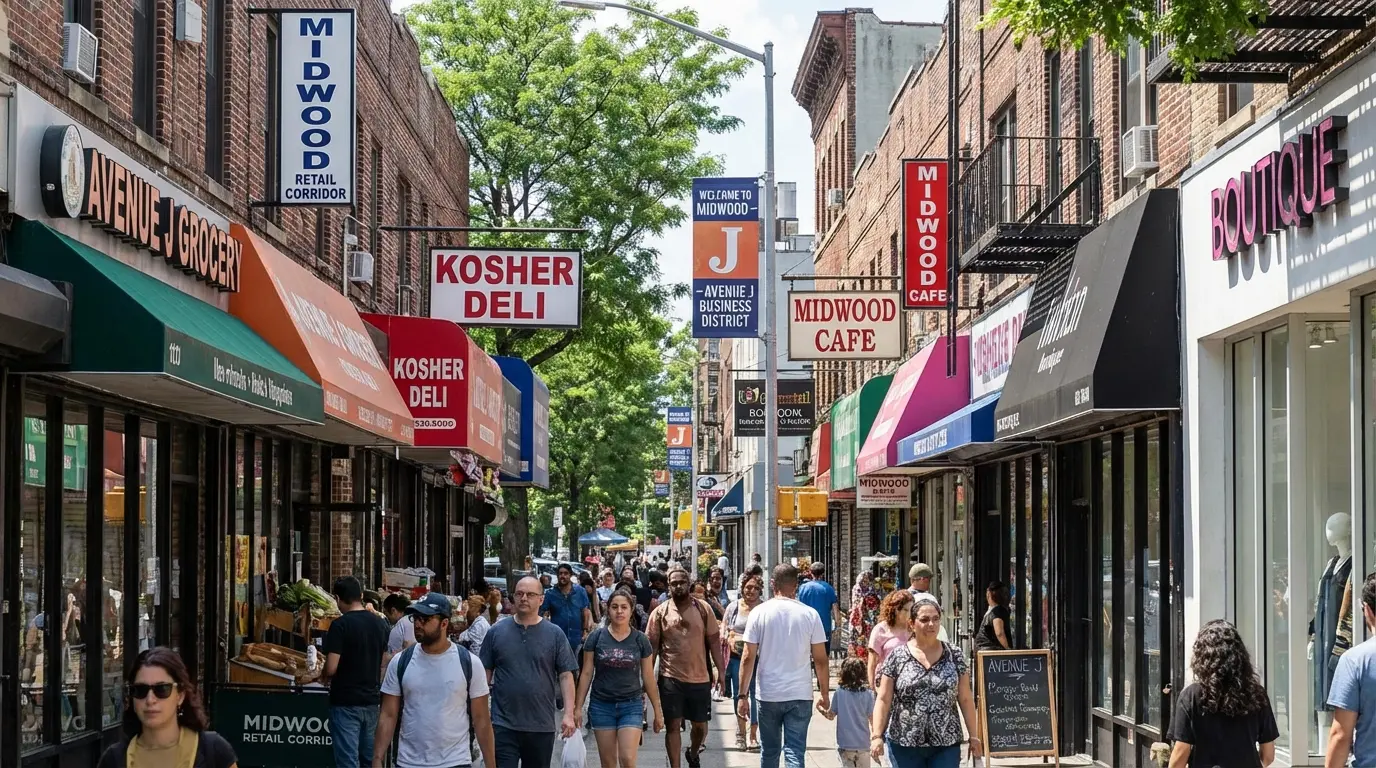
Shows the Avenue J retail spine, pedestrian density, storefront mix, and typical street-level activity a photographer will encounter when working in Midwood.
This view confirms the corridor’s role as a gateway block: low-rise buildings, mixed older signage, buses and parked cars, and a steady flow of people that shapes how and when street-level shooting is realistic.
Street pattern, transit, and arrival options
Midwood’s grid is straightforward: long north–south avenues (Ocean Avenue, Coney Island Avenue) cross a series of east–west residential streets and the key commercial corridors of Avenue J and Kings Highway. For wedding-day timing, it helps to think of movement on two layers:
- Transit layer: The Q line stations at Avenue J and Avenue M are the most reliable transit anchors for guests and small crews. From either stop, most residential addresses are a short walk on calm side streets, but crossing Avenue J itself can be slow during peak times because of long signal cycles and turning traffic.
- Driving layer: Kings Highway carries heavy, continuous vehicle flow, including deliveries and buses. Ocean Avenue and Coney Island Avenue move traffic more steadily, but you rarely get a truly quiet curb there. Parking is inconsistent along all three, and drop-offs usually work better on the cross streets just off the main avenues.
Street sound varies by micro-area. On Avenue J you get overlapping noise from buses, shopfront conversations, and delivery trucks backing into tight curb space. Kings Highway adds more engine noise and intermittent honking. By contrast, mid-block residential segments a few houses in from these corridors drop quickly to a background level of passing cars and occasional conversations—much more usable for vows, first looks, or quiet portraits with ambient audio.
Where sessions actually tend to happen in Midwood
Because Midwood doesn’t have large open parks or waterfront esplanades, most couples end up using a mix of calm residential streets and small green pockets for portraits. Detached and semi-detached homes with modest front yards, low fences, and consistent setbacks create familiar, repeatable backdrops that feel local without drawing extra attention from passersby.
When couples plan Wedding Photography that stays close to home, small spaces such as Kolbert Park, the P.S. 193 playground perimeter, and the pocket-scale greens around places like Midwood Park – NYC Parks function more as brief portrait stops than as full-session destinations. Their size, proximity to residential buildings, and regular family usage mean shoots need to be compact and respectful of play areas.
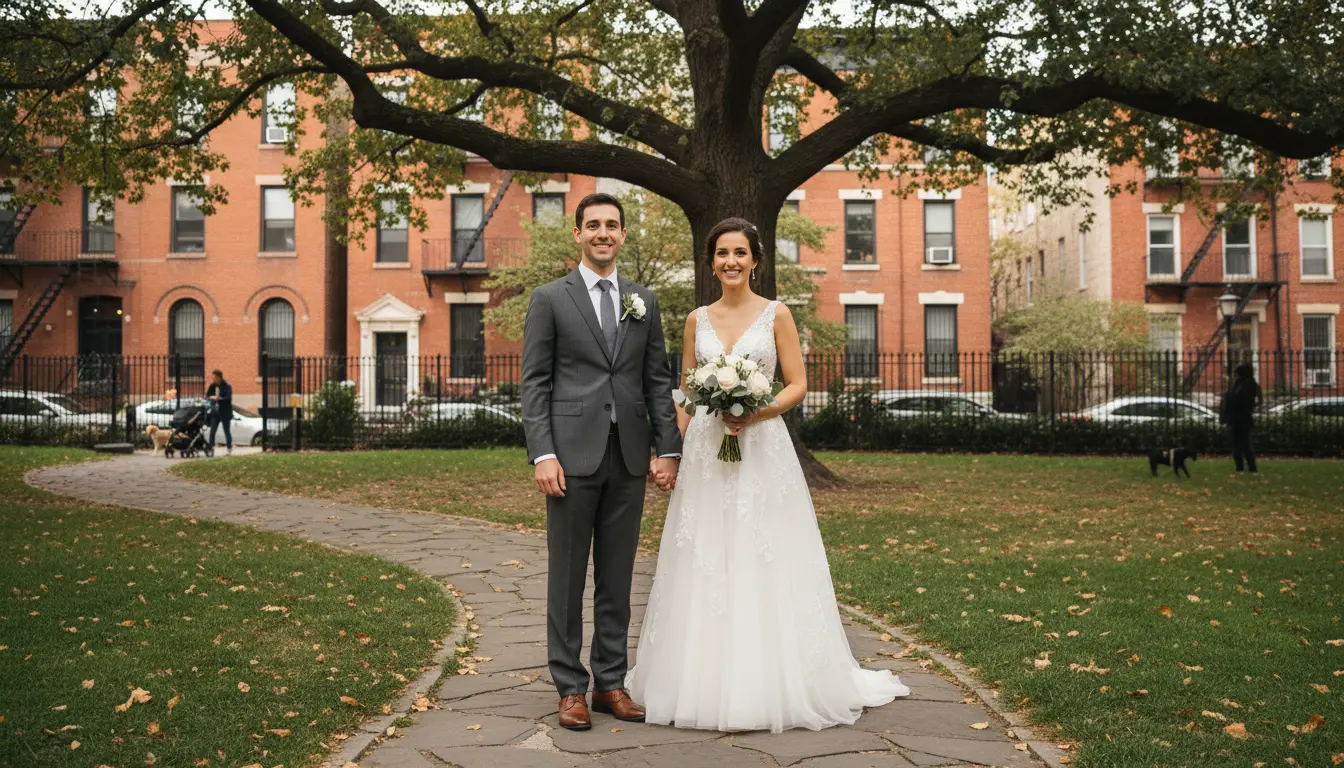
Demonstrates the usable scale of a Midwood pocket park for wedding portraits and how closely it sits to surrounding homes and institutions.
The image shows how quickly a park edge gives way to residential and institutional facades; background clutter, fences, and rooflines are part of the reality and need to be factored into framing and depth-of-field choices.
Comparing Midwood micro-areas for photos and video
Within Midwood, different subzones behave quite differently on camera:
- Avenue J core blocks: The busiest stretch, with dense kosher retail, groceries, and restaurants. Facades here show a pronounced texture mix—brick, stucco, aluminum siding, and older awnings stacked closely together. Restaurant turnover is visible in mismatched storefronts: long-standing kosher eateries beside newer quick-serve spots with fresher signage. This can be visually interesting for brief, candid shots but is rarely where couples want their only formal portraits.
- East Midwood residential grid: East of Coney Island Avenue, the grid leans toward detached and semi-detached homes with driveways, porches, and relatively uniform front setbacks. The tree canopy is stronger, and curb parking is present but not overwhelming. This is often the most convenient area for calm, front-of-house portraits or side-street walks.
- South Midwood and the quieter cross streets: Closer to the southern edges, commercial presence thins out and tree-lined streets dominate. Fewer shops mean fewer pedestrians, but you still share space with residents leaving or arriving, particularly around school start and dismissal times.
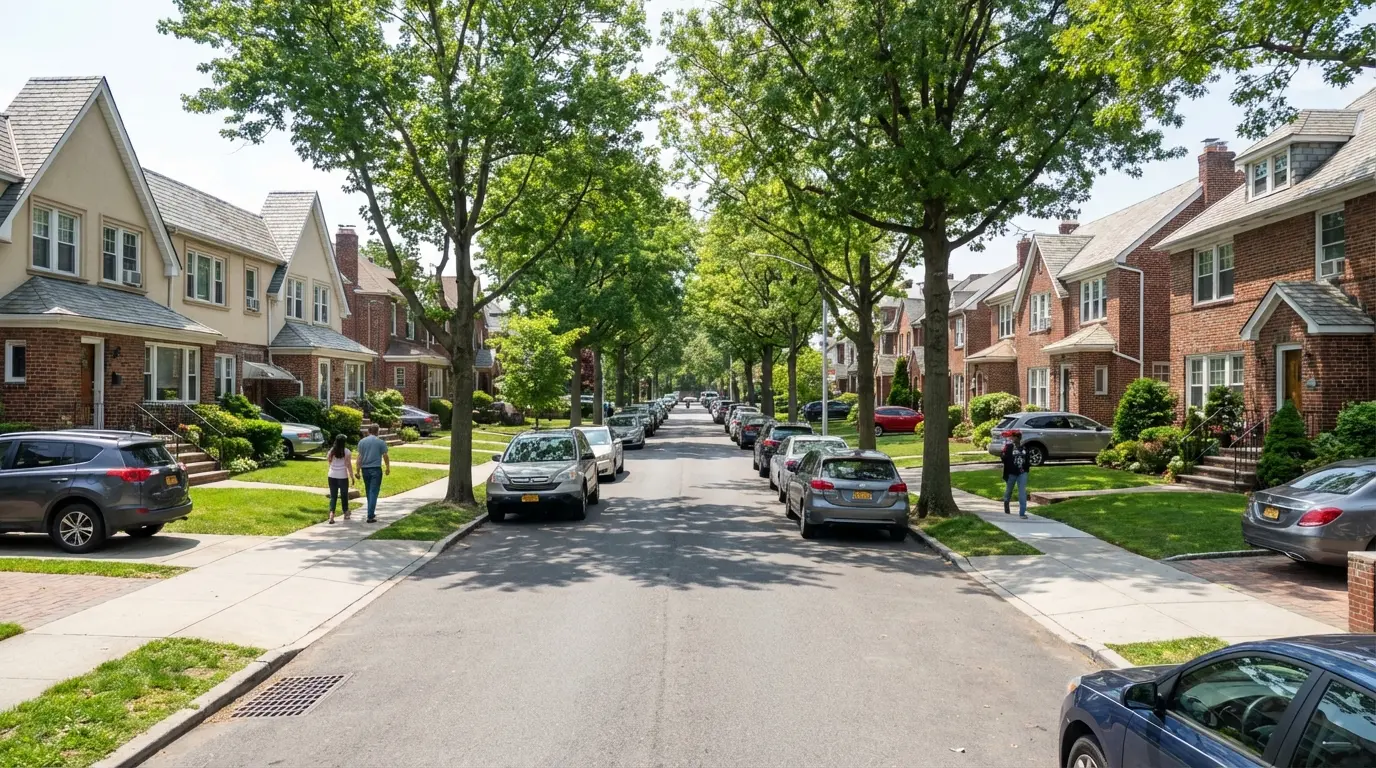
Shows typical East Midwood conditions: consistent setbacks, mature street trees, parked cars along the curb, and low-rise brick and siding facades.
This kind of street is representative of where many portraits are actually made—quiet enough for conversation and audio, visually orderly enough that parked cars and curb cuts can be managed in the composition.
Light behavior on Midwood streets throughout the day
Midwood’s low-rise building stock and relatively wide cross streets give it more usable natural light across the day than many denser Brooklyn neighborhoods:
- Morning: With the sun coming across mostly two- and three-story homes, east–west residential blocks get even, soft light and moderate shadows. Tree canopies filter light into a gentle pattern rather than hard stripes.
- Midday: Light bounces strongly off lighter siding and parked vehicles, especially on narrower cross streets. This can create unexpected glare spots in backgrounds, particularly near white vans or bright storefronts. On the residential grid, stepping a few houses down or shifting to the shaded side of the street usually resolves the issue.
- Late afternoon: As the sun drops, longer shadows fall across north–south avenues like Ocean Avenue and Coney Island Avenue. On Avenue J, awnings from shops and synagogues create irregular bands of shade on the sidewalk—useful for contrasty portraits but inconsistent if you need evenly lit group shots.
Because there are few high-rise structures, you rarely lose the sky completely. Even on tighter blocks, the combination of low roofs and tree gaps typically leaves enough open sky to keep skin tones natural without adding large artificial lights.
How we serve Midwood through Wedding photographer
Typical workflow and on-street setup scale
Most Midwood streets do not have the width or anonymity of a commercial studio district. Sidewalks narrow at stoops, driveways break up the curb, and many homes have low fences or hedges. Practically, that means wedding-day coverage in Midwood relies on compact, quick-deploy setups rather than large stands, booms, or generators.
Loading usually happens from a side street off a main avenue, with gear rolling a short distance to the home, synagogue, or park. Because residents are attentive to activity around their property lines, setups are typically kept within one or two sidewalk squares, avoiding any intrusion into driveways or private yards. This scale suits short portrait blocks between ceremony and reception, or brief video interludes on a quiet cross street.
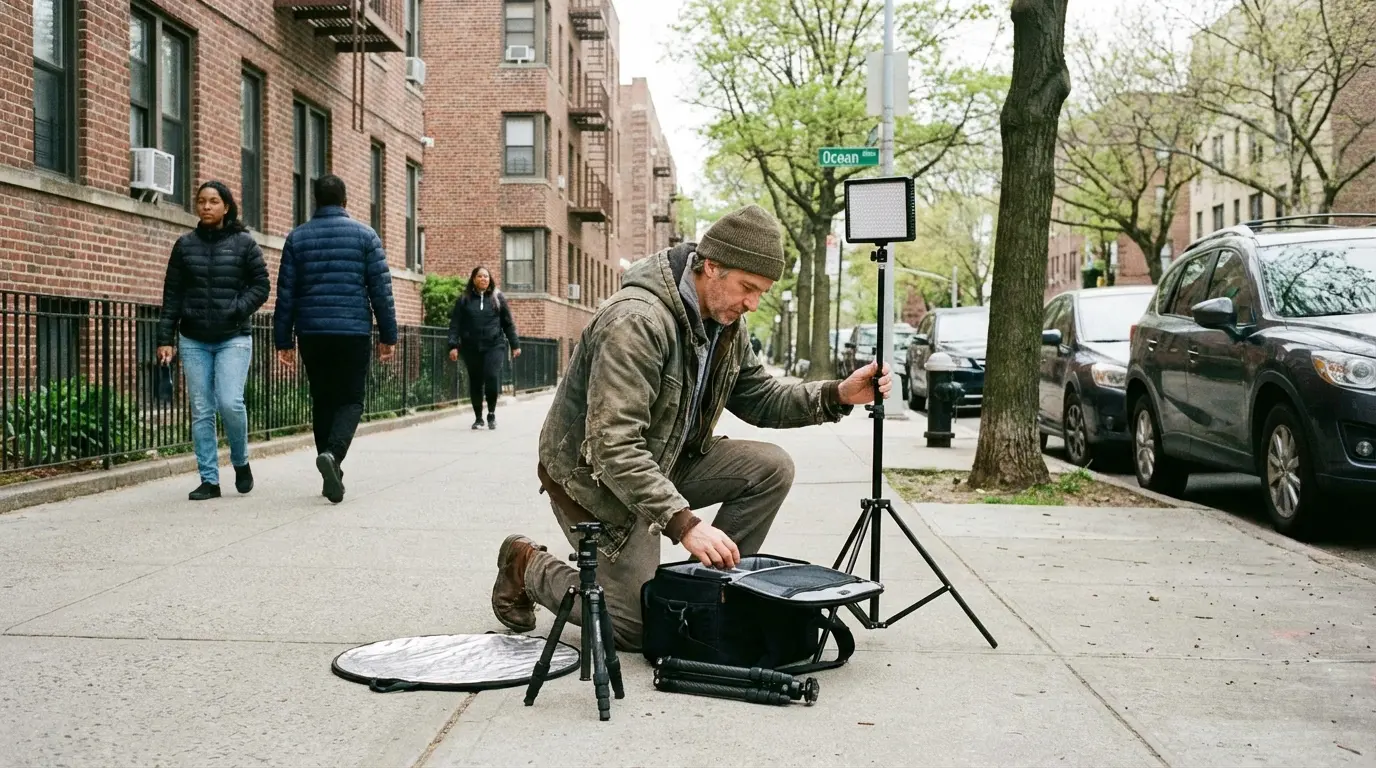
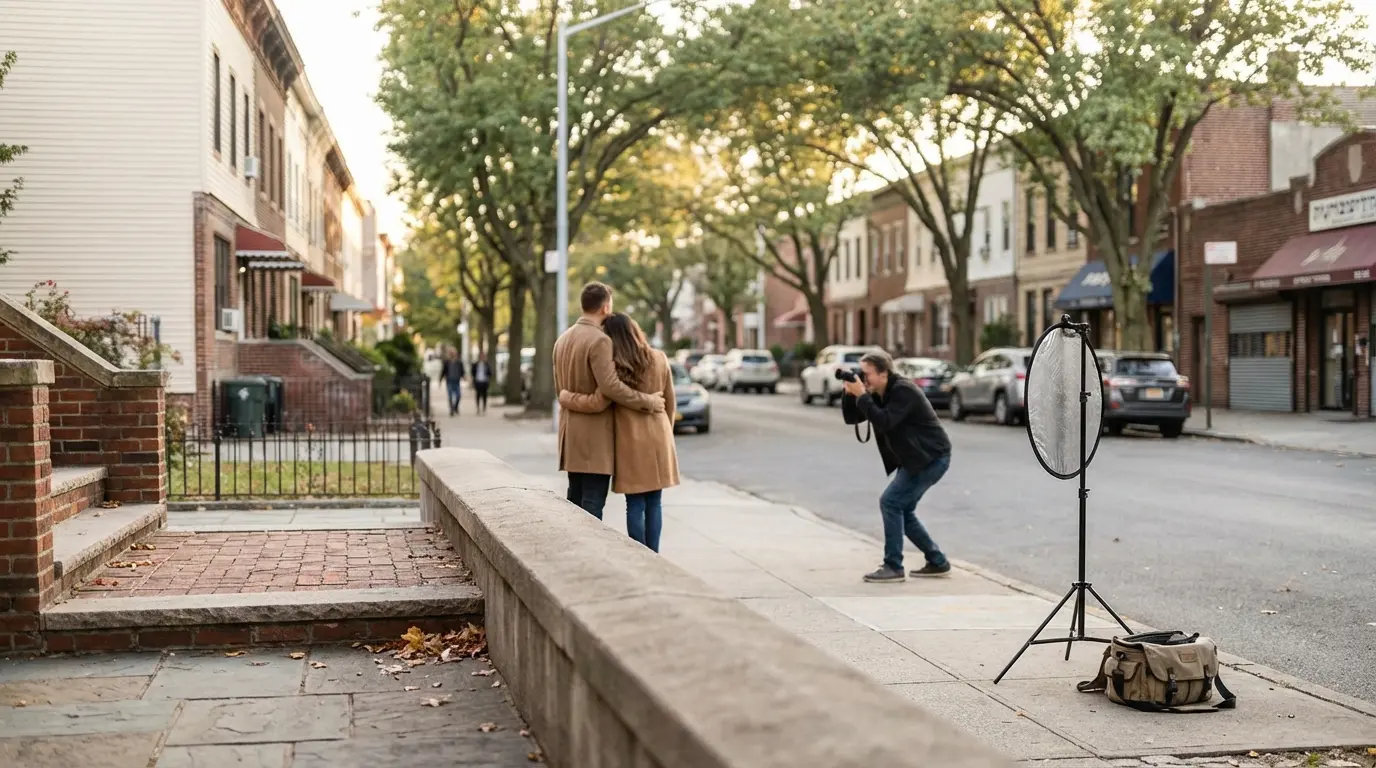
Illustrates how a small-footprint kit fits on a Midwood sidewalk without blocking driveways or impeding residents.
The image confirms what’s realistic here: light stands, reflectors, and bags stay close to the curb, and crews need to be able to clear the space quickly if a homeowner or vehicle needs access.
Environmental constraints, noise, and risk reduction
From a feasibility perspective, Midwood is forgiving but not unlimited:
- Crowds and traffic: Avenue J peaks in late afternoon and early evening, when school dismissal, errands, and restaurant traffic all overlap. Kings Highway is rarely quiet; it carries continuous traffic, plus double-parked delivery vans and buses that inject sudden noise. For staged portraits, it’s usually better to treat these corridors as background or transition spaces rather than primary locations.
- Parks and schools: The neighborhood’s small parks rarely trigger formal permit issues, but they are heavily used by families. Staff presence can be inconsistent, so the practical standard is to avoid blocking play equipment, ball courts, or narrow entrances, and to keep group sizes modest. Near schools, neighbors are sensitive to any activity that looks like loitering against fences or gates, so it’s important to maintain visible separation from school perimeters.
- Wind and exposure: On wider avenues like Coney Island Avenue and Ocean Avenue, light stands and reflectors catch more gusts than on sheltered side streets. In practice, this makes simple, weighted stands and smaller modifiers preferable, particularly in cooler months when wind is stronger.
- Private property: Many homes have short driveways and tight curb cuts. Residents are quick to react if they see gear or people blocking access, even briefly. Planning compositions that stay clearly on public sidewalk space, with doorways and stoops used only when explicitly invited, reduces friction.
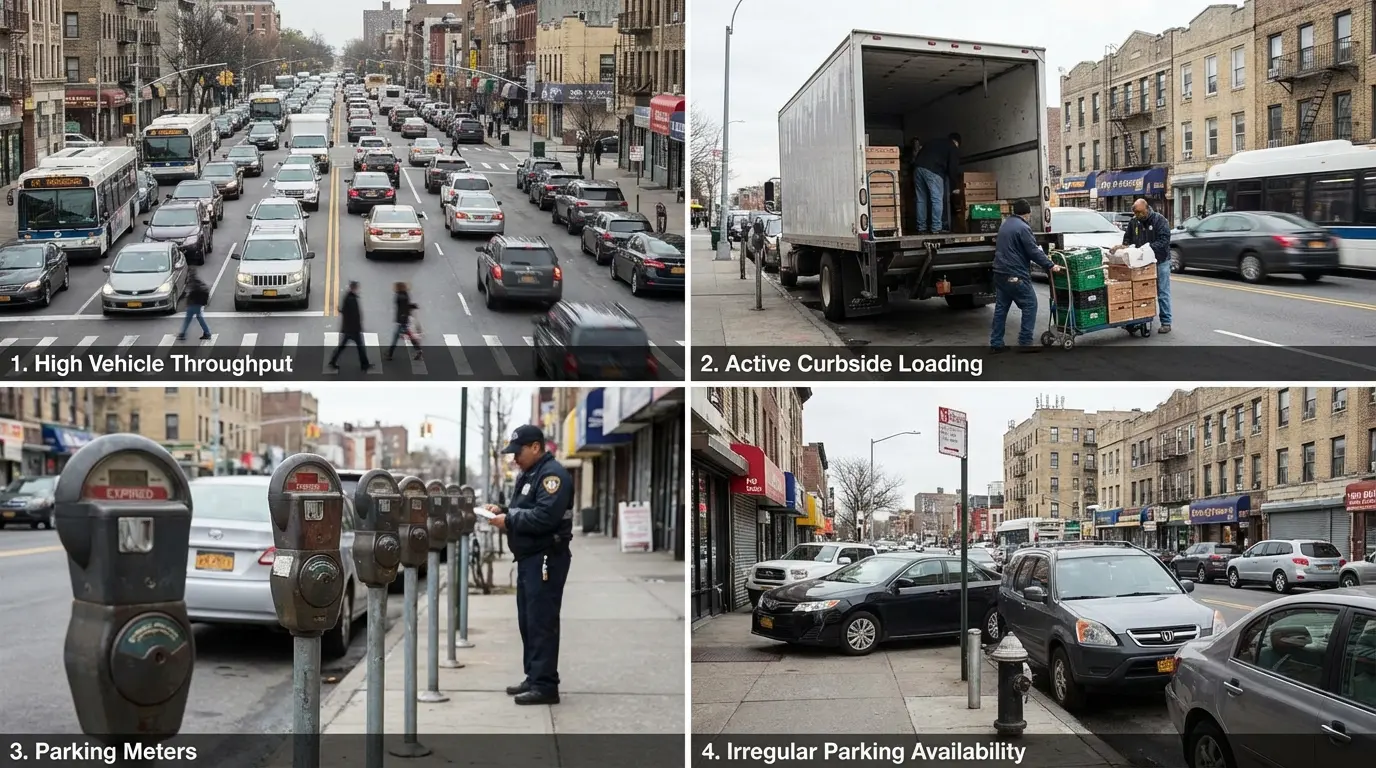
Confirms Kings Highway’s mix of steady traffic, metered parking, and double-parked deliveries that complicate loading and exact drop-off timing.
Visually, the curb is crowded with vehicles and signage; this is the reality to plan around when you’re coordinating arrival windows or moving equipment between a car and a nearby home or venue.
Recognizing Midwood’s institutional and commercial anchors
Beyond the street grid, a few recurring anchors shape wedding-day logistics in Midwood:
- Synagogues and houses of worship: Many are located near or along Avenue J and other commercial-adjacent blocks. Their schedules—especially around Fridays, holidays, and late afternoons—affect when nearby streets feel crowded or empty.
- Schools and playgrounds: Midwood High School at the northern edge and various elementary schools throughout the neighborhood create short, intense windows of foot traffic at arrival and dismissal times. Planning around those 20–30 minute peaks avoids unplanned crowds in the background.
- Retail and kosher corridors: The kosher cluster around Avenue J has relatively low turnover among established restaurants and bakeries, while smaller quick-serve spots change branding more often. Over a span of a few years, storefront backdrops can shift from muted to brightly colored signage, which matters when couples expect their block to look a certain way in photos.
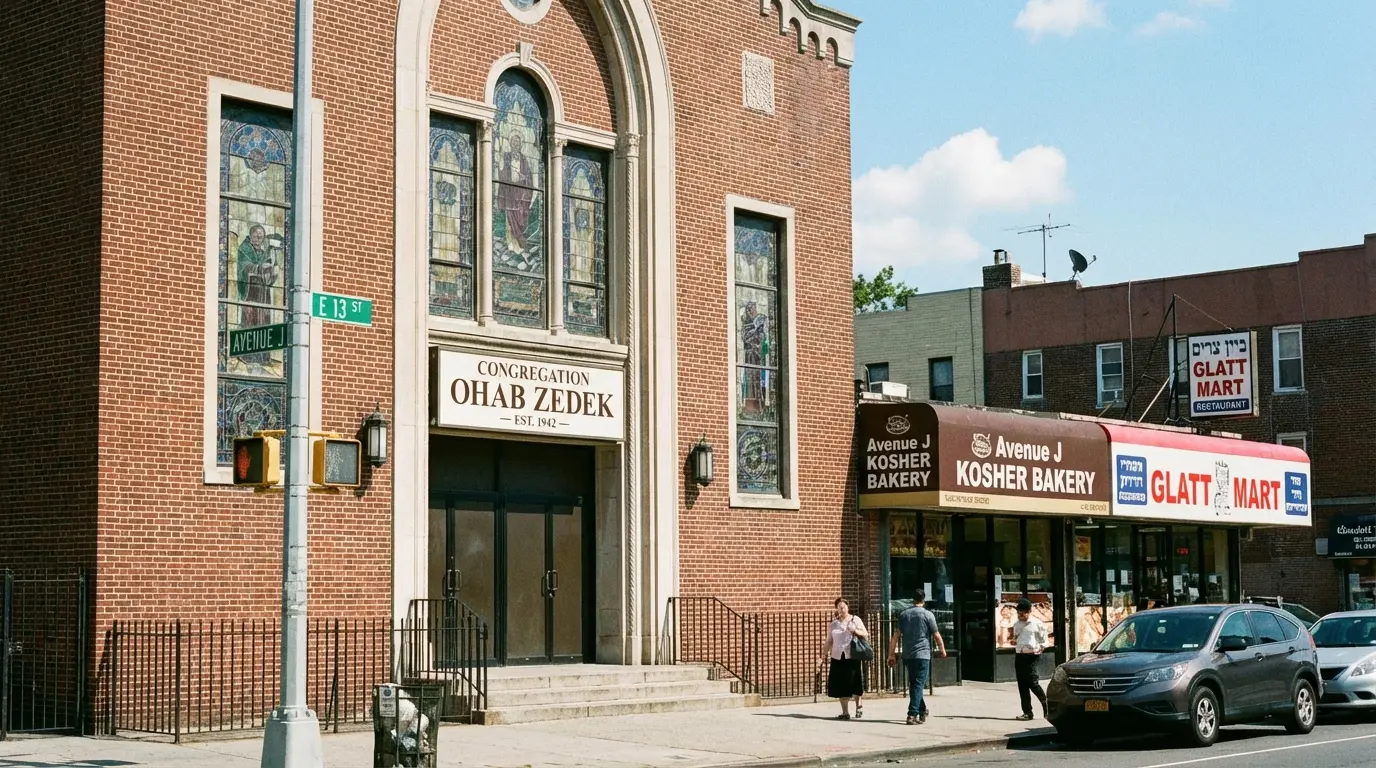
Provides clear proof of the Avenue J institutional and retail cluster used to orient schedules and meeting points.
You can see how a synagogue entrance, adjacent shops, and the Avenue J marker all sit within a short distance—good for short walking transitions but also a source of overlapping crowds, sound, and parked cars.
What final wedding images from Midwood typically include
Because Midwood’s built environment is dominated by low-rise brick homes, siding, small yards, and tree canopy, delivered photos from the neighborhood tend to share a few characteristics:
- Backgrounds often show alternating red and tan brick with patches of siding or stucco, plus the occasional metal gate or low fence.
- Street elements—parked cars, curb cuts, and utility poles—are present, especially in deeper focus shots along the street. These can be minimized with tighter framing and shallow depth of field but rarely disappear entirely.
- Light is usually soft enough that skin tones look natural without heavy artificial lighting, particularly in late afternoon when trees filter the sun into a warm, even glow.
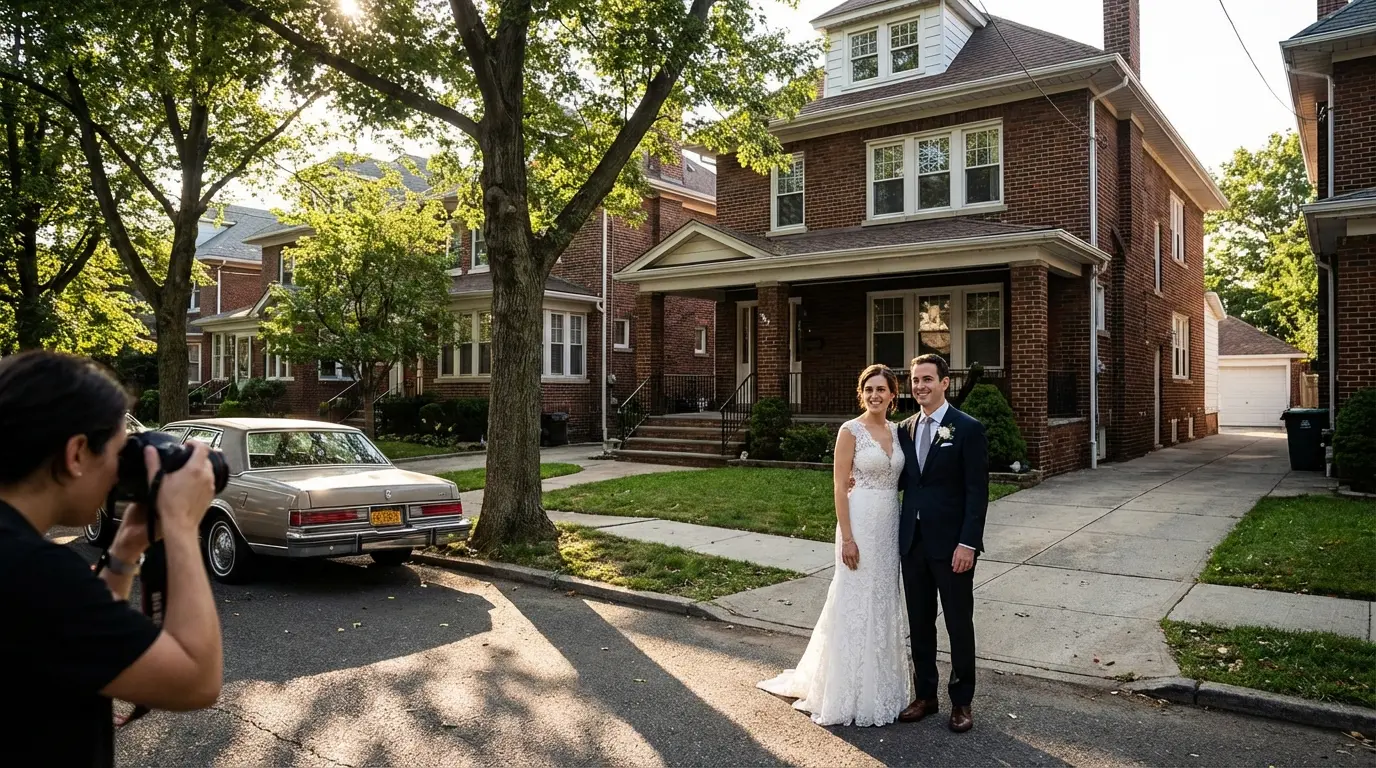
Shows a realistic final portrait using Midwood’s brick rowhouses and tree canopy, with late-afternoon light and everyday street elements softened but still present.
This is a good benchmark for expectations: a familiar residential backdrop, controlled but not erased street context, and light shaped by trees and low awnings rather than tall buildings.
Working across Midwood and nearby Brooklyn neighborhoods
Many weddings involving Midwood include movements to or from other parts of southern Brooklyn—ceremonies in one neighborhood, preparations in Midwood, and receptions in another. The Q line and the main avenues make these transitions predictable, but the low-rise, residential character of Midwood remains the constant.
Understanding how Midwood’s quieter side streets differ from the denser blocks to the north and the more open grids to the east and south helps in planning realistic timelines: how long it takes to move between a home, a synagogue, and a small park; when to expect crowd surges from schools or services; and which streets will likely remain usable even if Avenue J or Kings Highway feel chaotic.
Adjacent Neighborhoods we serve near Midwood
FAQ: Practical questions about wedding photography in Midwood
Is street parking realistic for wedding sessions in Midwood?
On residential side streets, curb parking is common but competitive; you can usually find a spot within a block or two, though not always directly in front of a home or park. Along Kings Highway, Ocean Avenue, and Coney Island Avenue, parking fluctuates with deliveries and bus patterns, so it’s better to plan those areas for short loading and unloading rather than long-term parking.
When are the quietest times to shoot on Midwood streets?
Late mornings on weekdays and mid-afternoons on Sundays are typically calmer on residential blocks. Avenue J and Kings Highway see consistent traffic, but mid-block segments a short walk away tend to stay usable. School arrival and dismissal windows, as well as Friday afternoons near synagogues, are the main periods to avoid if you want minimal background activity.
Which blocks are best for a peaceful first look or family portraits?
Streets in East Midwood and the southern residential sections—away from Avenue J and Kings Highway—offer the most predictable calm. Look for stretches with continuous tree canopy, uniform front yards, and fewer driveways; these reduce foot traffic and parked car density in the immediate frame.
How easy is it for guests to reach Midwood by subway?
Guests arriving by subway usually use the Q line at Avenue J or Avenue M. From either stop, most addresses in Midwood are within a 5–15 minute walk. The main consideration is crossing busy avenues safely and giving a bit of extra time for slow signals, especially for older guests or those unfamiliar with the area.
Do seasons change how Midwood looks in photos?
Yes. In spring and summer, leafed-out trees provide strong canopy and dappled shade on many residential blocks, softening light and partially screening parked cars. In fall, foliage adds color but also exposes more building mass as leaves drop. Winter strips the trees, making facades, fences, and cars more visually prominent, but low winter sun can be flattering along east–west streets.
Are there any permit or permission issues couples should know about?
Large-scale productions are rare in Midwood, so most wedding coverage uses a small footprint on public sidewalks and in pocket parks. Formal permits are unusual for the neighborhood’s small green spaces, but it’s important not to block playgrounds, sports areas, or narrow park entrances. Using private stoops, yards, or driveways requires explicit permission from property owners or building management, and school fences or steps should be avoided unless you have clear approval.
Will restaurant and storefront turnover affect our planned backdrops?
On Avenue J and nearby commercial strips, some long-established kosher businesses remain stable landmarks, while smaller quick-serve spots may change branding every few years. If a particular storefront is important to you, it’s wise to confirm its current appearance close to the wedding date, since signage and awnings can shift even when the business remains similar.