
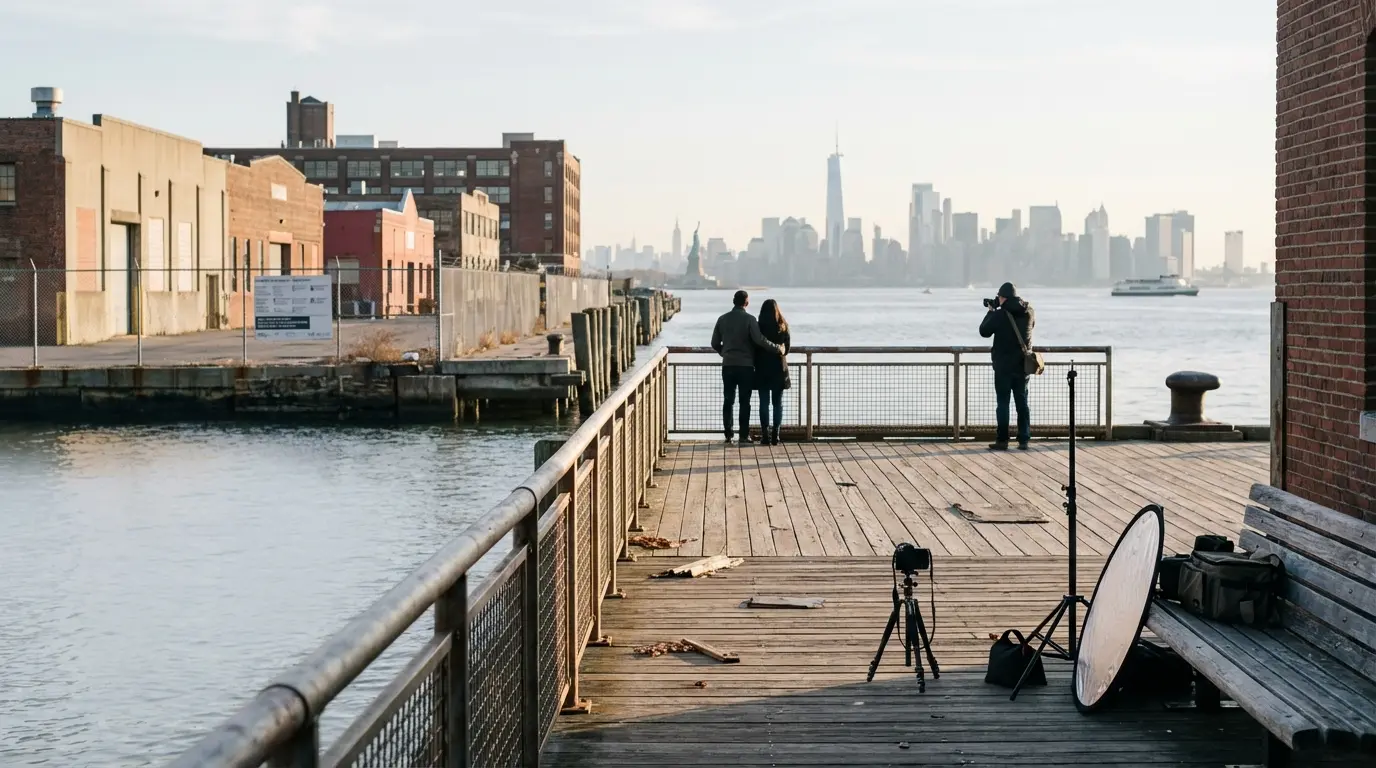
Red Hook in Brooklyn as a practical waterfront setting for wedding photography
How Red Hook fits into the Brooklyn waterfront
Red Hook sits on a projecting peninsula along Brooklyn’s southwest shoreline, facing the Upper New York Bay and the Lower Manhattan skyline across open water. Inland, it is buffered from the rest of Brooklyn by industrial corridors and the Gowanus Expressway, which is why it often feels physically separate from nearby brownstone neighborhoods.
Descriptions of Red Hook, Brooklyn consistently frame it as a low-rise, warehouse-heavy waterfront district with clear edges at the shoreline and at the highway structures to the east. To the north it transitions toward the Gowanus industrial zone, while the most common on-foot connection to residential streets is via Carroll Gardens to the northeast. Across the water, Sunset Park’s working piers are visible but not walkable.
Within the neighborhood, Van Brunt Street runs roughly north–south as the commercial spine, with side streets ending in dead-ends at the water or at pier gates. This creates short “corridors” of activity separated by wide industrial blocks, which matters for how far couples, guests, and crews are realistically willing to walk between spots during a session.
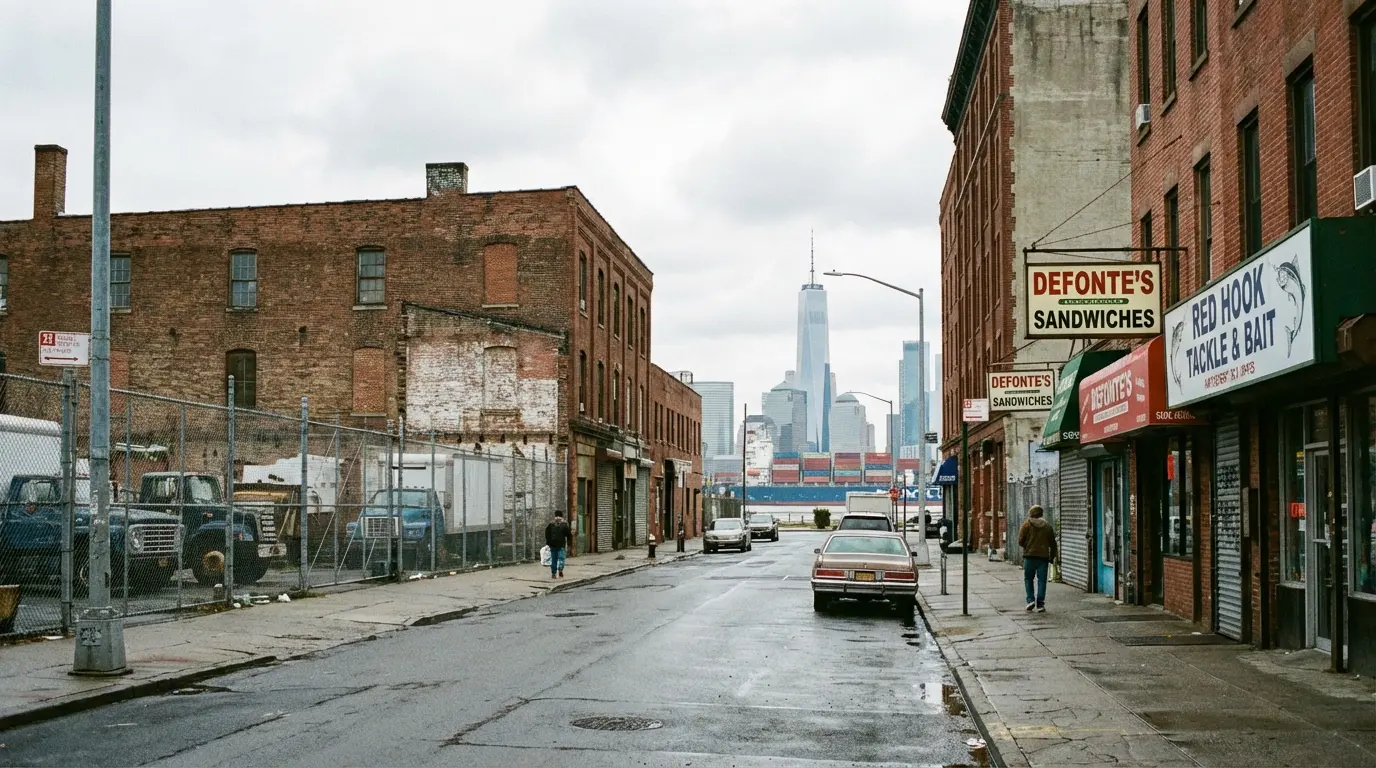
Shows the Van Brunt commercial spine and the visual connection to the waterfront so buyers can verify street scale, facade textures, sidewalk condition, and the proximity to ferry/Atlantic Basin sightlines.
This view of Van Brunt confirms the low-rise scale, mixed facades, and patchy sidewalks, as well as the clear sightline down to the water and Atlantic Basin, which are central to planning movement between street blocks and the waterfront during a wedding day.
Reaching Red Hook and moving between its blocks
Because there is no subway station within Red Hook itself, most people arrive via the B61 bus, by car, or by car service. The B61 runs along Van Brunt Street, making that corridor the default arrival zone for guests and wedding parties who are not driving. Walking from there to the piers or Red Hook Park is straightforward but involves crossing wide, sometimes truck-dominated intersections.
On the waterfront side, ferries at Atlantic Basin influence weekend rhythms: crowds spike near the ferry entrance around boarding times, and small waves of visitors move up Van Brunt afterward. This can briefly crowd narrow corners and affect how private a given block feels for a first look or small group photo.
Industrial-scale blocks between Van Brunt and the shoreline are long, and many streets terminate at fences or pier gates. That means moving from, for example, a warehouse façade near Coffey Street to Louis Valentino Jr. Park & Pier is a real, timed walk, not just a quick “step around the corner.” For elderly relatives or anyone with mobility limitations, this extra distance, combined with uneven sidewalks and occasional puddling, is an important constraint.
Closer to the Gowanus Expressway edge, intermittent low-frequency noise from traffic and trucks can carry into otherwise quiet streets. This is more noticeable on still days and may affect ambient sound for any live vows or on-location audio, especially for longer-form video coverage.
Streets, parks, and piers where photo sessions actually happen
Within Red Hook, a handful of specific locations tend to host most couple and group images:
- Louis Valentino Jr. Park & Pier: open horizon to the west, benches, and a clean pier edge where small groups can gather without feeling trapped between buildings.
- Red Hook Park (Athletic Fields) perimeter: wider sidewalks and more greenery, often used for a quick contrast to the harder industrial textures.
- Van Brunt Street: storefronts, side streets, and small stoops that allow candid frames with neighborhood activity in the background.
- Atlantic Basin ferry area: industrial water-edge views with visible ferries and working vessels.
- Erie Basin / IKEA waterfront: broad open concrete and water backdrop, but heavier weekend traffic due to retail visitors.
For Wedding Photography in Red Hook, these locations behave differently over the course of a day: the piers offer open sky and strong directional light, while Van Brunt provides more controlled shade from awnings and building massing, and Red Hook Park offers a softer green edge that still reads as part of the neighborhood.
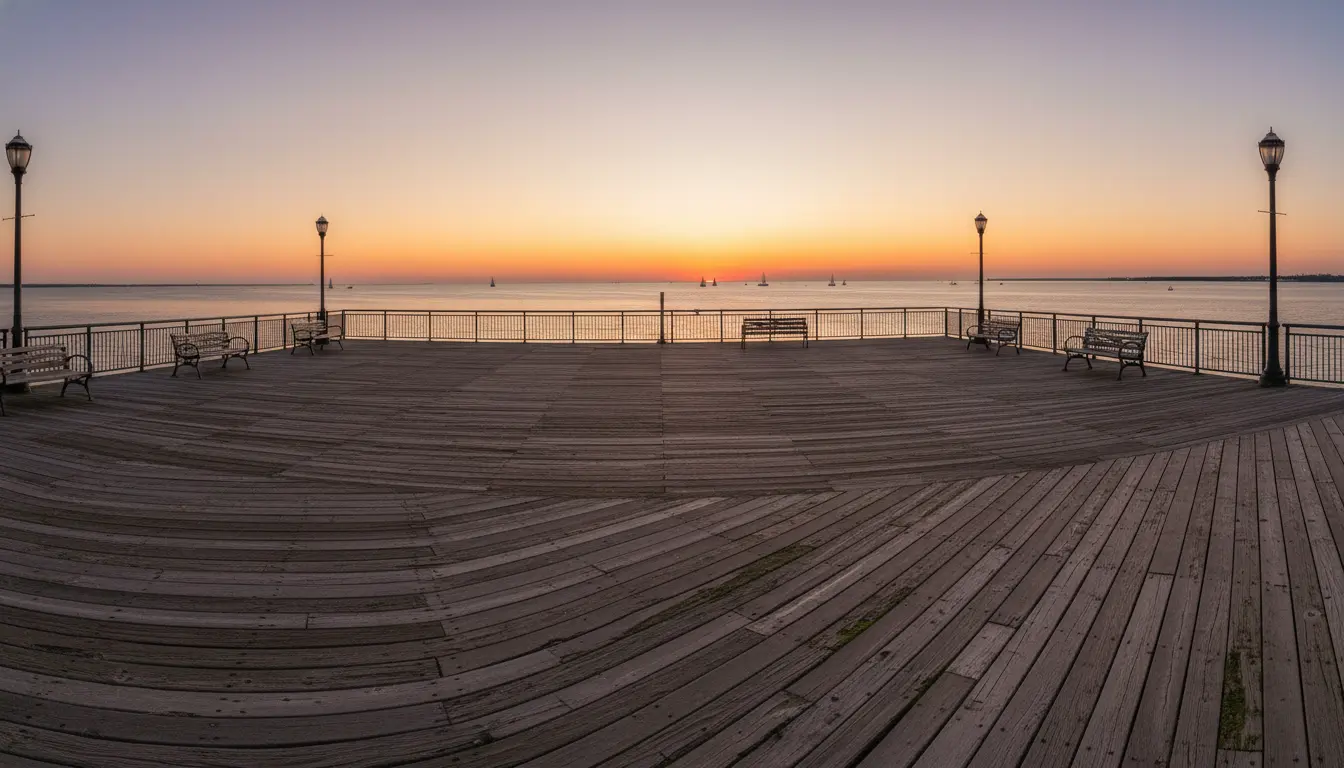
Documents the actual pier edge and horizon access where waterfront photo sessions commonly occur, allowing buyers to verify open-sky exposure, hard-surface footing, and wind exposure potential.
This image of Valentino Pier shows the hard-surface footing, railings, and open water exposure that shape both posing options and comfort levels, particularly on windy days when hair and clothing movement are more pronounced.
Comparing Van Brunt Street, Red Hook Park, and the piers
Couples often make a practical choice between three main micro-areas: Van Brunt Street blocks, the Red Hook Park edge, and the piers.
- Van Brunt Street has the most day-to-day activity: small shops, occasional delivery trucks, and residents running errands. It offers texture and real neighborhood life but also means more background pedestrians and parked cars in the frame.
- Red Hook Park draws families and older residents who linger on benches along the park edges. This makes it feel calmer than Van Brunt, but ball games, park maintenance, and stroller traffic can appear unexpectedly in wider shots.
- Valentino Pier and Atlantic Basin are where couples get uninterrupted water and skyline views. These areas can feel open and quiet on weekday mornings, then turn busy around sunset on warm weekends as visitors arrive for the view.
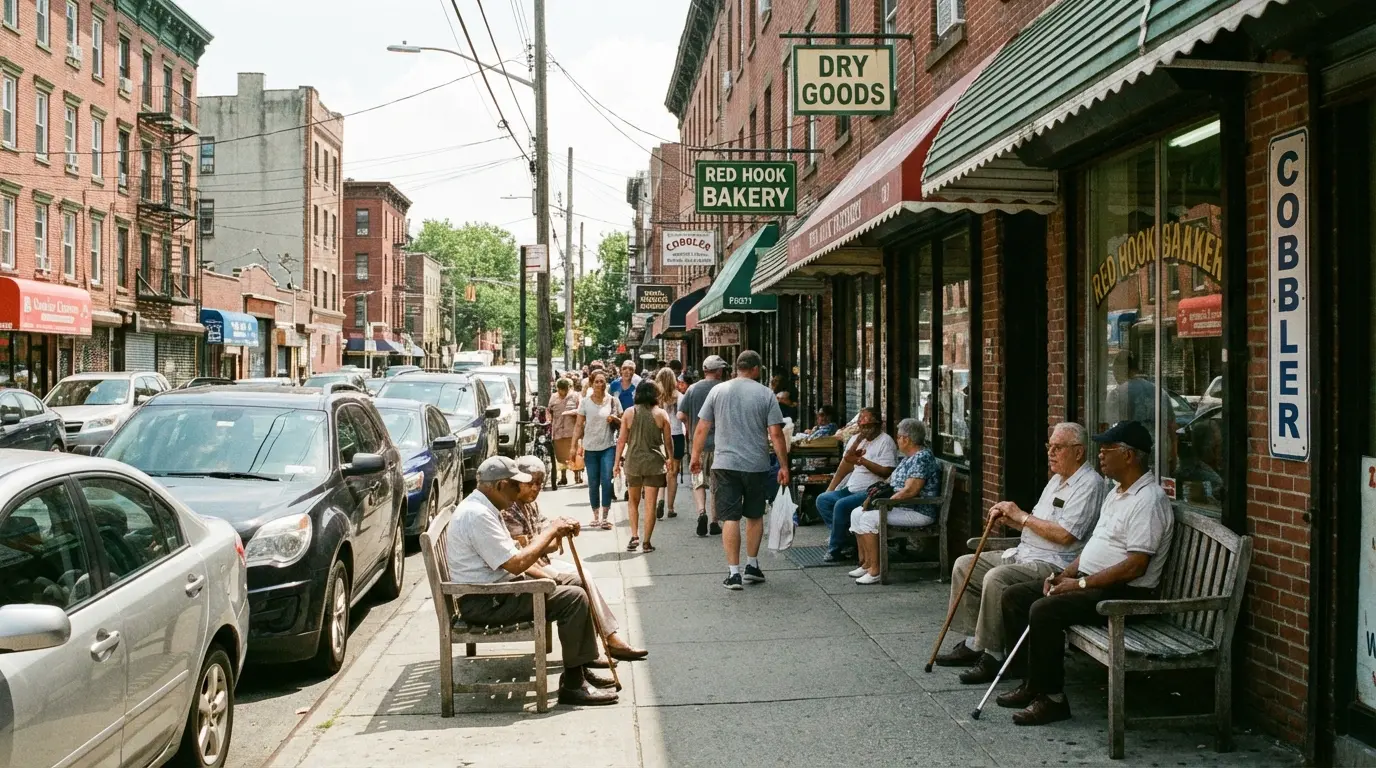
Provides visual comparison of commercial-block crowding, sidewalk width, and access for guests so buyers can judge privacy, scale, and transit/parking convenience between streets and piers.
Here you can see how sidewalk width, curb parking, and small clusters of pedestrians—including elderly shoppers—shape the feel of images on Van Brunt. For couples wanting quieter frames, this contrast with the more open pier edges is an important consideration.
Street textures, facades, and night lighting conditions
Red Hook’s built environment is defined by a mix of heavy brick warehouses, rusted steel doors, corrugated metal siding, and newer glass-fronted spaces on select corners. It’s common to see an abrupt transition from painted brick to metal roll-down gates to a recently renovated café, all on the same block. This facade texture mix reads clearly in wider photos and is part of what makes a set of images unmistakably “Red Hook” rather than generic waterfront.
Sidewalks are often patched or uneven, particularly near loading docks and older curb cuts. Chain-link fencing appears along many side streets, sometimes catching wind-blown debris. At night, lighting is irregular: some industrial stretches are quite dim, while specific loading areas use powerful, cold-toned fixtures that create hard shadows and bright hotspots on the pavement.
Local groups such as the Red Hook Local Development Corporation focus on supporting commercial corridors like Van Brunt, which has led to a gradual increase in active storefronts and gallery or studio spaces. For evening portraits, this means pools of warmer light spilling from shop windows in some segments, while just a block away the light may drop off quickly, requiring careful choices about where to pause a group or pose a couple after dark.
Elderly residents often favor the benches near Red Hook Park or lower-traffic storefronts on Van Brunt, contributing to slower, more stationary background figures in those areas compared with the transient crowds along the ferry axis.
Professional Photography Options in Red Hook
On-site workflow around warehouses and loading docks
South of Halleck Street and near the larger warehouse clusters, most façades are active workspaces first and visual backdrops second. Loading docks, roll-up doors, and truck bays may be active even on weekends, which limits how long a couple can pause in a single spot before a vehicle needs access.
For both stills and moving coverage, workable setups are usually compact: a small tripod or light stand, a reflector, and a minimal footprint kept close to a wall or fence so as not to interrupt loading paths or the narrow pedestrian route.
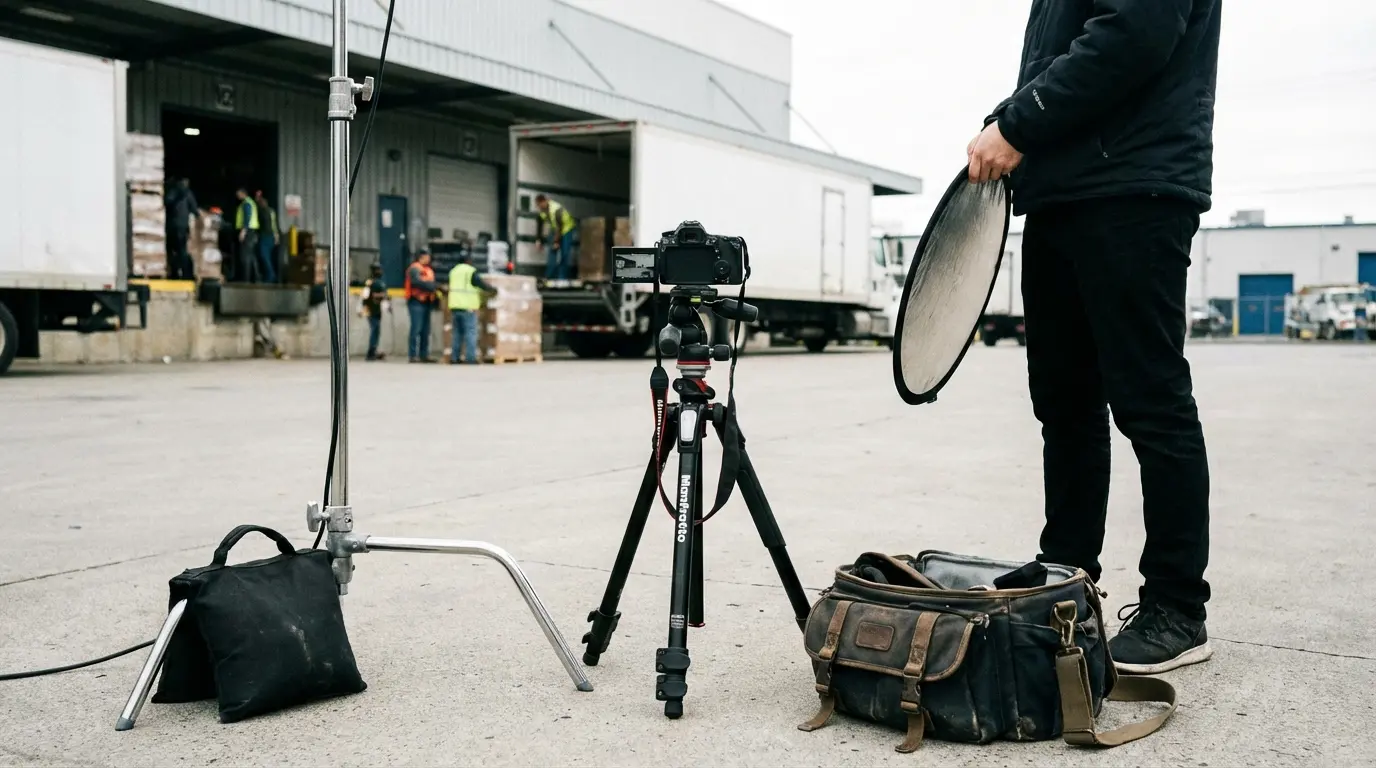
Shows realistic, small-footprint equipment and setup locations close to industrial facades so buyers can verify what gear fits the neighborhood constraints and how nearby loading activity may affect setups.
The setup here reflects what is realistically workable on these narrow sidewalks: light stands weighted to resist gusts, bags kept close to the wall, and constant awareness of trucks pulling into adjacent docks.
Managing wind, access limits, and other risks
Red Hook’s waterfront exposure means wind is a constant variable. Valentino Pier and Atlantic Basin can shift from calm to strong gusts over the course of a few minutes, affecting hair, veils, loose clothing, and any light modifiers. On days with sustained wind, it’s common to adjust posing or retreat slightly inland to more sheltered corners between buildings.
Weekend congestion is concentrated near the IKEA and its Erie Basin waterfront, as well as along Van Brunt when both retail visitors and ferry riders overlap. Parking availability can tighten quickly, and curb space near loading zones is actively used by trucks, not just parked vehicles. Any assumption of using a truck bay or driveway as a staging area without prior permission tends to be unrealistic.
At Valentino Pier, staff tolerance for informal use—small groups and cameras—is generally steady, but larger setups with multiple tripods, stands, or anything that looks like a cordoned-off area are more likely to draw attention and possible requests to move. Rooftop access is almost always controlled by private industrial property owners, so it should not be relied upon without explicit prior agreements.
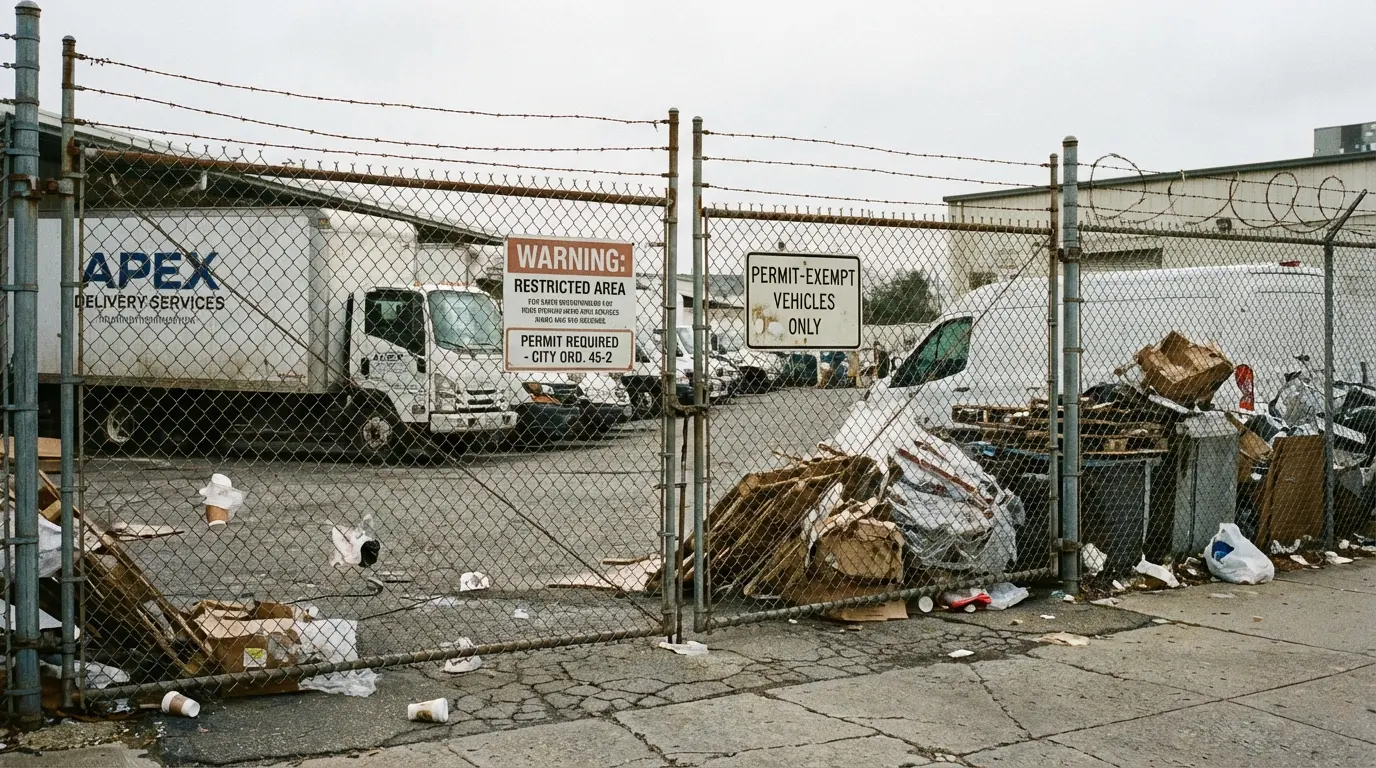
Documents access restrictions, active loading operations, and permit/posting presence so buyers can verify potential access limits, noise sources, and need for coordination with property operators.
The posted permits, enforcement signage, and visible loading activity in this scene are typical of Red Hook’s working blocks and underline why noise, truck movement, and access restrictions need to be factored into any timeline.
Recognizable Red Hook landmarks as location proof
For couples and guests who may not know the area well, certain landmarks help orient everyone quickly. The entrance to Louis Valentino Jr. Park & Pier, with its clearly marked sign and direct path to the water, is one of the clearest public access points.
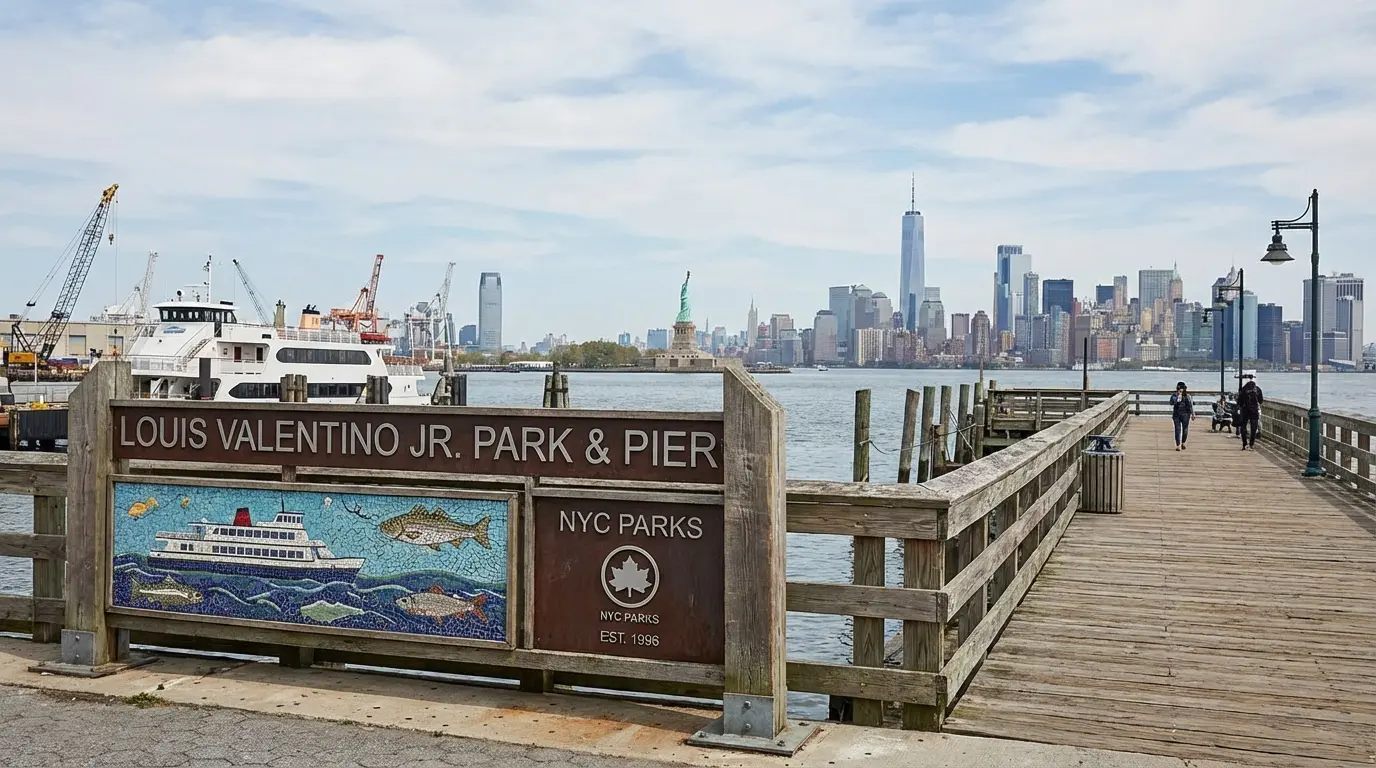
Confirms the exact location and public access point for Valentino Pier so buyers can verify the landmark, entry route, and nearby amenities before planning a shoot.
From this entrance, it is a short, level walk to the pier itself, with benches, lamp posts, and clear views back toward the Atlantic Basin and Manhattan skyline, making it straightforward to direct guests or vendors to a specific meeting point.
Light behavior across the day on the Red Hook waterfront
Red Hook’s light is shaped by its open western exposure and the bulk of its warehouses to the east:
- Morning: Inland blocks can stay in shade longer because warehouse roofs and upper walls block low eastern light. The waterfront edges pick up usable light earlier, so it’s often more effective to start near the water if morning timing is fixed.
- Midday: On Valentino Pier, there is almost no natural shade. Light comes from overhead, reflecting off the water and nearby metal roofs and containers, which can brighten lower parts of the frame and emphasize textures in clothing and skin.
- Late afternoon: As the sun moves toward the west/southwest, it skims across the water and into Van Brunt’s west-facing storefronts, creating strong side light and long, directional shadows on the sidewalk.
- Sunset: The open horizon over the bay means the sun remains visible longer than in more enclosed Brooklyn neighborhoods. Sessions that rely on “golden hour” here typically run later by comparison, with pronounced color shifts in the sky and strong rim light along the pier edge.
Because so much of the waterfront is unshaded, even small changes in cloud cover can quickly alter contrast, which is relevant for both stills and any continuous video coverage that spans from inland streets to the pier.
What finished Red Hook waterfront images usually show
Final images from Red Hook usually combine three elements: water and skyline, industrial infrastructure, and small traces of everyday use. Even with careful framing, container reflections, metal roofs, distant cranes, and pier structures are usually visible in the background, clearly distinguishing the setting from a park-only environment.
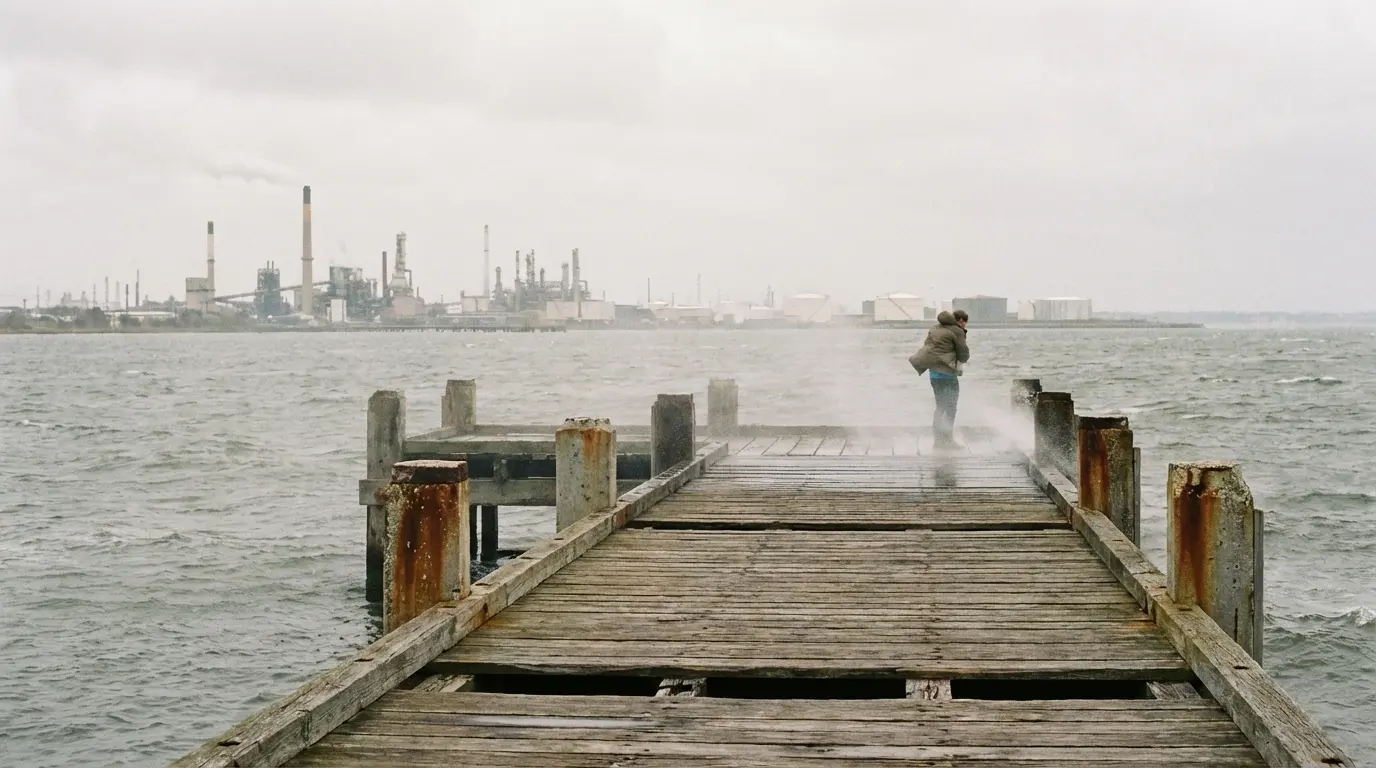
Illustrates a realistic, unidealized sample of final imagery clients receive in Red Hook so buyers can verify typical framing, background elements, light direction, and environmental imperfections to expect.
Uneven pier boards, small pieces of litter, and visible wind movement in hair or clothing—like in this example—are normal parts of the environment here, and they tend to remain present even when the horizon and couple are the focus.
Unpredictable everyday details to account for
Beyond the planned locations and light, a few “chaos” factors show up consistently in Red Hook:
- Noise from infrastructure: Truck braking, low rumbles from the Gowanus Expressway, and occasional ship horns can intrude even on visually quiet streets, especially near the eastern edge and along routes to Atlantic Basin.
- Night street lighting: Industrial fixtures create very bright pools of light near loading areas but leave mid-block stretches in relative darkness. This can make a 50-meter walk feel dramatically different from one corner to the next in terms of visibility and image quality.
- Elderly presence: Older residents using park benches or sitting outside small stores provide slow-moving, stationary background elements rather than fast, anonymous crowds. This affects how public or “observed” a couple may feel in different subzones.
- Facade texture mix: Sudden shifts from historic brick to patched concrete to fresh glass storefronts, sometimes within a single frame, mean the visual tone can change quickly with just a small repositioning along a wall or doorway.
These features don’t prevent Red Hook from working well for sessions, but they do reward planning that is specific to each micro-area rather than assuming uniform conditions across the neighborhood.
How Red Hook relates to other nearby photo districts
In practice, Red Hook is often paired with nearby brownstone areas for a contrasting set of looks within a single wedding day. It’s common for ceremonies or preparations to happen inland, in neighborhoods like Carroll Gardens or Cobble Hill, with a dedicated block of time reserved for waterfront portraits in Red Hook before or after.
Compared with denser areas such as Brooklyn Heights or DUMBO, Red Hook offers more uninterrupted horizon lines and fewer high-rise reflections, but also less immediate transit and more exposure to wind and industrial activity. Couples weighing these options typically factor in total travel time, guest mobility, and how comfortable they are navigating active warehouse streets in formal clothing.
Neighboring Areas in Brooklyn
FAQ: Practical questions about using Red Hook for wedding photos
Is parking reliable around the piers and Van Brunt Street?
Parking is usually easier than in more central Brooklyn neighborhoods, but it tightens on weekends, especially near IKEA and along Van Brunt during peak retail hours. Loading zones and driveways must remain clear for trucks, so curb space that looks available in a photo may not be usable in practice.
How crowded does Valentino Pier get at sunset?
On clear, warm evenings, Valentino Pier can see steady foot traffic from locals and visitors coming for the view. It rarely feels like a packed tourist spot, but uninterrupted, empty-background shots are harder to achieve right at sunset than earlier in the day or on weekdays.
Does wind at the waterfront affect video and audio?
Yes. Wind at the pier and Atlantic Basin can pick up quickly, affecting hair movement, veil control, and microphone clarity. Even small gusts can be audible in on-camera audio, so plans that involve spoken vows or interviews at the water’s edge should account for this.
Are surfaces uneven or difficult for heels and older guests?
Many sidewalks near warehouses are patched or slightly uneven, and the wooden or composite boards on the pier can have gaps. Red Hook Park paths and the main approach to Valentino Pier are smoother, but it’s still wise to factor in comfortable footwear for walks between locations, especially for elderly guests.
Is Red Hook workable after dark for portraits?
It can be, but conditions vary block by block. Some corners benefit from spill light from shops and industrial fixtures, while others are quite dark. Planning specific night locations in advance—rather than assuming all streets are equally lit—helps avoid surprise dark patches or overly harsh lighting from a single streetlamp.