
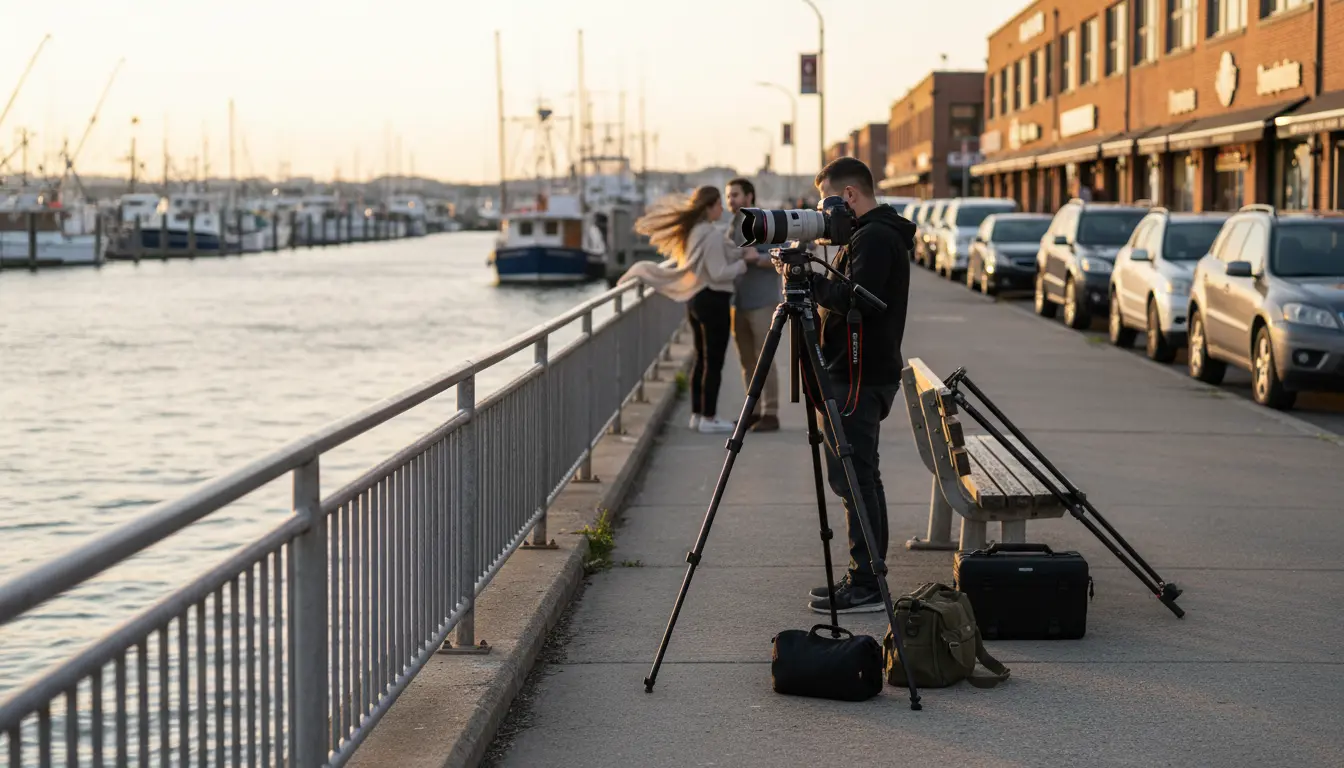
Sheepshead Bay in Brooklyn as a setting for wedding photography decisions
How Sheepshead Bay fits into the Brooklyn waterfront
Sheepshead Bay sits on the south edge of Brooklyn, wrapped around the sheltered bay itself, with most recognizable activity running along Emmons Avenue at the water’s edge. Inland, the neighborhood steps up into a tighter residential grid, so wedding photography here tends to move between open waterfront and lower-rise side streets rather than a single concentrated venue strip.
To the north, the neighborhood transitions toward Midwood’s deeper residential blocks. West, the road network bends toward Manhattan Beach and Coney Island, keeping the same coastal exposure but changing the feel from marinas to boardwalk and beach. East, the shoreline angles toward Gerritsen Beach and the Belt Parkway corridor, with Marine Park just beyond. These are still within everyday reach for residents and couples but are distinct from the mapped footprint of Sheepshead Bay, Brooklyn itself.
For photography planning, it helps to think of Sheepshead Bay as three vertical bands: the Emmons Avenue waterfront; the Avenue Z buffer; and the quieter south-grid streets near Shore Parkway. Most locations you see in wedding galleries from this area fall into one of these bands.
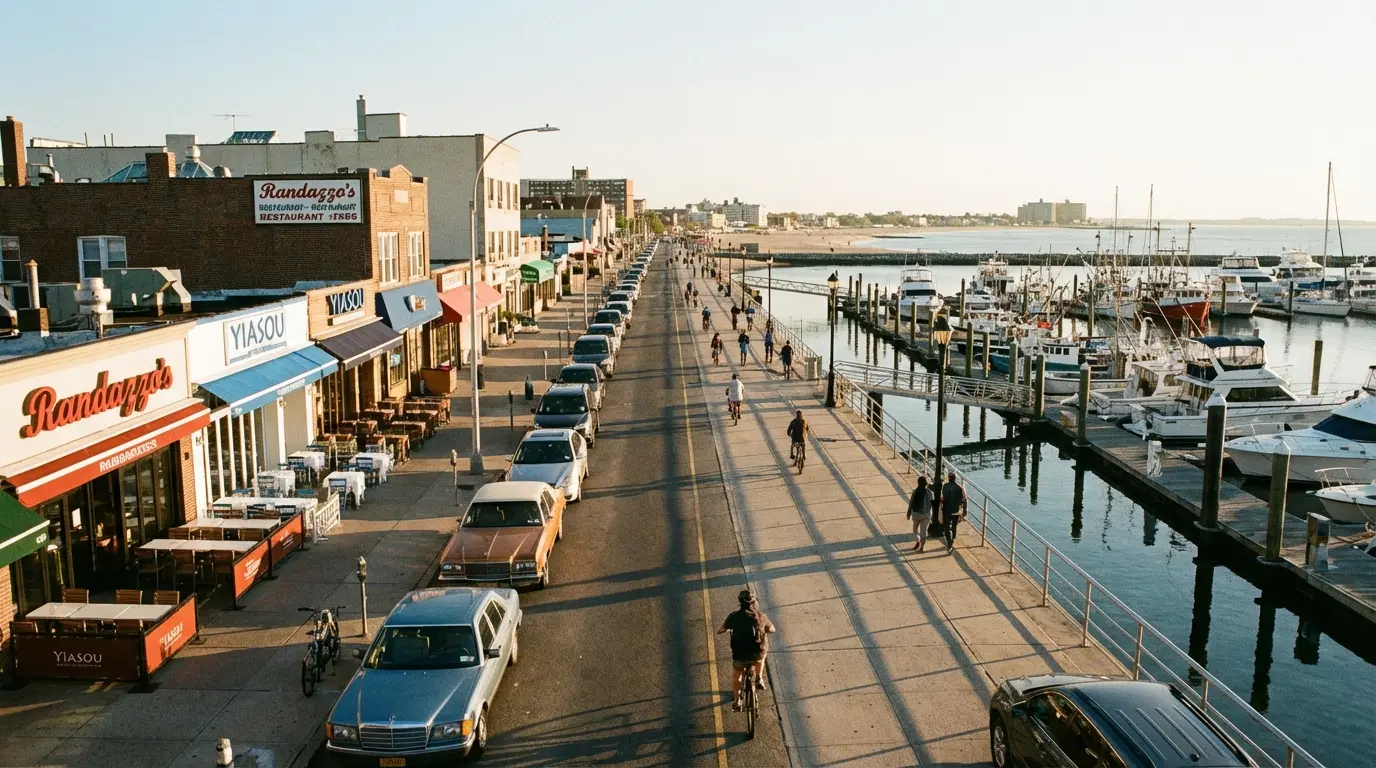
Visual verification of the Emmons Ave waterfront spine: sidewalk width, proximity of restaurants to the marina, and the open-sky reflections a photographer must contend with. You can also see how parked cars and the railing sit directly behind typical portrait positions, which shapes framing choices.
Street and transit patterns when you’re heading to a session
Most people arrive in Sheepshead Bay via Ocean Avenue or Ocean Parkway, filtering onto Sheepshead Bay Road or Emmons Avenue. The B/Q subway station on Sheepshead Bay Road creates a concentrated pocket of foot traffic, especially at rush hours and on weekends when people are heading to the bay. That matters if you are meeting a photographer near the station and then walking to the waterfront—there’s a brief, dense segment before the streets open up.
Emmons Avenue itself operates as a slow-moving waterfront spine. Traffic is typically steady but not fast, with a continuous line of parked cars along the curb. Pedestrian density spikes in the early evening around restaurant entrances and crosswalks, which can complicate group shots and wide angles. The feel of the street can flip in half a block—from a reasonably clear promenade segment to a tight squeeze between a parked delivery truck and a crowd waiting for a table.
South of Avenue Z, the numbered streets narrow and traffic calms. Here, on-street parking can be tight in the evenings, but once you’re out of the car, the density drops. These quieter blocks are where many couples live or rent apartments, so preparation photos often begin on a relatively calm residential street before shifting to the more crowded waterfront.
Informal navigation plays a role. Behind the Sheepshead Bay Road commercial strip, there are alley-like back routes and parking-lot cut-throughs that locals use to move between streets without returning to main intersections. Photographers who know these paths can shift a group from a busy corner to a quieter side street in a few minutes, avoiding congestion at key moments.
Small on-the-ground shifts that affect where you stand
Sheepshead Bay shows noticeable street-by-street change, and that directly affects where a photographer can realistically position people and equipment.
-
Street density feel: Emmons Avenue is visually open to the sky but functionally crowded at peak times. You might have a wide view of the bay, yet be sharing a relatively narrow walking lane with restaurant lines, cyclists, and dog walkers. One block inland, the residential grid can feel almost the opposite: less sky, more building mass, but far fewer people passing through.
-
Pet routes micro-patterns: Dog walkers consistently loop along Shore Boulevard and around Holocaust Memorial Park, often repeating the same circuits early in the morning and near sunset. In practice, this introduces recurring background elements—leashes, strollers, and joggers—into frames that otherwise read as calm park or shoreline scenes. Timing and angle choice matter more here than in a less-used greenspace.
-
Shortcuts and cut-throughs: Between the backs of Emmons Avenue restaurants and the side streets, there are service alleys and small parking lots that function as informal passageways. These aren’t shoot locations, but they are useful for moving a couple between the bright, exposed waterfront and a quieter residential backdrop without a long walk.
-
Avenue Z as a pivot: Avenue Z marks a clear environment shift. On one side, you still feel spillover from Emmons—more traffic, more visual clutter. A block or two south, brick walk-ups and small homes create more controlled spaces for portraits, with predictable parked-car patterns and fewer unexpected crowds. Couples often underestimate how different these adjacent blocks feel until they are standing in them.
For anyone planning a wedding session, these small shifts explain why two galleries both labeled “Sheepshead Bay” can look quite different: one might live entirely on Emmons, while another moves quickly into the south-grid streets.
Waterfront backdrops and indoor pockets for wedding photography
When people think of Sheepshead Bay wedding images, they usually imagine the Emmons Avenue side of the water: marina piers, railings, footbridges, and the bay itself as a backdrop. In reality, sessions here often mix three types of locations: the waterfront promenade, structured park space, and residential or small commercial interiors.
Along Emmons, classic couple shots happen on the promenade facing the bay, with the boats and bridge structures in the background. Holocaust Memorial Park, just off the water, adds formal paths and low walls that can be used for more composed groupings. A few blocks away, standard apartment living rooms and small restaurant private rooms provide sheltered spaces for details, family formals, or getting-ready photos when the weather or wind at the water is too strong.
If you’re looking at examples from a Wedding photographer working regularly in this part of Brooklyn, you’ll often see this blend: a preparation sequence in a south-grid apartment, a short transition to Emmons, then a return indoors for reception or dinner coverage. Support services such as rehearsal coverage, cinematic video work, and post-production editing typically wrap around that core waterfront-and-residential structure rather than replacing it.
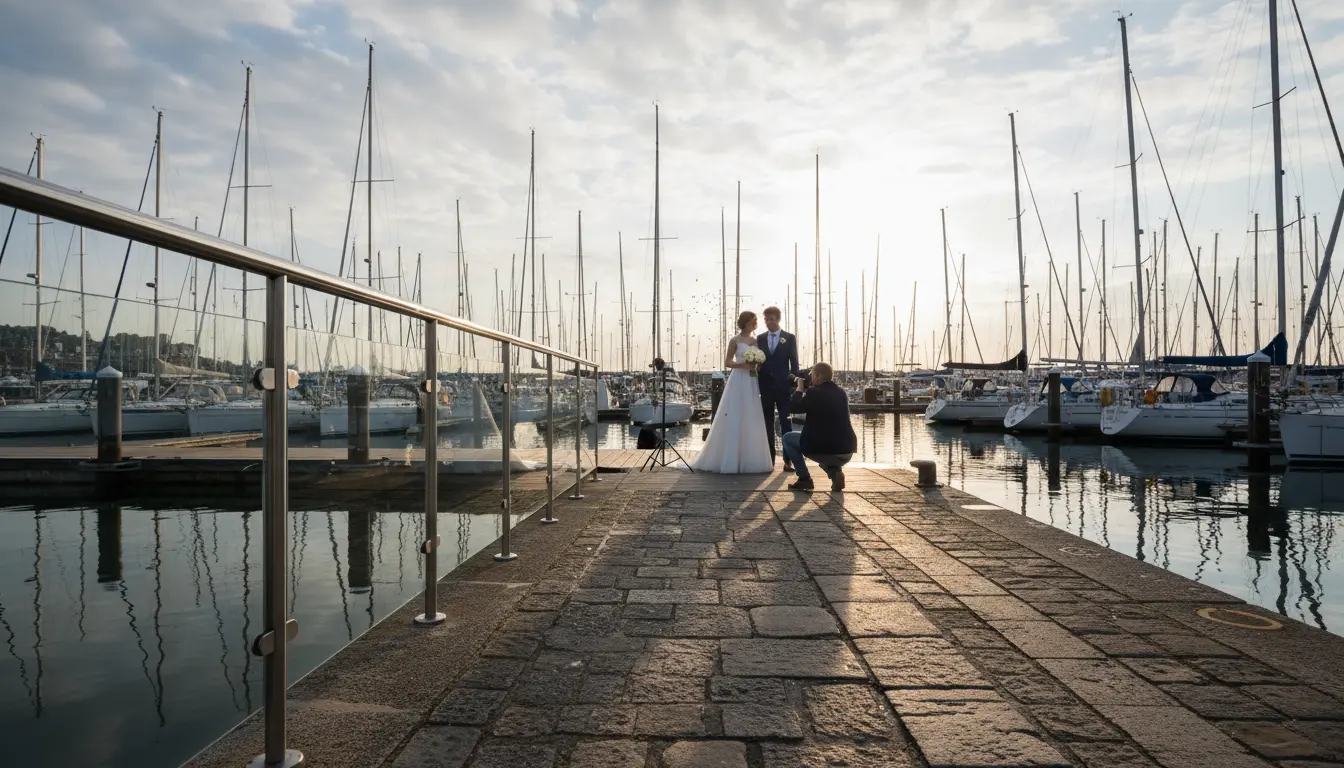
This image shows the exact waterfront backdrop many couples expect: narrow walkway, marina docks, bay reflections, and restaurant façades only a few meters behind the camera. It confirms how close traffic, parked cars, and pedestrian flow sit to typical shooting positions along the promenade.
Choosing between Emmons, Avenue Z, and the south-grid streets
Within a few minutes’ walk, Sheepshead Bay offers meaningfully different micro-areas for photos, each with its own tradeoffs.
-
Emmons Avenue waterfront: Strong horizon line, boats, and water reflections. The tradeoff is constant background motion—cars, diners, deliveries—and limited flexibility in where you can stand because of railings and curb lines. Street-density is highest here, especially on weekend evenings.
-
Avenue Z buffer zone: One block inland, Avenue Z feels like a hinge between commercial and residential. Traffic remains moderate, but the sidewalks narrow and trees start to appear. This is often used as a transitional backdrop—a quieter corner or side street for small-group portraits while still being close to the bay.
-
Residential south grid: South of Avenue Z, East and West numbered streets form a calmer grid with brick façades, stoops, and small front yards. Here, the main constraints are parked cars and the repetition of similar building fronts; the upside is reduced foot traffic and fewer interruptions during more private or emotional parts of a session.
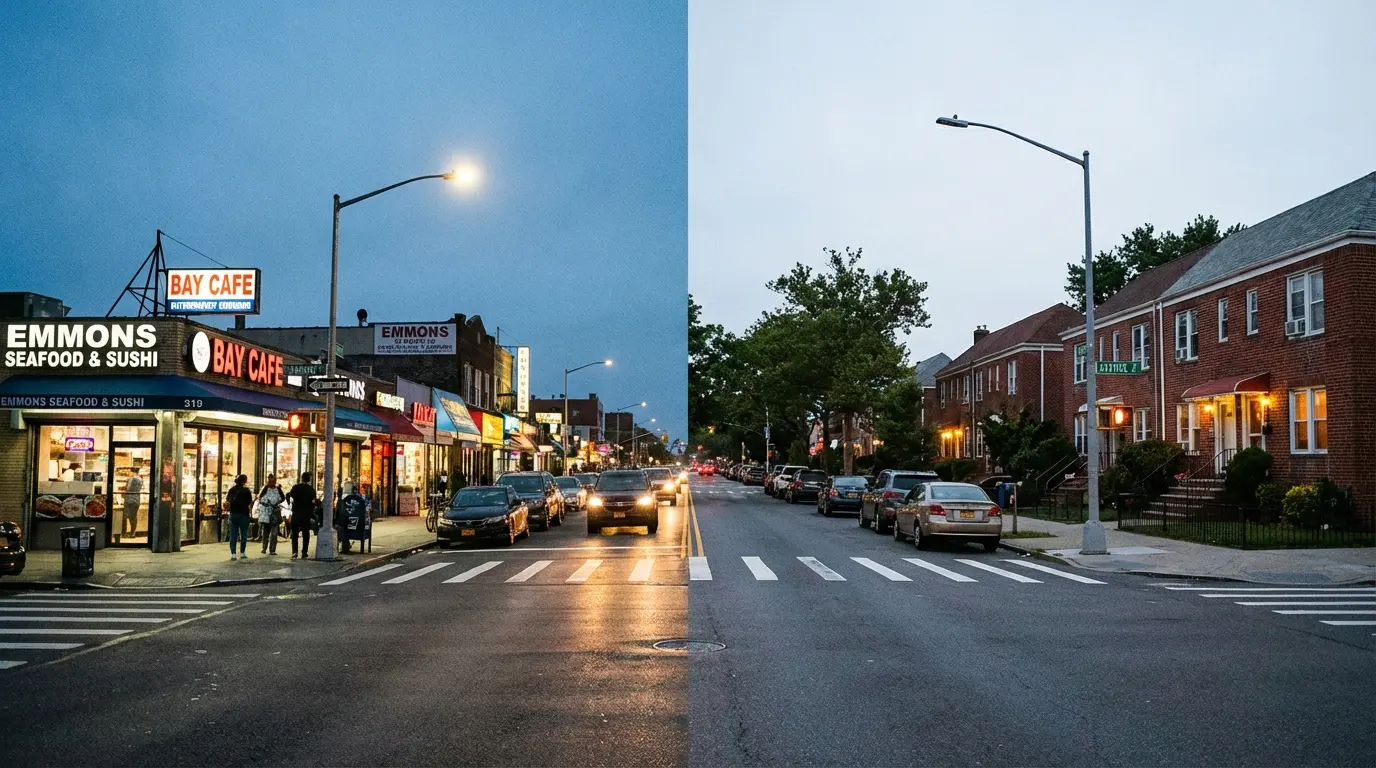
Here you can see the immediate shift between Emmons’s restaurant frontage and the narrower, greener Avenue Z blocks. It illustrates how crowding, parked vehicles, and available sidewalk space change within a single block—useful when deciding how far to walk in formal wear.
Professional Photography Options in Sheepshead Bay
- Video editing
- Cinematic Wedding Videographer
- Wedding preparations photography
- Wedding rehearsal photography
Inside apartments and small homes south of Avenue Z
Many Sheepshead Bay couples get ready at home or in a rented apartment in the south-grid streets. These buildings are typically walk-ups or small elevator buildings, with modest-sized living rooms and bedrooms. For photography, this means equipment and people need to be arranged carefully: there may be only one window with useful light, and hallways can be narrow.
Stairwells and entryways also matter. In fourth-floor walk-ups, for example, any larger lighting gear must be carried up by hand, and group portraits on the stairs may not be practical. In elevator buildings, small lobbies sometimes double as neutral backdrops for quick family groupings, especially if the apartment itself is crowded with preparation activity.
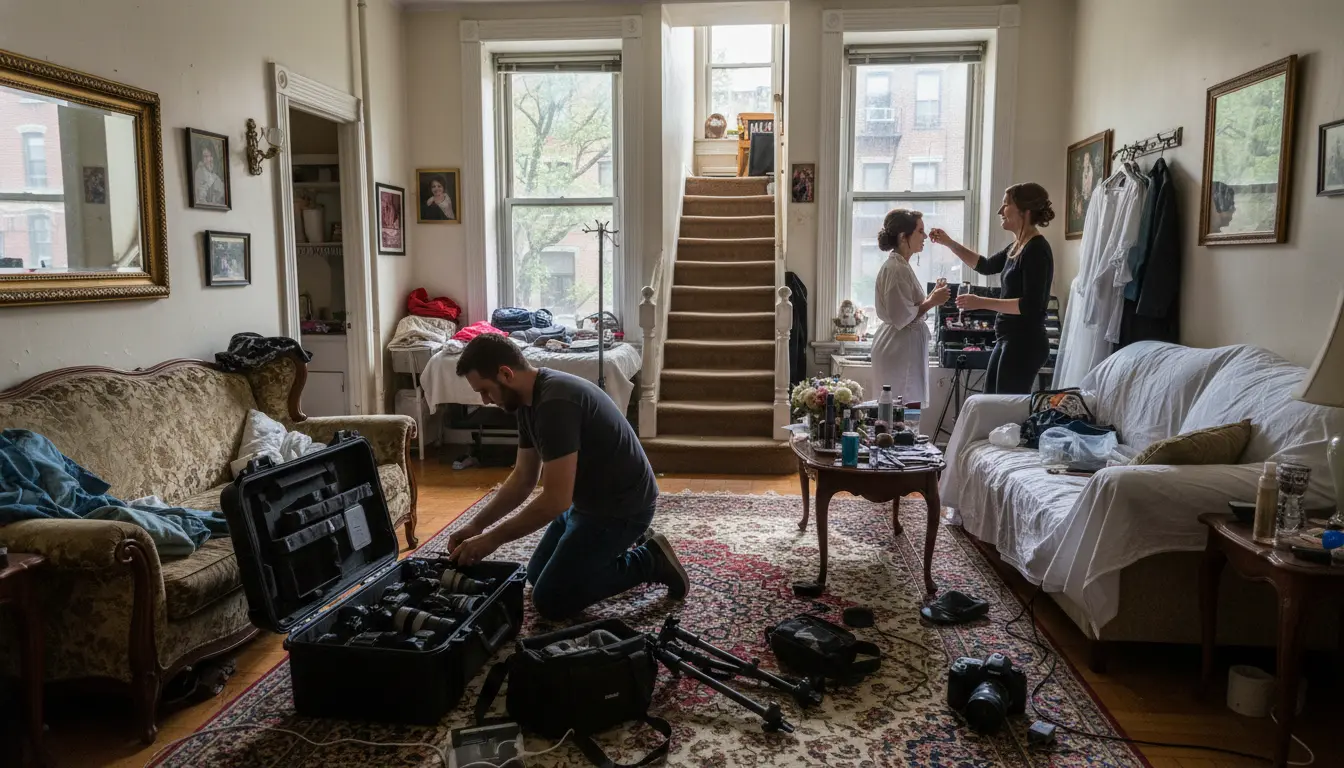
This setup image reflects typical interior constraints in local apartments: limited floor space for stands and cases, one main window providing natural light, and stair access that affects how much equipment can be brought in. It aligns with how preparation photography usually needs to be staged south of Avenue Z.
Environmental constraints along the water and marinas
While the bay itself is a major draw, the environment around the marinas adds specific constraints that couples should understand.
Wind exposure is significant along Emmons Avenue and on the footbridges. Gusts funnel between buildings and across open water, strong enough to move veils, hair, and lightweight décor. This is similar to conditions further east near Plumb Beach | NYC Parks, where the same open bay and Belt Parkway alignment create frequent coastal winds and occasional sand or salt spray. Tripods, light stands, and anything freestanding need to be stabilized.
Access is another limit. Some piers and docks are clearly marked as private marina property, and even where staff are accommodating, permission can be withdrawn on short notice if boat traffic or safety becomes a concern. Photographers typically work from public promenades, footbridges, and park edges rather than from within the piers themselves.
Crowding follows a predictable pattern: quieter in the early morning, busier toward sunset and into the evening, particularly near the restaurant clusters. Railings and benches fill quickly, narrowing options for unobstructed shots. Holocaust Memorial Park tends to remain calmer, but its memorial elements require respectful behavior and may not be appropriate for all types of posed images.
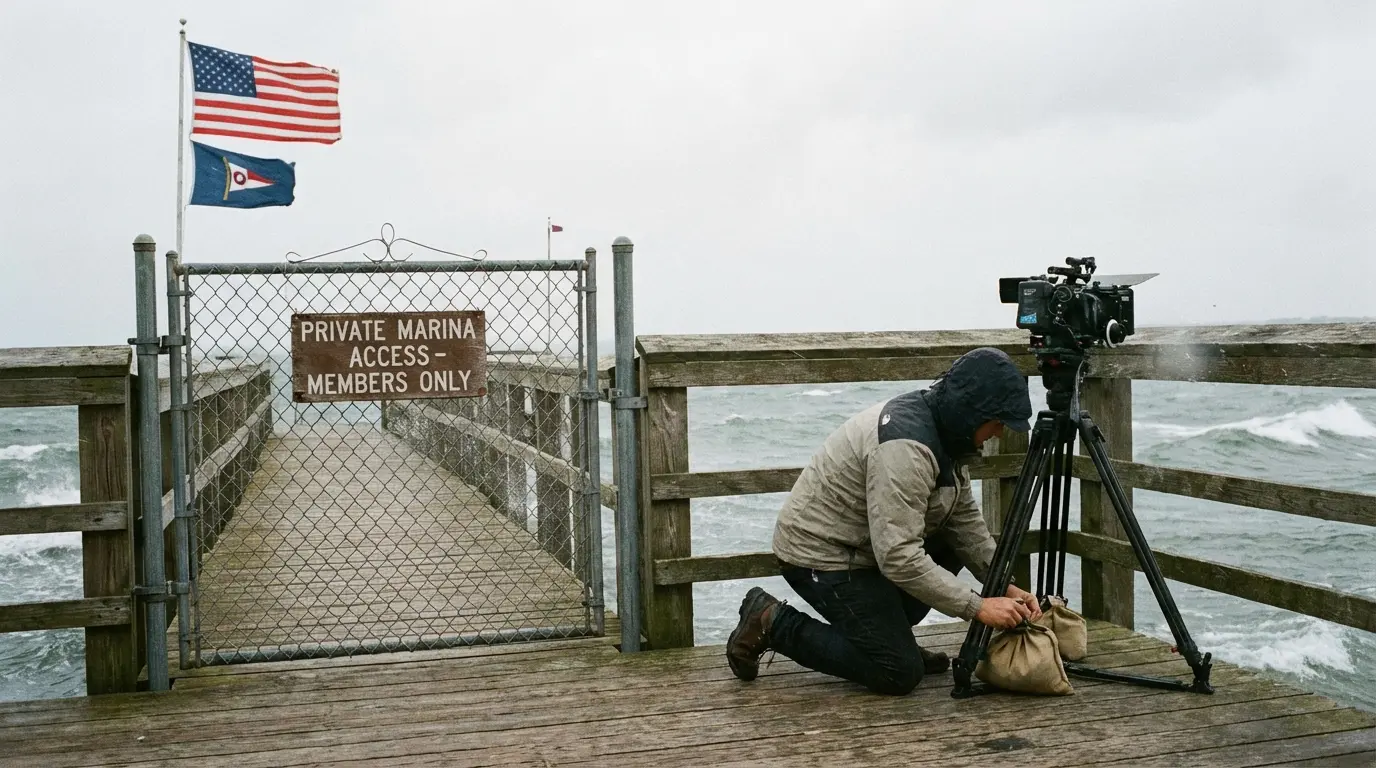
This pier image makes the constraints visible: “Private Dock/No Trespassing” signage, flags blown almost horizontal by wind, and a tripod weighted down to stay stable. It confirms why most sessions stay on public paths and why loose items must be secured during waterfront shoots.
Landmarks that quietly shape photo routes
Several mapped landmarks in Sheepshead Bay define how wedding photo routes unfold, even if they don’t appear in every final image.
Sheepshead Bay Marina and the adjacent piers are the visual anchor; many couples meet near a recognizable pier or footbridge before walking along the water. Shore Boulevard, on the opposite side of the bay from Emmons, offers a narrower shoreline strip with views back toward the restaurants and boats. It’s common to use this side for slightly quieter couple portraits while still keeping the same bay backdrop.
Holocaust Memorial Park introduces a very different geometry: straight paths, low walls, and carefully maintained plantings. Photographers may use the outer paths and open spaces for structured group shots, while avoiding more sensitive monument areas. Around the park’s edges, regular dog-walker and jogger traffic creates a repeating background rhythm that has to be timed around for cleaner frames.
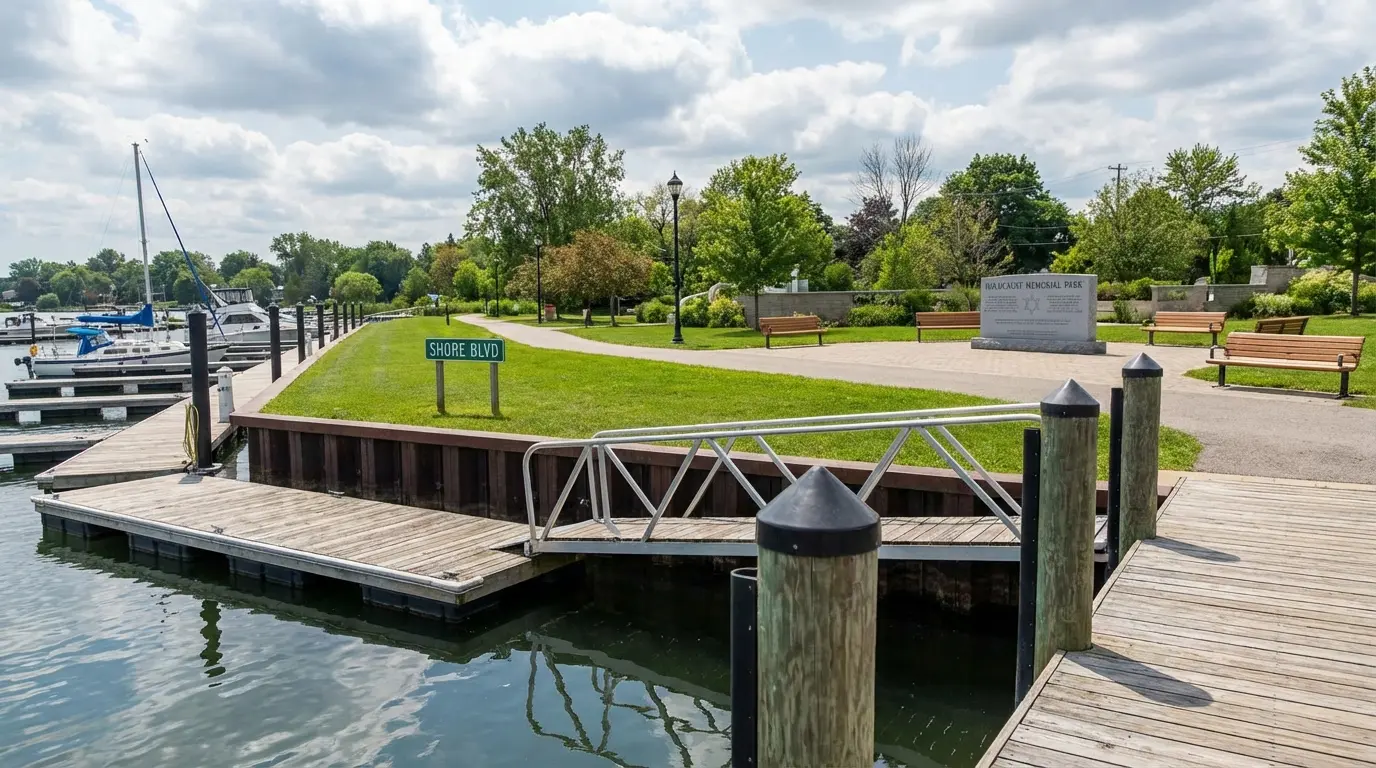
This photo ties together the marina piers, Shore Boulevard, and a visible Holocaust Memorial Park path, verifying how close these locations are in reality. It also shows the typical pedestrian routes that photographers and couples use to move between waterfront and park settings during a session.
How light moves between bay and brick
Light behavior in Sheepshead Bay is heavily driven by the open water to the south and the low- to mid-rise building mass inland.
-
Morning: Sunlight comes in fairly clean over the bay, with minimal obstruction. On the Emmons promenade, this can create strong backlight and high contrast if the couple is positioned facing inland. Water reflections add a secondary light source from below, which can brighten faces but also increase glare.
-
Midday: Along Emmons, midday light is harshest. The combination of water glare and light-colored restaurant façades produces a bright, flattened look unless shade from awnings or building projections is used. Inland, staggered 4–6-story buildings between Avenue Z and Shore Parkway cast alternating strips of sun and shadow across intersections, creating more manageable pockets of light.
-
Late afternoon into evening: Near the water, usable light lasts slightly longer because the open-sky horizon delays full shadow. This is when many cinematic-style walking or slow-motion video shots are captured, using the warm side light on faces and the bay. South-grid streets darken sooner as buildings block the low sun, which can be useful for softer, lower-contrast portraits.
-
Night: Streetlights and restaurant signage along Emmons introduce mixed color temperatures—sodium-vapor streetlights, cooler LED signs, and interior tungsten spill. Night images here typically include visible pools of light and reflections on pavement, with less separation between subject and background than in a more uniformly lit area.
Understanding these patterns helps couples and photographers decide whether to prioritize high-contrast waterfront images, softer residential shots, or a mix that follows the light over the course of the day.
What finished images from Sheepshead Bay usually look like
Final photo sets from Sheepshead Bay tend to share certain physical characteristics, regardless of photographer style.
Waterfront images almost always include some street elements: railings, parked cars, restaurant fronts, or footbridges. The bay provides depth and reflection, but because public space is narrow, it’s difficult to exclude the built environment entirely. In many cases, that mix of water and city detail is part of the appeal, but couples hoping for an uninterrupted “nature” look should be aware.
Inland, brick textures, small trees, and closely parked cars are common. On south-grid streets, there is usually less crowding but more visual repetition from similar façades. Group shots in front of homes or apartment entrances often include neighboring buildings in the frame simply because of spacing.
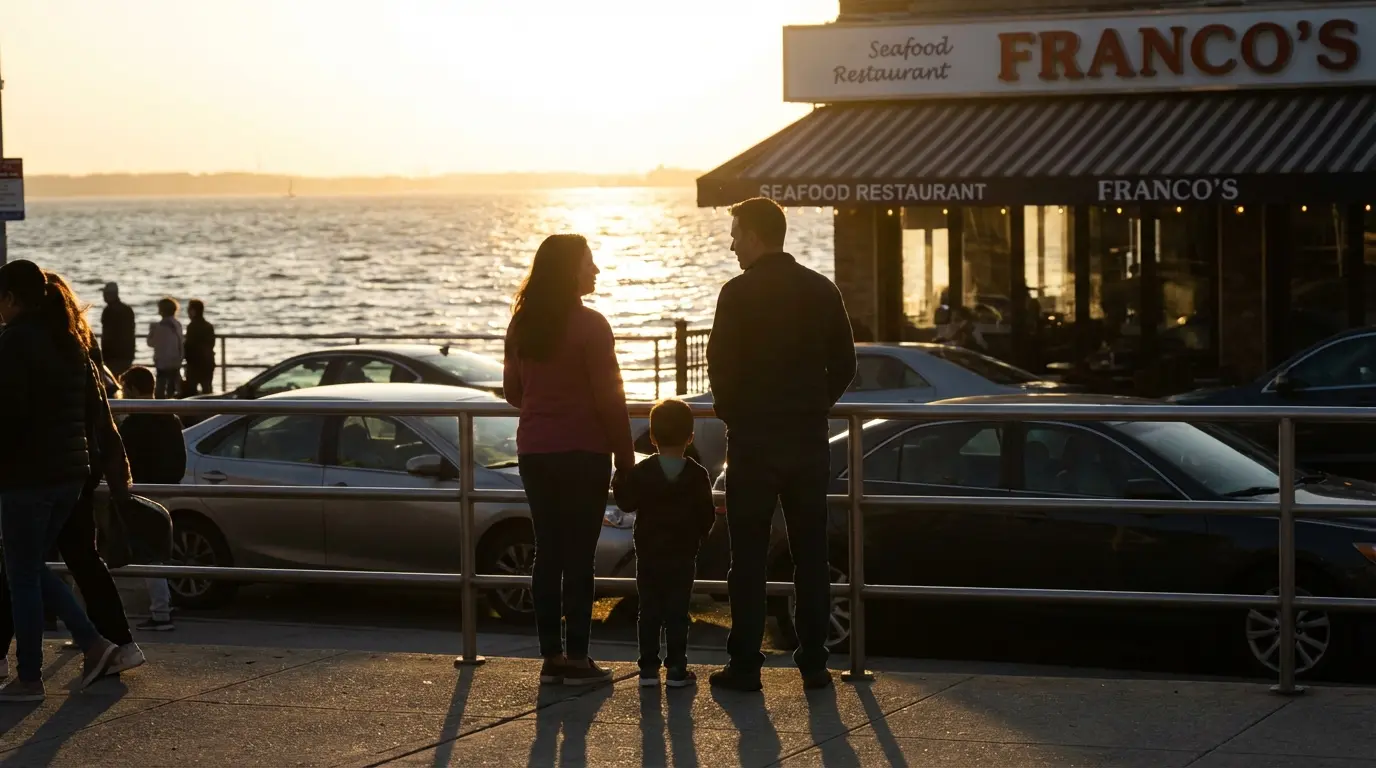
This sample Emmons Avenue portrait shows the typical mix: strong backlight and reflections from the bay, but also cars, restaurant signage, and railings clearly present. It sets realistic expectations for how much of the surrounding street life will appear in final images from the waterfront promenade.
Connecting Sheepshead Bay sessions to the wider borough
Sheepshead Bay sessions rarely exist in isolation. Couples may live in the south-grid streets, hold a rehearsal dinner in an Emmons Avenue restaurant, then host a larger reception elsewhere in Brooklyn. In practice, this means photography and video coverage often needs to adapt to multiple environments and travel segments in a single day.
Because the neighborhood links easily to Midwood, Marine Park, Gravesend, and Coney Island via Ocean Avenue, Shore Parkway, and local bus routes, it’s common to see a mix of waterfront portraits here combined with ceremony or reception coverage in a different part of the borough. Post-production services and additional coverage such as rehearsal or preparation sessions tend to be planned with that multi-location flow in mind.
Other Brooklyn Communities in our coverage
Questions couples often ask about Sheepshead Bay sessions
How crowded is the Emmons Avenue waterfront during typical wedding shoot times?
Early mornings are relatively open, with joggers and dog walkers but fewer diners. Late afternoons and early evenings, especially on weekends, bring heavier foot traffic, restaurant lines, and deliveries. This doesn’t make shooting impossible, but it does reduce the chances of fully empty backgrounds along the promenade.
Is wind really a concern for hair, veils, and audio at the bay?
Yes. Coastal wind along the bay can be strong and unpredictable, particularly on the footbridges and exposed sections of the promenade. It affects not only appearance (hair, veils, lightweight fabrics) but also audio quality for any live-recorded vows or speeches near the water.
Can we take photos on the docks and private piers?
Some marinas occasionally allow limited access, but many docks are clearly marked as private and may deny entry or ask visitors to leave. Most consistent planning assumes use of public promenades, bridges, parks, and sidewalks, with any pier access treated as a bonus rather than a guarantee.
What about parking for guests or larger wedding parties?
Street parking along Emmons Avenue fills quickly in the evenings, with additional pressure from restaurant patrons and marina users. South-grid streets often have more availability but can still be tight around typical dinner hours. It’s common to build in extra time for circling and walking, especially if you’re coordinating multiple cars.
Are porches, balconies, or rooftops commonly available for photos?
Some apartment units have small balconies or shared terraces, but there is no consistent culture of rooftop access in Sheepshead Bay. Co-op and condo rules vary, and many roofs are off limits. When they are available, size and safety railings often limit how many people can comfortably be included in a shot.
Where do preparation and rehearsal photos usually happen if the reception is in another neighborhood?
Preparation is often documented in Sheepshead Bay apartments or small homes south of Avenue Z, followed by a short walk or drive to the waterfront for portraits. Rehearsal coverage, when requested, typically centers on private rooms or reserved sections of Emmons Avenue restaurants before shifting to a different Brooklyn neighborhood for the main event.